My Favourite Books of 2010

Lots of bloggers are listing their best and worst books of the year, and I’d like to join in. I do have a few problems, though. Firstly, I don’t keep a record of what I’ve read or when I’ve read it, so I’m not entirely certain whether some of these books were read this year, or at the end of last year. Secondly, I’m not going to name any books that I’ve disliked. It is true that I’ve been disappointed by a few books I’ve read recently. In each case, I’d been expecting something great, either because I’d liked previous books by that author, or because there’d been a lot of hype about the book. However, it isn’t the authors’ fault that my expectations didn’t match their books, so I don’t think I ought to criticise them for it. Thirdly, this year has been a bit unusual for me, with respect to my reading. I spent the first few months working my way through two enormous boxes of Australian YA fiction (and some non-fiction), because I was helping to judge a literary award. Then, for the rest of the year, I was immersed in non-fiction about World War Two (with some British 1930s and wartime novels for light relief). Here, then, is a list of the books I remember enjoying (or being intrigued by) this year.

Australian YA Fiction
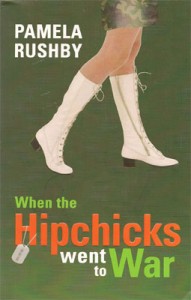
When The Hipchicks Went To WarI loved Pamela Rushby’s When the Hipchicks Went To War, which won this year’s Ethel Turner Prize in the NSW Premier’s Literary Awards. It’s a moving account of a teenage girl who goes to Vietnam to entertain the troops, told in a fresh, funny and very Australian voice. I enjoyed all the books on the shortlist for this prize (which is not very surprising, because I helped select the shortlist). I also liked Blue Noise by Debra Oswald. It’s an engaging story about some high schoolers who start a band, with an ending that was hopeful without being too neat or saccharine (also, hooray for an Australian book that is not set in a country town, and a story that does not rely on a teenage girl getting murdered or killing herself). I was also fond of Keepinitreal by Don Henderson (imagine the film The Castle, but with greyhound racing) and The Visconti House by Elsbeth Edgar (an old-fashioned mystery about an intriguing house and its former owner, featuring some beautiful writing).

Other Fiction

I must have read lots of other novels this year, but only two (well, three) remain in my thoughts. The Believers by Zoë Heller has had mixed reviews, but I thought it was terrific. I admit that the characters are extremely unlikeable, and I did find the conclusion to Rosa’s story irritating and implausible. However, I was intrigued enough by this very dysfunctional New York family that I re-read the book, and I enjoyed it even more the second time.

The Night WatchThe other novel that stuck in my mind was The Night Watch by Sarah Waters. Really, this book deserves a blog post all of its own. Suffice to say it’s the story of four people living in London during the Blitz, linked in ways that only become apparent at the end of the book, due to the very clever structure of the narrative. This was the first Sarah Waters book I’d read, and I was so impressed by her writing that I raced out and bought The Little Stranger. Which I did not like nearly as much (see what I mean about high expectations), even though it’s a very well-plotted ghost story with a fascinating setting (a crumbling country house in post-war England).

World War Two Non-Fiction

I read a LOT of books about wartime Europe this year, but it was for research purposes – I was interested in facts, not the literary qualities of the books. However, a few of them stood out because they were not only useful, but interesting and well-written enough to appeal to (some) general readers. Firstly, The Last Enemy by Richard Hillary was a fascinating, heart-breaking (and occasionally infuriating) memoir of a young RAF pilot who was shot down and badly injured during the Battle of Britain. The Last EnemyThe book gives an unsentimental account of his medical rehabilitation (his hands and face were surgically reconstructed by the pioneering plastic surgeon, Archibald McIndoe) and it describes Hillary’s evolving views on the war. The story is made more poignant by the fact that Hillary somehow managed to talk his way back into the air force (despite having only limited movement in his hands) and then crashed his plane during re-training, dying at the age of twenty-three. For a more general overview of Britain’s fighter pilots during WWII, I recommend Patrick Bishop’s Fighter Boys, which paints a vivid portrait of the individual (and very young) men who helped prevent Britain’s invasion in 1940. I also liked The Freedom Line by Peter Eisner, about the underground resistance in Belgium and France rescuing Allied airmen who’d been shot down over Nazi-occupied territory.

The best book I read about the experiences of civilians was Wartime: Britain 1939-1945 by Juliet Gardiner. Somehow, she managed to describe every aspect of wartime life, from rationing to the Blitz to the ‘invasion’ of Britain by American servicemen, in a way that was clear, coherent and accessible. However, at eight hundred pages, this book is probably only for those with a deep interest in the subject. For others, I recommend Keep Smiling Through: The Home Front 1939-45 by Susan Briggs, an intriguing collection of photos, cartoons, advertisements and newspaper articles from the war years, with just enough comment to provide context.

Other Non-Fiction

The God DelusionI think I only read two non-fiction books this year that weren’t about WWII, but they were both amazing. First was Kill Khalid: Mossad’s failed hit and the rise of Hamas by Paul McGeough. It reads like a thriller, but also explains the history of the Israel-Palestine conflict. By the end of the book, I had a much better understanding of Middle Eastern politics, and felt thoroughly pessimistic about peace ever being achieved in that part of the world. Secondly, The God Delusion by Richard Dawkins was, as I’d expected, a clear, rational argument for atheism. What I didn’t expect was that this book would be so entertaining, inspiring and plain laugh-out-loud funny. Admittedly, I’m an atheist, but I really feel this is an important book for everyone to read, regardless of their religious beliefs.

Phew! I seem to have read a lot of Very Serious Books this year, but this really wasn’t a typical reading year for me. I’m also sure I’ve left out some wonderful books that I’ve simply forgotten (due to my brain being over-stuffed with Very Serious Thoughts). What I have decided is that, from the first of January, I’m going to write down the title of each book I read, with a very short comment. I already have some book titles for my 2011 pile, including:

India Dark by Kirsty Murray
Monster Blood Tattoo Book Three: Factotum by D. M. Cornish
Graffiti Moon by Cath Crowley
Anonymity Jones by James Roy
Wolf Hall by Hilary Mantel
The Slap by Christos Tsiolkas

and possibly, Let the Right One In by John Ajvide Lindqvist, depending on how brave I’m feeling.

Hope you’ve all had a great reading year, and that 2011 brings you lots of smart, enthralling and inspiring books!
The Kitchen Front, Part One: Carrot Cookies

During the Second World War, the British government introduced rationing so that the population wouldn’t run out of food. I’ve been doing lots of research on this subject for the novel that I’m writing, but I’ve decided that simply reading about it isn’t enough. I think I need to experience it. Well, some of it. I’m not so dedicated to my craft that I’d actually change my entire diet (although some people do), but I have been trying out some 1940s recipes.

One of the main aims of the Ministry of Food during the war was to convince the British public that vegetables were healthy, filling and delicious. Eggs, sugar, cheese, butter and meat were rationed, so housewives were encouraged to be creative with potatoes, parsnips, swedes, cabbage, cauliflower – even nettles. An oversupply of carrots at one stage resulted in a Ministry of Food advertising campaign led by a cartoon ‘Doctor Carrot’, who explained how to make ‘carrot soup’, ‘carrot croquettes’, ‘carrot pudding’, ‘Carrolade juice’, ‘curried carrots and chestnuts with potato border’, ‘carrot savoury’, ‘braised carrots’ and ‘boiled carrots’ (I think they were running out of ideas by the end).

I was tempted by the idea of ‘carrot fudge’, until I read that it consisted of carrots, gelatine and orange essence. I could not see how that could be remotely appetising, and this blogger’s attempt to make it simply reinforced my aversion. However, I thought ‘carrot cookies’ sounded interesting, so I gave them a go. This version comes from the wonderful World Carrot Museum website.

Carrot Cookies

1 tablespoon margarine
2 tablespoons sugar
1 to 2 teaspoons of vanilla essence
4 tablespoons grated raw carrot
6 tablespoons self-raising flour (or plain flour with ½ teaspoon baking powder added)
1 tablespoon of water


Method – Cream the fat and the sugar together with the vanilla essence. Beat in the grated carrot. Fold in the flour. If mixture is very dry, add a little water. Drop spoonfuls onto greased tray and press down just a little.  Sprinkle tops with sugar and cook in an oven at 200° Celsius for about 20 minutes.

In the interests of authenticity, I used my most withered carrots (few houses back then had refrigerators). I suspect that 1940s flour was somewhere between our white and wholemeal flour, but I only had plain white flour, so I used that with baking powder. I wasn’t quite sure what sort of sugar was most common then, so I used caster sugar. Unfortunately, I don’t have a 1940s wood-burning stove (or even a gas stove), but I did grate the carrots and beat the mixture BY HAND (mostly because I don’t own a food processor).

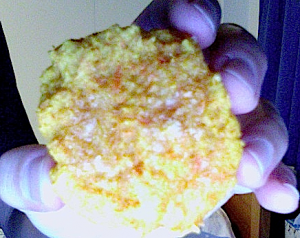
Here’s the final product (my apologies for the poor quality image, but the only camera I possess is the webcam inside my computer):

Carrot Cookie
A cookie - made of carrots!

I didn’t have very high expectations, but these cookies were delicious! They were moist and chewy, rather than crisp, and tasted like a cross between plain sugar cookies and pumpkin scones. I must admit they didn’t taste much like carrots, although they were very orange – and very sweet. If I made them again, I’d only use one tablespoon of sugar, and I wouldn’t sprinkle extra sugar on top before baking. It just shows how much natural sugar is in carrots (now those Ministry of Food recipes for ‘carrot lollies’ make more sense to me). I’d also use wholemeal flour next time.

So, a success! But I think my next attempt at 1940s food will be something savoury. Stay tuned for updates on the Kitchen Front.

ARCs

I am feeling very Oscar the Grouch because I’ve just seen ARCs of the American edition of The FitzOsbornes in Exile for sale, for almost twice the price of the real book, five months before publication date. This is not the first time this has happened.

An ARC, for the uninitiated, is an Advance Reader’s Copy of a book. It’s a set of uncorrected typeset pages of the book, bound into paperback form, usually with an early version of the cover art on the front. The first page of the ARC gives information about the book’s publication date, price and other bits of information useful for librarians, booksellers and reviewers (who receive ARCs for free). The ARCs of Random House books also include this notice:

“ATTENTION, READER: THESE ARE UNCORRECTED ADVANCE PROOFS BOUND FOR REVIEW PURPOSES. All trim sizes, page counts, months of publication, and prices should be considered tentative and subject to change without notice. Please check publication information and any quotations against the bound copy of the book. We urge this for the sake of editorial accuracy as well as for your legal protection and ours.”

And then, on the front cover of the ARC, it says “NOT FOR SALE”. Which some recipients of ARCs interpret to mean “YAY! LET’S SELL THIS ON-LINE! FREE MONEY FOR ME!” Even worse, according to Liz B. from Tea Cozy, some librarians in the US are actually putting ARCs on their library shelves, rather than buying the proper book.

Here’s why authors get grouchy about this:

1. Authors don’t earn any money from sales of ARCs. The ARC is produced by publishers and given away free for publicity purposes. A sale of an ARC is not counted towards book sales figures, and it doesn’t earn the author any royalties. Most authors are not rich. They need all the book sales they can get.

2. People buying ARCs are not buying the proper book. They are buying a cheap, flimsy paperback that will fall apart after a couple of reads, instead of a beautifully-produced hardcover.

But, most importantly,

3. An ARC contains grammatical errors, unchecked facts, weird spellings, odd typesetting and many other problems. It is not the final version of the book. My publishers and I go to lots of trouble to proof-read the typeset pages of my books before they are printed, and I want readers to read the corrected, final book, not an ARC. I certainly don’t want readers paying inflated prices for a book full of errors, not when the book has my name on the cover.

So, if you’re a book blogger, professional reviewer or librarian reading this, and you’re wondering what to do with all those ARCs you’ve received – don’t sell them. And don’t give them to someone else who’s going to sell them. If you do, don’t be surprised if the authors and publishers involved get very cross with you.

And while I’m having a whinge – what’s with all those book reviews I’ve been reading lately where the reviewer hasn’t even seen the final copy of the book? For example, a recent review of a YA novel (which I am not going to name, because I don’t think that’s fair to the author or the book) complained about editing problems in the book, then admitted:

“As this review has been assessed from an uncorrected proof, my comments in relation to editing issues need to be considered in this light.”

Well, why didn’t you wait until you could assess the final book, then? This review appeared in a published journal, and its readers want to know about the final, published book, not some earlier, uncorrected version!

Right. Now I’ve got that off my furry, green chest, I’m climbing back inside my trash can for a nap.

Top Ten Girls in Fiction

Earlier this year, CMIS Evaluation Fiction Focus listed their “top 10 female protagonists in recent Australian YA literature”, to mark the occasion of Australia’s first female Prime Minister being sworn in to office. I was chuffed to see my very own Sophie FitzOsborne make the list, and it got me thinking about my own favourite fictional girls.

I found it surprisingly difficult to come up with ten of them, though. There are a lot of great girl characters in my favourite books, but often they had some fatal flaw that kicked them off my list. For example, Hermione in the Harry Potter series is clever, hard-working and loyal to Harry – but has an inexplicable fondness for Ron Weasley, a boy who spends six books mocking her intelligence, forgets to ask her to the Yule Ball and shows a complete lack of regard for her feelings (I pretend that the epilogue to Book Seven doesn’t exist). Here’s my final list, although I didn’t restrict myself to “recent”, “Australian” or “YA” fiction.

1. Myra in Apple Bough (Traveling Shoes in the US) by Noel Streatfeild

Myra broke my heart when I read this book as a ten-year-old. Myra, a “funny, solemn little thing”, is the eldest child of the Forum family, and the only one without any discernible artistic or musical talent. Her brother Sebastian is a musical prodigy touring the world and earning millions; Wolfgang is a child actor; Ettie is a celebrated dancer. All Myra wants is to live at Apple Bough, the family home, with her dog Wag, but both of these are taken away from her by Sebastian’s career – yet she still unselfishly looks after Sebastian, Wolf and Ettie for years. Myra finally starts to realise how important she is to her whole family after her perceptive grandfather tells her,

“You have a trouble which is unique in your family. You underestimate yourself.”

(Yes, Myra is finally re-united with Wag. Thank goodness.)

2. Claudia in From the Mixed-up Files of Mrs Basil E. Frankweiler by E. L. Konigsburg

Claudia is imaginative and sensitive enough to want to escape the “injustice” and “monotony”of her suburban life, but she’s smart and organised enough to plan her running-away down to the smallest detail. She’s also absolutely hilarious in her attempts to control her uncontrollable little brother. I love how Claudia grows up (with some help from Mrs Frankweiler and ‘Angel’) at the end of the book.

3. Cassandra in I Capture the Castle by Dodie Smith

Cassandra can be an infuriating snob (for example, see her horrible treatment of Stephen), but she’s so honest and curious about life, and so charming and articulate, that most of the time, I can overlook her flaws. It helps that she loves books as much as I do, and that she has a couple of adorable pets in Heloise and Abelard. And that she lives in a castle.

4. Nona in Miss Happiness and Miss Flower by Rumer Godden

I just adore Nona. Despite feeling shy and miserable and lost, she devotes herself to building a dollhouse for poor, homeless Miss Happiness and Miss Flower – an authentic Japanese dollhouse, even though Nona initially knows nothing about Japan. By the end of the book, Nona has drawn together not only her new family, but half the neighbourhood. She’s such an inspiration.

5. Madlyn in The Beasts of Clawstone Castle by Eva Ibbotson

Madlyn is a “very pretty” blonde who loves shopping (which is usually enough to stop me liking a girl character), but she’s also smart, sensible and caring, particularly when it comes to her eccentric little brother:

“She soothed him when stupid people asked after his skunk instead of his skink; she stopped the cleaning lady from throwing away the snails he kept in a jar under his bed; and when he had a nightmare she was beside him almost as soon as he woke.”

Madlyn doesn’t really want to spend two months at gloomy old Clawstone Castle, but she doesn’t complain about it, and she comes up with an ingenious plan to save the threatened Beasts. She’s also very brave during the terrifying showdown with the villains.

6. Brownie in The Hole in the Hill by Ruth Park

Another elder sister (I am sensing a theme here), who’s smart, responsible, and practical. Brownie’s also quietly courageous – for example, when necessary, she grits her teeth and walks along a ledge under a gigantic waterfall, even though she’s terrified of heights. At the start of the book, her father says, “Good grief, you kids of today have no more initiative than a jellyfish”, but by the end of their adventures, he’s forced to eat his words. Go, Brownie!

7. Jo in Little Women by Louisa May Alcott

Is there anyone who actually prefers Meg or Amy or Beth? Okay, Jo should have married Laurie instead of that old German guy, but in every other way, Jo March is awesome.

8. Sophie in Sophie’s World by Jostein Gaarder

Only a girl as thoughtful, inquisitive and imaginative as Sophie could possibly make sense of all those mysterious letters and postcards that arrive in her mailbox (or in her hedge, on her bedroom floor or stuck to the kitchen window). She’s not afraid to question her teachers and her mother during her search for philosophical truth, and she has a great sense of humour. I also really like Sophie’s real-world ally, Hilde.

9. Anaximander in Genesis by Bernard Beckett

All right, I’m taking some liberties with the definition of ‘girl’ here, but as Anaximander is described as young and female, I think she counts. Her compassion, intelligence and determination to uncover the truth is inspiring – or it would be, if we didn’t slowly realise where it was leading her. (Oh, that book’s conclusion!)

10. Agatha in Saint Maybe by Anne Tyler

Agatha is possibly my favourite Anne Tyler character ever, which is really saying something. She’s another eldest child, left to look after her siblings by hopeless parents, but unlike Madlyn, “Agatha never concerned herself with appearances”. She’s bullied by her classmates, but by high school, she’s “supremely indifferent, impervious” to them (“You could tell she thought prettiness was a waste of time”). However, the main reason I love Agatha is her ferocious intelligence. She’ll take on anyone in an argument – even God. Here she is having a theological debate with her Uncle Ian, who’s getting rather flustered because he’s losing:

“‘Agatha,’ Ian said, ‘there’s a great deal in the Bible that’s simply beyond our understanding.’
‘Beyond yours, maybe,’ Agatha said.”

She ends up becoming an oncologist, marries a handsome, charming doctor, and earns piles of money. I just wish there’d been a final scene where she attends a school re-union.