First Lines

The Atlantic recently asked some writers about their favourite first lines in literature. As Joe Fassler reports, “The opening lines they picked range widely in tone and execution – but in each, you can almost feel the reader’s mind beginning to listen, hear the inward swing of some inviting door.” I especially like the opening of Charlotte’s Web by E. B. White:

“Where’s Papa going with that axe?” said Fern to her mother as they were setting the table for breakfast.

You know right from the start that it’s all going to end in tears, don’t you?

Here are some more of my own favourites. I think it’s good to be told up front exactly what sort of book you’ve picked up:

We think it our duty to warn the public that, in spite of the title of this work and of what the editor says about it in his preface, we cannot guarantee its authenticity as a collection of letters: we have in fact, very good reason to believe it is only a novel.

Les Liaisons Dangereuses, or Letters Collected in One Section of Society and Published for the Edification of Others by Choderlos de Laclos

It’s also nice when an author explains all that we need to know about the protagonist:

The education bestowed on Flora Poste by her parents had been expensive, athletic and prolonged; and when they died within a few weeks of one another during the annual epidemic of the influenza or Spanish Plague which occurred in her twentieth year, she was discovered to possess every art and grace save that of earning her own living.

Cold Comfort Farm by Stella Gibbons

Although this can sometimes be done just as effectively in half the words:

I planned my death carefully; unlike my life, which meandered along from one thing to another, despite my feeble attempts to control it.

Lady Oracle, probably Margaret Atwood’s funniest book

Or even fewer words:

I am a man you can trust, is how my customers view me.

A Patchwork Planet by Anne Tyler

And sometimes, an author’s first line not only tells us a lot about the protagonist, but also conveys an essential truth about literature:

Alice was beginning to get very tired of sitting by her sister on the bank, and of having nothing to do: once or twice she had peeped into the book her sister was reading, but it had no pictures or conversations in it, “and what is the use of a book,” thought Alice, “without pictures or conversation?”

Alice’s Adventures in Wonderland by Lewis Carroll

'Alice's Adventures in Wonderland', illustrated by John Tenniel
“The chief difficulty Alice found at first was in managing her flamingo . . .”

Madeleine St John

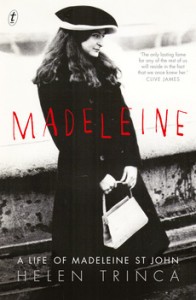
'Madeleine: A Life of Madeleine St John' by Helen TrincaEarlier this year, I enjoyed The Women in Black, Madeleine St John’s first novel, and became interested in learning more about this writer. I had vague memories of seeing interviews with her after she became the first Australian woman to be short-listed for the Booker Prize, for her third novel, The Essence of the Thing. She insisted at the time that she wasn’t Australian at all, she disparaged the existence of literary prizes and she claimed to loathe every second of this Booker-related publicity, and I remember thinking she was protesting a tad too much. And now, having just read Helen Trinca’s biography of the novelist, I’ve learned that, in fact, Madeleine St John was absolutely thrilled at all the attention. It was the highlight of her life – a life that, according to this biography, was desperately sad and bitter. She had a troubled relationship with her cold, autocratic father, the Australian politician Ted St John, and her alcoholic mother killed herself when Madeleine was twelve years old. This seems to have led to a lifelong state of insecurity. Her biographer notes,

“Over and over, she would draw people in with her loving charm, intelligence, creativity and high values. But before long, she would create a crisis or an argument, driving away friends who were left bewildered by her behaviour. Then, after a break, a card or phone call would signal a desire to resume relations. All her life, Madeleine made sure she rejected others before they could abandon her, then hauled them back on her terms.”

while her younger sister, Colette, said,

“She just had this talent for alienating people and it didn’t matter what you did. That’s what she did with relationships, she was terrified of intimacy.”

She struggled with depression most of her life, trying various forms of psychotherapy, medication and religion in an attempt to relieve the anguish, then died alone, aged sixty-four, of lung disease. It must be said that there isn’t much evidence of Madeleine’s “loving charm” in this biography, but the charm must have existed, otherwise why else would so many intelligent, creative and successful people have wanted to be her friend in the first place?1 Yet she was a terrible snob, keeping a copy of Debrett’s on her bedside table and constantly reminding people that her family was in it (her father was distantly related to Baron St John of Bletso). Perhaps that’s why she was so good at describing people in her novels – she’d spent so long observing other people’s language and manners in order to determine their ‘true’ position in society and work out whether they were worthy of her attention. And perhaps her “high values” help to explain why her first novel wasn’t published till she was in her fifties – perhaps she felt that none of her fiction was good enough to show anyone else until then.2 Michelle de Kretser gave this biography a lukewarm review in The Sydney Morning Herald, saying it was “carefully researched” but not “a work of literature”, and anyway, Madeleine St John was only a “minor writer”3, but I found it fascinating.

'A Pure Clear Light' by Madeleine St JohnHowever, I think Madeleine St John’s novels are even better, and I especially recommend A Pure Clear Light, her second novel. Ostensibly, it’s the story of a pair of middle-class Londoners (complete with three beautiful children, a Volvo and summers spent in France) whose marriage starts to unravel when the husband begins an affair, but it’s actually a chance for the author to poke fun at some very shallow, hypocritical people. Simon, the adulterous husband, is particularly awful, disparaging his wife’s forty-something unmarried friend who’s “missed the bus” (“loose-cogging around the scene, just getting in the way – it’s embarrassing . . . she’s just so pointless”), all the while relishing his mistress’s “autonomy” (naturally, he has fits of jealousy if she mentions any of her male friends). He’s also horrified when his wife turns to her local church for consolation, because he thought he’d successfully “talked her out of” Roman Catholicism (“having itemised the horrid ingredients of that scarlet brew – moral blackmail, misogyny, cannibalism and the rest”). Flora, his wife, is a little too good to be true – running her own business, managing the children (even her friend’s children) with good humour and good sense, and being endlessly supportive of her horrible husband – but it does make the reader care about what happens to her, and I found the novel’s conclusion to be both clever and plausible.

I also liked The Essence of the Thing, involving two characters who play minor roles in A Pure Clear Light. Again, an apparently solid relationship is revealed to have deep cracks, and this time, it breaks apart. Nicola simply can’t understand how Jonathan could abandon her so callously, but he’s such an inarticulate, repressed character that the reader can’t help thinking she’s much better off without him. In fact, I can’t understand why any of the women in Madeleine St John’s novels put up with their respective men, but their situations do provide lots of opportunity for thoughtful and often hilarious commentary on love, sex, marriage and modern life. This novel’s plot was a little too predictable and the lessons a little too obvious, but it’s still an enjoyable read. I haven’t read Madeleine St John’s final novel, A Stairway to Paradise, but it’s on my To Read list. I’m so glad I came across this writer. Even if some people regard her as “minor”.

_____

  1. Among her friends and advocates were Bruce Beresford and Clive James, who were her contemporaries at the University of Sydney in the early 1960s.
  2. She worked for decades on a biography of Madame Blavatsky, the founder of the Theosophical Society, but destroyed the manuscript after it was rejected by a publisher.
  3. What are the criteria that differentiate a “minor” from a “major” writer? Is a “minor” novel by a “major” writer superior to a “major” novel by a “minor” writer? And is Michelle de Kretser a “minor” or a “major” writer? Enquiring minds want to know.

Miscellaneous Memoranda

Random House has announced it will commemorate the 400th anniversary of Shakespeare’s death by commissioning some “cover versions” of his plays, with Jeanette Winterson reinventing The Winter’s Tale, while Anne Tyler tackles The Taming of the Shrew. The publisher’s press release makes it all sound a bit gimmicky (does Shakespeare really need a project like this to bring him “alive for a contemporary readership”?), but I’d happily read an Anne Tyler version of anything, even the phone book, so I’ll await the results with interest.

Of course, ‘Random House’ doesn’t actually exist any more. This week, it announced its merger with Penguin, to form ‘Penguin Random House’ (sadly, they ignored my suggested names of ‘Random Penguins’, ‘Penguin House’ and ‘Random Penguin’s House’). I know all about this merger because they decided to send me not one, but three letters about it, telling me how highly they value their authors. (I guess this means they’ll be paying me lots of money soon. Oh, good.)

It has also been brought to my notice that top renowned best-selling author Dan Brown has a new book out. Okay, some critics say his writing is “clumsy, ungrammatical, repetitive and repetitive” and “full of unnecessary tautology”, but they’re just jealous because he sells millions of books and they don’t. Can those critics afford to buy “a specially commissioned landscape by acclaimed painter Vincent van Gogh and a signed first edition by revered scriptwriter William Shakespeare”? No, I didn’t think so! (For the record, I liked The Da Vinci Code. Come on, it was about the Holy Grail! It had ancient conspiracies and secret codes and high-speed chases through Europe! The only thing missing was Nazis. And homing pigeons. Wait, there may have been Nazis, it’s been a while since I read it.)

If you’re a young writer and you think you’re as talented as Dan Brown (or possibly, more talented), then you might like to enter the Young Writers Prize (entries close 22nd July) or the John Marsden Prize for Young Australian Writers (entries close 19th August).

I’ve also been perusing the blog of Stroppy Author, who has some useful advice for old writers (for example, Quit Whingeing And Write Something and Don’t Publish Crap). In addition, it was heartening (sort of) to see that even top renowned best-selling YA authors like Libba Bray get “Them Old, I-Can’t-Write-This-Novel Blues“. (Although I have news for Libba Bray – outlining does not help with this problem. I am a meticulous outliner, and I still spend more time stuck than writing. Coincidentally, I’ve just found out about the Snowflake Method, which I kind of worked out for myself during the process of writing my first couple of novels. If only I’d done a creative writing course and learned about all this stuff! I might have saved myself a lot of time, and maybe even become a top renowned best-selling author.)

That’s enough about writing for the moment. Here, have a picture of a giant squid:

Giant squid that washed ashore at Trinity Bay, Newfoundland in 1877. Published in 'Canadian Illustrated News', October 27, 1877.
Giant squid that washed ashore at Trinity Bay, Newfoundland in 1877. Published in ‘Canadian Illustrated News’, October 27, 1877.

Looking For A Good, Clean Book

The first time I heard about this, I assumed it was a joke, but apparently this is an actual thing – librarians being asked by adult patrons to recommend ‘clean’ books. ‘Clean’ means different things to different readers, which must make it difficult for the librarians, but generally, these readers are looking for books untainted by ‘language’ (that is, swearing), sex and violence. Sometimes the readers are looking for a suitable book for their children, but often, they are adults looking for a book for themselves that, in the words of one Christian blogger, “won’t be a near occasion of sin”.

'Mary Magdalene Reading' by Ambrosius BensonLuckily, these readers don’t have to rely on librarians for recommendations, because there are a number of blogs and websites that review and recommend books based on such criteria. The most well-organised and thorough site seems to be Compass Book Ratings (formerly SqueakyCleanReads.com), which I came across because it rated one of my own novels. As Compass Book Ratings rightly points out, movies, TV shows and games are rated, so why not books? This website rates books for children, teenagers and adults, with books given a rating for literary quality (from one to five stars), three separate ratings for profanity/language, violence/gore and sex/nudity (from zero to ten) and a recommended age range (9+, 12+, 14+, 16+, 18+ and 21+). A handy search page means that a reader can search by genre, ratings and recommended age ranges to compile a ‘clean’ reading list, or alternatively, the reader can check the ratings of a particular book.

For example, here is the Compass Book Ratings review of The FitzOsbornes in Exile (which is, I think, a fair and generally positive review). The book gets a four-star rating for literary quality and is recommended for readers aged sixteen and above. It receives a rating of two out of ten for profanity (“8 religious exclamations; 7 mild obscenities”), two out of ten for violence (with a list of all the violent incidents in the book, such as “a character is shot, but suffers no permanent injury”) and four out of ten for sex/nudity (again, with a list of incidents). There’s also a listing for “Mature Subject Matter” (“War, Homosexuality, Refugees, Persecution of ethnic groups”) and “Alcohol/Drug Use” (I was puzzled here by the claim that “a 14 year old smokes cigarettes”, until I realised it referred to a brief mention of Javier, the chain-smoking Basque refugee). This all seemed fairly accurate to me, although I must admit I’ve never counted the number of swear words, and I do think a fourteen- or fifteen-year-old could read this novel without incurring any permanent moral or psychological damage. And really, if a reader is going to be disturbed by “7 mild obscenities”, a “discussion about Oscar Wilde’s homosexuality” or a mention of “periods”, then I don’t want them to waste their time or money reading The FitzOsbornes in Exile.1

Of course, ratings for a book aren’t very meaningful unless you can compare them to other familiar books, so I looked up the ratings for The Great Gatsby. Good news for me! It gets four stars, which means my book is of the same literary quality as the Great American Novel! The Great Gatsby is slightly more profane (a rating of three) and violent (a rating of five), but oddly, is reported to contain no sex or nudity at all. Really? The FitzOsbornes in Exile is more confronting than The Great Gatsby, regarding sexual morality?

Then I looked for books with higher (that is, less ‘clean’) ratings and found reviews of Jasper Jones (which gets a ten for profanity, nine for violence and eight for sex, and is described as “well-crafted” but “overwhelming”) and The Fault in Our Stars (which gets a more positive review, but a ten for profanity and a six for sex). What was more confusing to me were the recommended age ranges for books. Jasper Jones is recommended for eighteen years and over, but a book of quotations about Jane Austen (which has no profanity, sex or violence at all) is strictly for readers twenty-one and above. ‘Clean’ books on the topics of family life and motherhood are also recommended only for readers well into adulthood, so I assume the reviewers are making judgements here about reader interests, rather than the books’ potential to cause moral harm. But no, wait. The reviewer of Persepolis says that the “use and amount of profanity in this book would make it inappropriate for anyone under the ages of 21”, while To Say Nothing Of The Dog is twenty-one-plus because it has slow pacing. Okay . . .

Despite the website claiming to have a “formalized content review process” that produces “consistent results”2, the ratings really depend on the individual reviewers, who vary in their qualifications and reviewing philosophies. The reviewers range from a thoughtful high school English teacher with experience on a library board, who wants to find books “that are both enjoyable and relevant to my students and acceptable to their parents as far as content is concerned” and who states “I do not believe in censorship, but I do believe there is an important place for content advisory”, to a student who proudly states she will “throw books across the room on occasion if the content is inappropriate or distasteful” and another young woman who is horrified by “seemingly great books that end up having WAY too much content”. Otherwise, the reviewers are not exactly representative of the general population. All the reviewers are white and, while it doesn’t explicitly state this anywhere on the website, I wondered if the site was affiliated, if only informally, with the Church of Jesus Christ of Latter Day Saints, otherwise known as the Mormons3.

Apart from the variable quality of the reviews, I had Issues with Compass Book Ratings. (Yes, I know the site’s not for readers like me, who’ll read just about anything. I’m still allowed to have an opinion on it, especially if it rates my books.) I’m concerned that the site provides lists of ‘objectionable content’ without any context, which can then be used as ammunition by people who want to ban books that they haven’t bothered to read. And I have a problem with keeping teenagers away from ‘objectionable’ content in books, anyway. Surely it’s safer for them to read about these things before they encounter them in real life, so they’ve had a chance to think about them and discuss them? And if there are adult readers who’ll be psychologically damaged by accidentally picking up a book that contains any mention of sex, nudity, violence or swearing, then maybe they should consider abandoning reading altogether and taking up a safer hobby, like knitting. But mostly, I’m disappointed that Compass Book Ratings hasn’t reviewed the Bible. Violence and gore and sex and nudity? Surely they’d have to rate that book ten out of ten.

_____

  1. Honestly, I’d love it if all those readers would avoid my books entirely. Then they’d stop ranting on the internet about how disgusting my books are, and they wouldn’t feel any need to direct their homophobic readers to my own LGBTQ-themed blog posts, and we’d all be much happier.
  2. The website recently added some disclaimers on this page, which makes me wonder if they’ve had some complaints about inconsistent ratings. Those disclaimers weren’t there when I first encountered the site, and the site owners haven’t removed the ‘less consistent’ reviews.
  3. The site seems to be based in Utah, at least one reviewer graduated from Brigham Young University, and the site gives glowing reviews to a number of books written by and about Mormons.

The Cats of Montmaray (Plus, Les Chats Du Château)

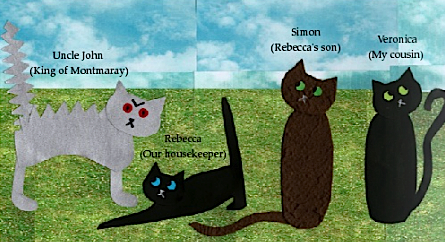
I know this blog has been rather Montmaray-heavy lately, and I will get back to my usual (non-Montmaravian) book ramblings soon, but I just had to share this with you. Ellie Maish, a very talented teenage artist, has created an amazing picture book based on A Brief History of Montmaray as a school project. Ellie has kindly allowed me to post some of the pictures from her book, The Cats of Montmaray, here. And yes, the Montmaravians are all portrayed as cats. Here are a few of the characters:

'The Cats of Montmaray' by Ellie Maish p.4

Don’t you love spiky John-Cat and worshipful Rebecca-Cat? And how Simon-Cat and Veronica-Cat are pointedly looking in opposite directions?

Here’s a scene in the Great Hall featuring the Fabergé egg:

'The Cats of Montmaray' by Ellie Maish p. 11

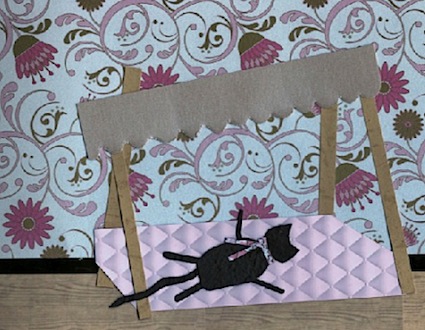
All the castle scenes are beautifully realised in collage form, but I particularly liked the ornate Gold Room. Whatever you do, don’t flop on the bed:

'The Cats of Montmaray' by Ellie Maish p. 15

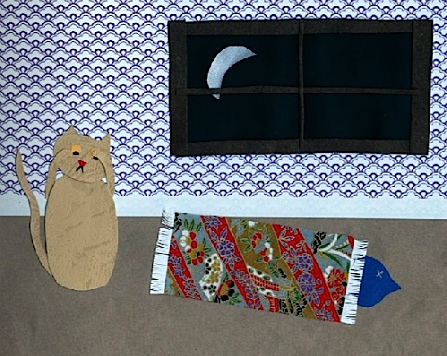
There’s plenty of action and adventure, too. On this page, Sophie-Cat is horrified by the sight of the dead . . . well, he’s not actually a dead Nazi in this book. He’s an evil hawk, with two-inch-long talons and a sharp beak that could easily carry off a defenceless cat. He still ends up dead under a rug, though:

'The Cats of Montmaray' by Ellie Maish p. 25

Isn’t it great? Thanks, Ellie.

In other Montmaravian news, a French university student who translated A Brief History of Montmaray as part of her studies has sent me the translation, and I am very impressed. Mind you, I can’t actually read French, but the text looks so much more elegant in French than it does in English. I am having lots of fun reading about “Carlos, notre chien d’eau portugais” and “les pigeons voyageurs” and, of course, “les chats du château”.