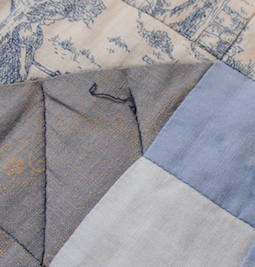
Five Ways In Which Writing A Novel Is Like Making A Quilt

1. When you first start making quilts (or writing novels), it’s probably best to keep the structure simple and use only a couple of colours. That way, you won’t get overwhelmed, and it won’t take you years and years to finish. Simple things can still be interesting.

Double nine patch quilt

2. Even if you follow a pattern, you’ll use your own materials and probably change the size, so you’ll end up with something that only you could have produced. (This can be a good or bad thing, depending on your skills.)

3. When you’re piecing a quilt together, you need to consider how the elements will look when placed next to each other. It’s more interesting if there are various shades of light and dark beside each other.

Milky Way quilt

For some reason, everything I produce is tinged with blue.

4. You will start off with a lot of enthusiasm and energy, but halfway through, you will wonder why you ever began this project. You will make lots of mistakes. Things may begin to unravel.

Unravelling quilt

But problems can usually be fixed with a bit of effort and skill.

They can even be fixed years later. If, for example, you sit your malfunctioning printer on your bed and it leaks ink over your quilt. Ha ha ha, as if anyone would be so silly as to do that!

Repaired quilt

5. In the end, you will be glad you persisted, because you will have created something that is warm and beautiful and comforting. Wait, that only applies to quilt-making. Probably. Depends what sort of novels you write.

Same-Sex-Attracted Gentlemen in English Society in the 1930s and 1940s

I’ve been meaning to write a blog post on this topic ever since The FitzOsbornes in Exile was first published in North America (that is, two years ago, which says something about my blogging habits). I don’t want to give away any plot spoilers to those who haven’t read the book, but let’s just say that it’s set in the late 1930s, in England, and that at least one male character is gay1. A surprising number of readers seemed to assume that any well-brought-up young lady of this time and place would have been shocked, horrified and outraged at the very idea of homosexuality, and that all gay men were shunned by Society and were in constant danger of being carted off to prison, à la Oscar Wilde. So, there were a number of comments from readers about how ‘implausible’ it was that Sophie and Veronica, the two young ladies at the centre of the story, would be so accepting of their gay male relative.

Now, it’s true that any kind of sexual activity between men was illegal in England between 1885 and 19672, but it’s also true that these laws were applied very selectively. In general, rich, aristocratic men were free to do whatever they liked. Yes, Oscar Wilde was convicted of “gross indecency”, but that was an unusual case because he started the whole thing off (by bringing a libel action against his boyfriend’s belligerent father, when what the father was saying about Wilde was mostly true). Anyway, that case was in 1895, forty-two years before the events of The FitzOsbornes in Exile. Consider current attitudes to gay issues, and compare this to how most people thought in the early 1970s, and you’ll see that things can change significantly in forty-two years. The fact is that in the 1930s and 1940s, there were quite a lot of popular, important and influential same-sex-attracted men who were part of English Society. Here are some of them.

First, the obvious ones. In the world of theatre and music, the most famous were probably Ivor Novello, Noël Coward and Benjamin Britten. There was also stage designer Oliver Messel, who was closely associated with the British royals and designed Princess Margaret’s Caribbean house. Norman Hartnell and Hardy Amies held Royal Warrants to design frocks for various British royals (Hardy Amies also happened to be a Special Operations Executive agent who worked with the Belgian resistance during the war), while the crème de la crème of Society queued up to be photographed by Cecil Beaton.

Ivor Novello
Ivor Novello

Meanwhile, the Bloomsbury set was not, strictly speaking, part of respectable Society, but it was influential and included writer Lytton Strachey, economist John Maynard Keynes and artist Duncan Grant.

Those with connections to Oxford included Maurice Bowra (Warden of Wadham College, later Vice-Chancellor of the university and awarded a knighthood), Brian Howard (poet, journalist, supposedly an inspiration for the character of Anthony Blanche in Brideshead Revisited) and Harold Acton (writer, also supposedly a model for Anthony Blanche). Other famous same-sex-attracted male writers were Siegfried Sassoon, Raymond Mortimer and E.M. Forster.

Then there were a whole lot of aristocrats who didn’t do much, but were certainly accepted in Society, starting with Prince George (brother of King Edward VIII and King George VI), whose male lovers were rumoured to have included his cousin Louis Ferdinand, Prince of Prussia, Noël Coward and Anthony Blunt (art historian, cousin to the Queen, Communist spy). There was also Stephen Tennant, who “spent most of his life in bed” and supposedly inspired the character of Cedric in Love In A Cold Climate. However, I think my favourite aristocrat would have to be Gavin Henderson, 2nd Baron Faringdon: “Described by David Cargill as a ‘roaring pansy’, Henderson was known for his effeminate demeanour, once opening a speech in the House of Lords with the words ‘My dears’ instead of ‘My Lords.'”

What is more interesting to me is the number of gay men in positions of real political power, either in the House of Commons or the diplomatic services. For example, Oliver Baldwin, son of Prime Minister Stanley Baldwin, had a long career in politics, first as a Labour MP, then as Parliamentary Secretary to the Secretary for War. When he was appointed Governor of the Leeward Islands, a British colony in the Caribbean, he took his partner, John Boyle, with him. Other politicians included Henry ‘Chips’ Channon, Harold Nicolson, Tom Driberg and Robert Boothby. It’s true that these men did not always receive unconditional positive regard from their family and colleagues. For example, Oliver Baldwin never became a government minister, despite his experience and political connections. He was also recalled from the position of Governor after three years (although this was more because he supported socialism and anti-colonial attitudes in the islands than because the white colonials were scandalised by his relationship with John Boyle – and Oliver’s parents did eventually come to accept his partner as almost a son-in-law).

Some of these men had long, happy, unconventional marriages with women (for example, Harold Nicolson’s marriage to Vita Sackville-West); some entered into brief or unhappy marriages in an attempt to placate their families and produce an heir; others were ‘confirmed bachelors’. Some of them were definitely gay, others were probably bisexual, and very few of them were ‘out’ in the public sense that we mean now. But all of these men participated in Society, and other people in Society knew about them and accepted them to varying degrees – which isn’t so different from the way things are now.

So I think Sophie and Veronica’s attitudes in The FitzOsbornes in Exile are entirely plausible – especially as neither of them is particularly religious, and Veronica makes a habit of rebelling against conservative values. And I also think Veronica would have loved a chance to debate Marxism with Oliver Baldwin.

_____

  1. Yes, I know they probably wouldn’t have used the word ‘gay’ in 1937, but the vast array of words used for male homosexuality in the twentieth century would take up an entire blog post of their own. For those who are interested, A Dictionary of Euphemisms, by Judith S. Neaman and Carole G. Silver, has a good discussion of North American, British and Australian terms.
  2. Lesbians did not exist, according to the law.

What I’ve Been Reading Recently

'Restoration' by Rose TremainI absolutely loved Restoration by Rose Tremain, about a medical student in Restoration-era England who attracts the patronage of King Charles II after (accidentally) saving the life of the King’s spaniel. Robert Merivel is a most endearing character, despite his many faults, which include laziness, gluttony and a complete inability to resist temptation. He has a good heart and a robust sense of humour, and he humbly accepts his punishment when he does the unforgivable and falls in love with the King’s mistress. All the other characters are equally vivid and interesting, but my favourite is Merivel’s best friend, Pearce, who works at a remote Quaker-run lunatic asylum. The author does a wonderful job of recreating the era in a manner that is accessible without feeling too ‘modern’. It’s true that Merivel’s beliefs about medicine are sometimes extremely progressive for his time (for example, he questions bloodletting as a cure and refers to the spread of the “plague germ”), but then, he is meant to be a rationalist in a rapidly changing world. I actually read this book because the sequel, Merivel, was recently published and sounded very interesting, but Restoration is so perfect and complete in itself (ending in exactly the right place) that I wonder why it needed a sequel. However, I can certainly understand why the author would want to spend more time with Robert Merivel, so I’ll probably read Merivel, too – just not right now.

'The Women in Black' by Madeleine St JohnI also enjoyed The Women in Black by Madeleine St John, a charming story about a group of women working at a grand Sydney department store in the 1950s. I loved the descriptions of familiar Sydney experiences: eating lunch by the Archibald Fountain in Hyde Park; catching the train from Wynyard Station; strolling through Martin Place and giving in to the temptation “to walk along the GPO colonnade”. (The only unfamiliar bits were the trams and eating ice-creams at Cahill’s, both before my time.) The author, an Australian who moved to England in 1968 and never moved back, was clearly glad to escape a narrow-minded society that provided her with very limited options. Marriage was then the only acceptable goal for women, although Australian men aren’t exactly portrayed as prizes in this book. For example, Patty’s husband is described as a “drongo . . . neither cruel nor violent, merely insensitive and inarticulate”, while Fay’s two previous lovers have dumped her without marrying her. Meanwhile, young Lisa longs to accept the university scholarship she’s been offered, but her father refuses to sign the permission form (“I can’t see what you want with exams and first-class honours and universities and all that when you’re a girl”). Luckily, Lisa and Fay are taken under the wing of Magda, the ‘Continental’ refugee who happens to have a lot of suave, cultured male friends, and even Patty manages to put aside her bitterness and reach for happiness. The plot of this book is utterly predictable, but that doesn’t matter – read this for the gorgeous, detailed descriptions, the spot-on dialogue and the sympathetic portrayal of female friendship.

'The Oopsatoreum' by Shaun Tan with the Powerhouse MuseumFinally, I’ve been chortling my way through The Oopsatoreum, by Shaun Tan with the Powerhouse Museum. This is an entertaining look at the life of Henry Archibald Mintox (1880–1967), one of Australia’s “most fearless inventors”, whose “sheer diversity of his legacy is matched only by its great lack of practical relevance”. Mr Mintox produced “a startling range of prototype inventions from his back shed in Burrumbuttock, New South Wales, and came to be known as the ‘Edison of Australia’, although only within his own family and at his own insistence.” Among his useless inventions were a ‘lesson trap’ (a giant cage baited with a cupcake for luring in schoolchildren; after being trapped, they’d receive “a stern lecture on the perils of tooth decay”); an automated ‘dog walker’ that reeled in the dog after thirty minutes; and a ‘handshake gauge’ for testing the trustworthiness of job applicants. The book consists of photographs of the inventions with short explanations of their history, along with some illustrations in the form of Mr Mintox’s ‘plans’. Mr Mintox is, of course, a figment of Shaun Tan’s imagination, but the ‘inventions’ are actual objects from the Powerhouse Museum (the ‘handshake gauge’, for instance, is “an artificial hand for use with a resuscitation mannequin in first-aid training”). This is a very funny book, let down only by some design flaws (for example, the designer has chosen to place a lot of the illustrations over two adjacent pages, causing details to become invisible where the pages meet the book’s spine; also, the publishers forgot to employ a proofreader). But I’m sure less persnickety readers will overlook this, and it’s certainly a book that Shaun Tan’s many fans will enjoy – and, according to his website, there’s an accompanying exhibition planned for 2013 at the Powerhouse Museum.

Miscellaneous Memoranda

Otherwise known as, A List Of Things I Bookmarked Months Ago But Didn’t Ever Get Around To Posting On My Blog.

In January, the American Library Association announced the 2013 Rainbow List of LGBTQ1 books for children & teenagers. At the end of last year, YALSA also blogged about LGBTQ books appearing on lists of the year’s best Young Adult literature and mentioned “several books with secondary or tertiary characters who are LGBTQ and aren’t necessarily struggling with their sexuality . . . It’s wonderful to have books about teens dealing with issues of sexuality and gender, but to me, it says more about the status of LGBTQ characters in YA fiction that there are so many books where the sexuality of gay, bisexual, transgendered, or otherwise queer characters isn’t an issue.” Hear, hear!2

Remember the kerfuffle a couple of years ago when the Booker Prize judges decided to shortlist books based on ‘readability’ rather than ‘literary quality’? Even though I don’t agree with all of Jeanette Winterson’s criteria for determining whether a novel is Literature, I laughed out loud at this: “The most unreadable books I have read recently were Stephenie Meyer’s Twilight series.”

I was also interested in this article by Lionel Shriver about how women authors behave when shortlisted for literary awards, compared to men: “Any victory that translates into beating someone else makes women feel guilty.” Ms Shriver is impatient with such ‘girly’ attitudes. When asked whether she was surprised that her novel We Need To Talk About Kevin had won the Orange Prize, this was her response:

“No,” I said. And then I made a wrong answer worse by adding, “It’s a good book.”

I wonder if her overt self-confidence, and the reactions of others to this, have more to do with her being a self-confident American living in self-deprecating Britain than her being an ‘ungirly’ woman novelist. I’m also surprised that she believes that literary awards inevitably go to a ‘good book’.3

There’s been a lot of discussion about New Adult books lately, although I’m still trying to figure out what constitutes Young Adult.

Courtesy of The Hairpin via Bookshelves of Doom, here are some text messages written by the characters of Little Women. For example, Jo and Meg:

Jo, Father still isn’t dead
really?
I saw him not four hours ago
could have sworn he died at sea

See also, Texts from Jane Eyre:

DID YOU LEAVE BECAUSE OF MY ATTIC WIFE
IS THAT WHAT THIS IS ABOUT
yes
absolutely
BECAUSE MY HOUSE IN FRANCE DOESN’T EVEN HAVE AN ATTIC
IF THAT’S WHAT YOU WERE WORRIED ABOUT

Australian bloggers may be interested in the 2013 Best Australian Blogs Competition, while writers for children and teenagers might like to check out the Aspiring Writers Mentorship Program (which I’ve previously written about here, for New South Wales writers only) and the Text Prize (for Australian and New Zealand writers only).

Finally, because you can never have too much Kate Beaton, here’s her take on various Nancy Drew book covers.4

_____

  1. That’s lesbian, gay, bisexual, transgender and queer/questioning, in case anyone was wondering.
  2. Especially as one of those “several books” was The FitzOsbornes at War.
  3. Whether We Need To Talk About Kevin is actually a ‘good book’ is another issue, and probably not an issue that Lionel Shriver and I would agree on.
  4. If I had to choose a favourite, it would probably be Mystery of Crocodile Island (“This was not a mystery that needed to be solved.”)

Five Favourite Picture Books

I don’t read many children’s picture books these days, but I’ve just come across two excellent ones, which reminded me of some old favourites. Note: I realise lots of children’s picture books are designed to teach Important Moral Lessons, but when I read a picture book, I mostly want it to make me laugh. All of these books deliver on that front.

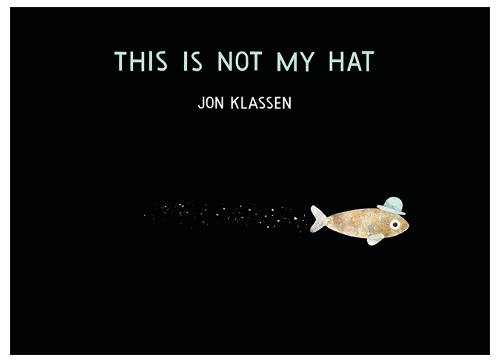
1. This Is Not My Hat by Jon Klassen
'This Is Not My Hat' by Jon Klassen

“A fish has stolen a hat. And he’ll probably get away with it. Probably.”

This is a clever and very funny story about a little fish who steals a hat from a big fish. The little fish is not worried about his crime, because even if the big fish “does notice that it’s gone, he probably won’t know it was me who took it. And even if he does guess it was me, he won’t know where I am going.” Unfortunately, it turns out there’s a witness to the crime. But he won’t tell, will he?

The illustrations are fabulous, featuring simple, flat figures that manage to convey a vast amount of information through tiny changes in shape. I loved the single, visible eye of the big fish, which progressively showed the fish asleep, awake, alert to his missing hat, angry, and very, very determined to get his hat back. And the text was perfect, juxtaposing the little fish’s blithe narration (“So I am not worried about that”) with images of his impending doom (a little crab with scared, googly eyes points frantically with his claw as the big fish bears down on them). Bonus points for this book because the text is printed in a clear, easy-to-read black font of uniform size on an off-white background. (My pet peeve regarding children’s picture books is when the illustrator uses a barely-readable font that meanders all over the page, changes size constantly and blends in with the background colours, all for no apparent reason other than to make the book seem Wacky and Zany. Illustrators – it just makes it really hard for new readers to figure out the words. So stop doing it.) Oh, and I guess this book does have an Important Moral Lesson, too: Don’t steal hats from big fish.

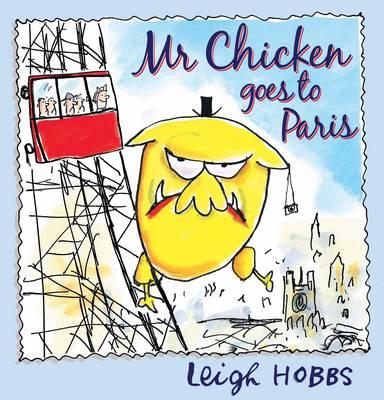
2. Mr Chicken Goes To Paris by Leigh Hobbs
'Mr Chicken Goes To Paris' by Leigh Hobbs

“The world’s most beautiful city meets the world’s most startling chicken . . .”

Mr Chicken, a four-metre-tall, bright yellow chicken, visits his friend Yvette in Paris. It is a very eventful trip. He rides the Métro, drops in at the Musée du Louvre (where the tourists decide he’s far more interesting than the Mona Lisa), climbs the outside of the Eiffel Tower (“Mr Chicken was far too excited to wait for the lift”), plays in the bell tower of Notre Dame, does lots of shopping, and decides to go on a diet after looking at his “great big bottom” in the Hall of Mirrors at Versailles. This does not stop him eating “everything on the menu” at dinner, which causes some problems when he tries to squeeze onto the plane at the end of his trip. But luckily, his clever young friend Yvette has a solution . . .

Bonus points for teaching me some French phrases (for example, Monsieur Poulet va à Paris). Magnifique!

3. What Faust Saw by Matt Ottley

'What Faust Saw' by Matt Ottley

“One night, Faust woke up, looked out the window and saw something very strange . . .”

Faust is a big brown dog who just happens to be the only witness when a horde of drooling, multicoloured aliens invades his suburb. Faust wakes up his family to inform them, but they don’t believe him. It is all very unfair. Faust decides to run away (“Then they’d be sorry”), but the aliens follow him and worse, someone hears him barking at them. Oh no, it’s the dog catcher!

This book loses some points for having hard-to-read text that meanders all over the page, but the richly coloured, beautifully detailed oil paintings make up for it. This book was very popular with my young students (as long as I read the words aloud to them), because they loved the aliens, especially the big, dinosaur-like one with the disgusting string of snot hanging from one nostril.

4. Counting on Frank by Rod Clement

'Counting On Frank' by Rod Clement

This book is about a boy who likes counting. No, he really, really likes counting. He especially likes calculating and estimating – for example, figuring out how long it would take the entire house to fill with water if he leaves the bath taps on and the plug in the bath, or how many humpback whales would fit inside his house, or how long his arms will grow if he has to keep dragging tins of dog food home from the shops for his dog, Frank. The (unnamed) boy’s counting is driving his parents mad – until they encounter a situation where his talent really comes in handy.

This has great illustrations of the bizarrely logical world of the boy’s imagination. This will appeal to children who like maths or have their own obsessive behaviours, especially when they see the boy’s (and Frank’s) moment of triumph at the end.

5. Traction Man Is Here by Mini Grey

'Traction Man Is Here' by Mini Grey

“An exciting adventure about a boy and his superhero can-do toy.”

A brand-new Traction Man arrives for Christmas (complete with “dazzle-painted battle pants”, jungle camouflage, sub aqua suit and space gear). He’s soon embroiled in daring adventures, including battling deep-sea monsters (aka a dishcloth in the sink), photographing the legendary Mysterious Toes (in the bathtub), rescuing dollies from the Wicked Professor Spade, and also acquiring a sidekick, Scrubbing Brush. But after taking the InterGalactic People Mover to Granny’s house, Traction Man faces his toughest assignment yet – getting rid of the “knitted green romper suit and matching bonnet” that Granny’s made him for Christmas.

This is a hilarious celebration of children’s imaginative play, with a few sly jokes for grown-ups hidden in the detailed, brightly coloured illustrations. Super good!