What I’ve Been Reading Recently

'Restoration' by Rose TremainI absolutely loved Restoration by Rose Tremain, about a medical student in Restoration-era England who attracts the patronage of King Charles II after (accidentally) saving the life of the King’s spaniel. Robert Merivel is a most endearing character, despite his many faults, which include laziness, gluttony and a complete inability to resist temptation. He has a good heart and a robust sense of humour, and he humbly accepts his punishment when he does the unforgivable and falls in love with the King’s mistress. All the other characters are equally vivid and interesting, but my favourite is Merivel’s best friend, Pearce, who works at a remote Quaker-run lunatic asylum. The author does a wonderful job of recreating the era in a manner that is accessible without feeling too ‘modern’. It’s true that Merivel’s beliefs about medicine are sometimes extremely progressive for his time (for example, he questions bloodletting as a cure and refers to the spread of the “plague germ”), but then, he is meant to be a rationalist in a rapidly changing world. I actually read this book because the sequel, Merivel, was recently published and sounded very interesting, but Restoration is so perfect and complete in itself (ending in exactly the right place) that I wonder why it needed a sequel. However, I can certainly understand why the author would want to spend more time with Robert Merivel, so I’ll probably read Merivel, too – just not right now.

'The Women in Black' by Madeleine St JohnI also enjoyed The Women in Black by Madeleine St John, a charming story about a group of women working at a grand Sydney department store in the 1950s. I loved the descriptions of familiar Sydney experiences: eating lunch by the Archibald Fountain in Hyde Park; catching the train from Wynyard Station; strolling through Martin Place and giving in to the temptation “to walk along the GPO colonnade”. (The only unfamiliar bits were the trams and eating ice-creams at Cahill’s, both before my time.) The author, an Australian who moved to England in 1968 and never moved back, was clearly glad to escape a narrow-minded society that provided her with very limited options. Marriage was then the only acceptable goal for women, although Australian men aren’t exactly portrayed as prizes in this book. For example, Patty’s husband is described as a “drongo . . . neither cruel nor violent, merely insensitive and inarticulate”, while Fay’s two previous lovers have dumped her without marrying her. Meanwhile, young Lisa longs to accept the university scholarship she’s been offered, but her father refuses to sign the permission form (“I can’t see what you want with exams and first-class honours and universities and all that when you’re a girl”). Luckily, Lisa and Fay are taken under the wing of Magda, the ‘Continental’ refugee who happens to have a lot of suave, cultured male friends, and even Patty manages to put aside her bitterness and reach for happiness. The plot of this book is utterly predictable, but that doesn’t matter – read this for the gorgeous, detailed descriptions, the spot-on dialogue and the sympathetic portrayal of female friendship.

'The Oopsatoreum' by Shaun Tan with the Powerhouse MuseumFinally, I’ve been chortling my way through The Oopsatoreum, by Shaun Tan with the Powerhouse Museum. This is an entertaining look at the life of Henry Archibald Mintox (1880–1967), one of Australia’s “most fearless inventors”, whose “sheer diversity of his legacy is matched only by its great lack of practical relevance”. Mr Mintox produced “a startling range of prototype inventions from his back shed in Burrumbuttock, New South Wales, and came to be known as the ‘Edison of Australia’, although only within his own family and at his own insistence.” Among his useless inventions were a ‘lesson trap’ (a giant cage baited with a cupcake for luring in schoolchildren; after being trapped, they’d receive “a stern lecture on the perils of tooth decay”); an automated ‘dog walker’ that reeled in the dog after thirty minutes; and a ‘handshake gauge’ for testing the trustworthiness of job applicants. The book consists of photographs of the inventions with short explanations of their history, along with some illustrations in the form of Mr Mintox’s ‘plans’. Mr Mintox is, of course, a figment of Shaun Tan’s imagination, but the ‘inventions’ are actual objects from the Powerhouse Museum (the ‘handshake gauge’, for instance, is “an artificial hand for use with a resuscitation mannequin in first-aid training”). This is a very funny book, let down only by some design flaws (for example, the designer has chosen to place a lot of the illustrations over two adjacent pages, causing details to become invisible where the pages meet the book’s spine; also, the publishers forgot to employ a proofreader). But I’m sure less persnickety readers will overlook this, and it’s certainly a book that Shaun Tan’s many fans will enjoy – and, according to his website, there’s an accompanying exhibition planned for 2013 at the Powerhouse Museum.
Miscellaneous Memoranda

Otherwise known as, A List Of Things I Bookmarked Months Ago But Didn’t Ever Get Around To Posting On My Blog.

In January, the American Library Association announced the 2013 Rainbow List of LGBTQ1 books for children & teenagers. At the end of last year, YALSA also blogged about LGBTQ books appearing on lists of the year’s best Young Adult literature and mentioned “several books with secondary or tertiary characters who are LGBTQ and aren’t necessarily struggling with their sexuality . . . It’s wonderful to have books about teens dealing with issues of sexuality and gender, but to me, it says more about the status of LGBTQ characters in YA fiction that there are so many books where the sexuality of gay, bisexual, transgendered, or otherwise queer characters isn’t an issue.” Hear, hear!2

Remember the kerfuffle a couple of years ago when the Booker Prize judges decided to shortlist books based on ‘readability’ rather than ‘literary quality’? Even though I don’t agree with all of Jeanette Winterson’s criteria for determining whether a novel is Literature, I laughed out loud at this: “The most unreadable books I have read recently were Stephenie Meyer’s Twilight series.”

I was also interested in this article by Lionel Shriver about how women authors behave when shortlisted for literary awards, compared to men: “Any victory that translates into beating someone else makes women feel guilty.” Ms Shriver is impatient with such ‘girly’ attitudes. When asked whether she was surprised that her novel We Need To Talk About Kevin had won the Orange Prize, this was her response:

“No,” I said. And then I made a wrong answer worse by adding, “It’s a good book.”

I wonder if her overt self-confidence, and the reactions of others to this, have more to do with her being a self-confident American living in self-deprecating Britain than her being an ‘ungirly’ woman novelist. I’m also surprised that she believes that literary awards inevitably go to a ‘good book’.3

There’s been a lot of discussion about New Adult books lately, although I’m still trying to figure out what constitutes Young Adult.

Courtesy of The Hairpin via Bookshelves of Doom, here are some text messages written by the characters of Little Women. For example, Jo and Meg:

Jo, Father still isn’t dead
really?
I saw him not four hours ago
could have sworn he died at sea

See also, Texts from Jane Eyre:

DID YOU LEAVE BECAUSE OF MY ATTIC WIFE
IS THAT WHAT THIS IS ABOUT
yes
absolutely
BECAUSE MY HOUSE IN FRANCE DOESN’T EVEN HAVE AN ATTIC
IF THAT’S WHAT YOU WERE WORRIED ABOUT

Australian bloggers may be interested in the 2013 Best Australian Blogs Competition, while writers for children and teenagers might like to check out the Aspiring Writers Mentorship Program (which I’ve previously written about here, for New South Wales writers only) and the Text Prize (for Australian and New Zealand writers only).

Finally, because you can never have too much Kate Beaton, here’s her take on various Nancy Drew book covers.4

_____

  1. That’s lesbian, gay, bisexual, transgender and queer/questioning, in case anyone was wondering.
  2. Especially as one of those “several books” was The FitzOsbornes at War.
  3. Whether We Need To Talk About Kevin is actually a ‘good book’ is another issue, and probably not an issue that Lionel Shriver and I would agree on.
  4. If I had to choose a favourite, it would probably be Mystery of Crocodile Island (“This was not a mystery that needed to be solved.”)

Five Favourite Picture Books

I don’t read many children’s picture books these days, but I’ve just come across two excellent ones, which reminded me of some old favourites. Note: I realise lots of children’s picture books are designed to teach Important Moral Lessons, but when I read a picture book, I mostly want it to make me laugh. All of these books deliver on that front.

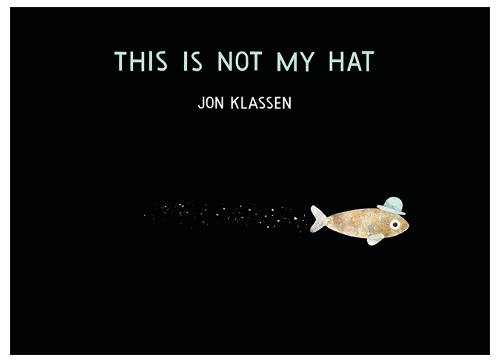
1. This Is Not My Hat by Jon Klassen

'This Is Not My Hat' by Jon Klassen

“A fish has stolen a hat. And he’ll probably get away with it. Probably.”

This is a clever and very funny story about a little fish who steals a hat from a big fish. The little fish is not worried about his crime, because even if the big fish “does notice that it’s gone, he probably won’t know it was me who took it. And even if he does guess it was me, he won’t know where I am going.” Unfortunately, it turns out there’s a witness to the crime. But he won’t tell, will he?

The illustrations are fabulous, featuring simple, flat figures that manage to convey a vast amount of information through tiny changes in shape. I loved the single, visible eye of the big fish, which progressively showed the fish asleep, awake, alert to his missing hat, angry, and very, very determined to get his hat back. And the text was perfect, juxtaposing the little fish’s blithe narration (“So I am not worried about that”) with images of his impending doom (a little crab with scared, googly eyes points frantically with his claw as the big fish bears down on them). Bonus points for this book because the text is printed in a clear, easy-to-read black font of uniform size on an off-white background. (My pet peeve regarding children’s picture books is when the illustrator uses a barely-readable font that meanders all over the page, changes size constantly and blends in with the background colours, all for no apparent reason other than to make the book seem Wacky and Zany. Illustrators – it just makes it really hard for new readers to figure out the words. So stop doing it.) Oh, and I guess this book does have an Important Moral Lesson, too: Don’t steal hats from big fish.

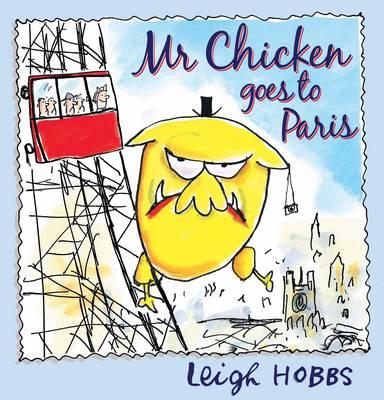
2. Mr Chicken Goes To Paris by Leigh Hobbs

'Mr Chicken Goes To Paris' by Leigh Hobbs

“The world’s most beautiful city meets the world’s most startling chicken . . .”

Mr Chicken, a four-metre-tall, bright yellow chicken, visits his friend Yvette in Paris. It is a very eventful trip. He rides the Métro, drops in at the Musée du Louvre (where the tourists decide he’s far more interesting than the Mona Lisa), climbs the outside of the Eiffel Tower (“Mr Chicken was far too excited to wait for the lift”), plays in the bell tower of Notre Dame, does lots of shopping, and decides to go on a diet after looking at his “great big bottom” in the Hall of Mirrors at Versailles. This does not stop him eating “everything on the menu” at dinner, which causes some problems when he tries to squeeze onto the plane at the end of his trip. But luckily, his clever young friend Yvette has a solution . . .

Bonus points for teaching me some French phrases (for example, Monsieur Poulet va à Paris). Magnifique!

3. What Faust Saw by Matt Ottley

'What Faust Saw' by Matt Ottley

“One night, Faust woke up, looked out the window and saw something very strange . . .”

Faust is a big brown dog who just happens to be the only witness when a horde of drooling, multicoloured aliens invades his suburb. Faust wakes up his family to inform them, but they don’t believe him. It is all very unfair. Faust decides to run away (“Then they’d be sorry”), but the aliens follow him and worse, someone hears him barking at them. Oh no, it’s the dog catcher!

This book loses some points for having hard-to-read text that meanders all over the page, but the richly coloured, beautifully detailed oil paintings make up for it. This book was very popular with my young students (as long as I read the words aloud to them), because they loved the aliens, especially the big, dinosaur-like one with the disgusting string of snot hanging from one nostril.

4. Counting on Frank by Rod Clement

'Counting On Frank' by Rod Clement

This book is about a boy who likes counting. No, he really, really likes counting. He especially likes calculating and estimating – for example, figuring out how long it would take the entire house to fill with water if he leaves the bath taps on and the plug in the bath, or how many humpback whales would fit inside his house, or how long his arms will grow if he has to keep dragging tins of dog food home from the shops for his dog, Frank. The (unnamed) boy’s counting is driving his parents mad – until they encounter a situation where his talent really comes in handy.

This has great illustrations of the bizarrely logical world of the boy’s imagination. This will appeal to children who like maths or have their own obsessive behaviours, especially when they see the boy’s (and Frank’s) moment of triumph at the end.

5. Traction Man Is Here by Mini Grey

'Traction Man Is Here' by Mini Grey

“An exciting adventure about a boy and his superhero can-do toy.”

A brand-new Traction Man arrives for Christmas (complete with “dazzle-painted battle pants”, jungle camouflage, sub aqua suit and space gear). He’s soon embroiled in daring adventures, including battling deep-sea monsters (aka a dishcloth in the sink), photographing the legendary Mysterious Toes (in the bathtub), rescuing dollies from the Wicked Professor Spade, and also acquiring a sidekick, Scrubbing Brush. But after taking the InterGalactic People Mover to Granny’s house, Traction Man faces his toughest assignment yet – getting rid of the “knitted green romper suit and matching bonnet” that Granny’s made him for Christmas.

This is a hilarious celebration of children’s imaginative play, with a few sly jokes for grown-ups hidden in the detailed, brightly coloured illustrations. Super good!

International ‘Please Don’t Pirate My Book’ Day

Apparently, today is International ‘Please Don’t Pirate My Book’ Day. Or maybe it was yesterday? Anyway, you already know what I think about people who illegally download copies of my books instead of buying the books or borrowing them from a library (and, for that matter, what I think of the term ‘piracy’ to describe this behaviour), but Seanan McGuire has just written a very good blog post about the issue, which you might find interesting.

I’d also like to take this opportunity to say a big ‘thank you’ to those of you who do buy books. You’re awesome.

‘Dated’ Books, Part Seven: Swallows and Amazons

A note for the benefit of those new to this series: ‘dated’ means ‘of its time, not ours’. ‘Dated’ books can be horribly offensive to modern sensibilities, or they can be charmingly nostalgic, or they can simply be a bit . . . odd. I found Swallows and Amazons by Arthur Ransome fell mostly into the ‘charmingly nostalgic’ category, apart from a couple of cringe-worthy scenes, which I shall discuss below. But first, have a look at the gorgeous old edition I read!

'Swallows and Amazons' by Arthur Ransome

I love how, whenever I reserve a children’s book at my library, they give me the most ancient edition in existence, which I imagine they have to dig out of a wooden trunk in the deepest, darkest basement of Sydney Town Hall. This is a 1949 edition from ‘The Australasian Publishing Co. Pty. Ltd’, with a fraying, faded olive-green cloth binding. It’s so old, it has one of those cardboard pockets in the back, containing an orange card with the book’s details handwritten in blue ink. It’s so old, it has a flimsy bit of paper stuck in for date stamps1. It’s so old, it has an illustrated ‘Ex Libris’ book plate in the front proclaiming the book belongs to the ‘City of Sydney Public Library JUVENILE SECTION’2. This book even smelled nice (not a nasty, mouldy old-book smell, but a nice, dry, old-paper scent).

Anyway, to return to the datedness of the story itself. The main reason I think this book is dated is the central premise. How many modern-day middle-class English parents would allow their four pre-adolescent children to sail off by themselves to a deserted island for an extended camping holiday, when the youngest is seven years old and CANNOT SWIM? True, the island is a short boat trip from the mainland, and they visit a nearby farmer each day to collect fresh milk3 and bread, and their mother sails over a few times to make sure they haven’t drowned, set themselves on fire or died of malnutrition, but STILL!

Of course, the children prove to be sensible, capable and independent, as most children in the 1920s were. The Walker siblings put up their own tents, cook their own meals (often consisting of fish they’ve caught themselves), sail up and down the lake, have a ‘war’ with a couple of local girls and their grumpy uncle, and even manage to outwit some (admittedly, not very bright) burglars. Actually, the detailed descriptions of the children’s life on the island were my favourite parts of the story. Among other things, I learned how to sew and erect a tent, how to turn a pine tree into a lighthouse, and how to build a camp fire. (The very detailed explanations of how to sail a boat were not as interesting to me, but children who can sail would probably love these bits.) I also enjoyed the descriptions of the lake’s wildlife, such as the dipper bird “under water, flying with its wings, as if it were in the air, fast along the bottom of the lake”.

However, the children’s constant talk of ‘natives’ and ‘savages’ quickly became tiresome. Some critics argue that this sort of talk isn’t racist, because the children don’t actually insult or belittle the ‘natives’, and anyway, the ‘natives’ aren’t real. I think that’s rather disingenuous, when it’s made clear that Mrs Walker grew up in Australia4, and the book contains dialogue such as this:

“‘This is where the savages have had a corroboree,’ said Titty. ‘They cooked their prisoners on the fire and danced around them.'”

Her mother goes along with this ‘joke’,

“telling how she had nearly been eaten by savages, and had only escaped by jumping out of the stew-pot at the last minute.”

This sort of talk was perfectly acceptable in 1930, but is not so funny now, especially when there are politicians in Australia who have used the supposed ‘cannibalism’ of Aboriginal Australians to justify racist policies.

The book also reflects the attitudes to class in 1920s England. In one scene, Nancy, the young daughter of a local land-owner, berates a policeman who is, quite reasonably, asking the Walker children if they know anything about a nearby burglary:

“‘Sammy, I’m ashamed of you. If you don’t go away at once, I’ll tell your mother . . . Run away, Sammy, and don’t make those mistakes again.'”

Apparently, it’s fine for a child to chastise and humiliate an adult who’s simply doing his job, if the child is rich and the adult is the mere son of a servant.

I was also a little worried at first that this would be a book where the boys did all the exciting stuff while the girls did the housework, and indeed, Susan does do all the cooking and most of the cleaning on the island (she and her sister also wear frocks, which you’d think would be a bit impractical for sailing). In addition, their mother, a competent and intelligent woman bringing up five children by herself while her husband is at sea, has to write to ask his permission when the children want to camp on the island. However, Nancy proves to be quite good at destroying gender stereotypes. She wears breeches, can out-sail, out-shoot and out-plan John, and generally bosses everyone around. Also, Susan’s unfortunately-named younger sister Titty5 ends up saving the day several times during the course of their holiday SPOILER ALERT! by firstly, capturing Nancy’s boat during the ‘war’ and secondly, finding the treasure buried by the burglars OKAY, SPOILERS FINISHED NOW.

Overall, I enjoyed the children’s adventures, which were exciting but plausible (well, more plausible than anything the Famous Five got up to). I liked reading about such competent, good-hearted child characters, and I know I would have loved this book to bits if I’d come across it as a young reader. (Although I’m pretty sure that even then, I’d have raised an eyebrow at the racism.)

More ‘dated’ books:

1. Wigs on the Green by Nancy Mitford
2. The Charioteer by Mary Renault
3. The Friendly Young Ladies by Mary Renault
4. Police at the Funeral by Margery Allingham
5. Emil and the Detectives by Erich Kästner
6. The Wind in the Willows by Kenneth Grahame
7. Swallows and Amazons by Arthur Ransome
8. Kangaroo by D. H. Lawrence

_____

  1. This book was in great demand in 1957 (borrowed three times!) but left the library only six times between then and 2003.
  2. It’s been a very long time since the City of Sydney had only one library, and I’m pretty sure the term ‘juvenile’ went out of fashion a couple of decades ago.
  3. Unpasteurised milk, straight from the cow, poured into an unsterilised milk-can! Because I am a persnickety grown-up with a science degree, I kept thinking, “I hope those cows have been tested for TB.”
  4. Slightly off-topic, I was puzzled by one of Mrs Walker’s tales about her childhood, when she described “the little brown bears that her father caught in the bush, and that used to lick her fingers for her when she dipped them in honey.” What is she talking about? Koalas? Possums? But they’re grey, not brown (unless they’ve been rolling in red dirt). She describes kangaroos separately, and anyway, kangaroos are not very bear-like. Maybe wombats? Do they like honey? Would any rational person put his or her fingers anywhere near a wombat’s mouth?
  5. This seemed such an odd name, even for the 1920s, that I had to investigate further. Apparently, three of the Walker children were named after real friends of the author, the Altounyans. Titty’s name, “the nickname of the real life Mavis Altounyan, from Joseph Jacobs’s children’s story, Titty Mouse and Tatty Mouse, has caused titters among generations of children, causing it to be changed to Kitty in the original BBC adaptation of the book”.