Plain, bookish Margaret and her beautiful friend Hilda are drawn into the orbit of a pompous playwright in Blitz-battered London – but who is exploiting whom?
Four Londoners – all on the outskirts of society because they’ve fallen in love with the wrong people, all terribly damaged by the war – have their interlinking stories gradually revealed in a clever narrative that travels backwards through the 1940s.
The code-breaking work done at Bletchley Park during WWII is said to shortened the war by several years. It told the British where German U-boats were during the Battle of the Atlantic, helped them defeat Rommel’s forces in North Africa, and allowed the Allied strategists to plan the 1944 D-Day landings.
To encode their messages, the German military used rotor machines, the most famous of which was Enigma. The Enigma codes should have been unbreakable, but luckily, Polish intelligence had managed to work out Enigma before the war and had passed on all their information to the Allies. Then the British managed to capture a German U-boat in 1941, complete with an Enigma machine and code book. A large electromechanical device called the Bombe was used at Bletchley to work out which daily settings the Germans were using on their Enigma machines, and the deciphered messages were translated into English and sent off to high-ranking British military leaders.
Bletchley was staffed by thousands of ‘boffins and debs’, who took their vows of secrecy so seriously that it wasn’t until the 1970s that the general public began to learn about their remarkable achievements. Many of the ‘debs’ who worked there had been recruited because of their social connections (“they were really frightfully snobbish about the girls who worked there”1). Other workers were recruited due to their linguistic or mathematical skills, with several of them identified after winning a national crossword competition. Among the ‘boffins’ was the brilliant mathematician Alan Turing, who was greatly admired by one of the debs, Sarah Norton:
“I once offered him a cup of tea but he shrank back in fear. He seemed terrified of girls and on the rare occasions when he was spotted, like a protected species, he would be shambling down to the canteen in a curious sideways step, his eyes fixed on the ground. It was explained to me that if you had spent most of your adult life closeted away in a study in Cambridge, you too would be scared of women and not know how to handle them.”2
Or, you know, you might be gay, which was then illegal. Sadly, Alan Turing was arrested after the war for consensual sex with another man, lost his high-security job, was given a choice of imprisonment or chemical castration, and killed himself. The laws against homosexuality were applied very selectively in those days. It was much easier to get away with being same-sex-attracted if you were rich and royal, like Prince George, Duke of Kent.
Tomorrow: My favourite novels about Britain at war.
_____
Jean Campbell-Harris, quoted in Anne de Courcy’s Debs at War↩
Today, I’m going to be talking about Dad’s Army . . . I mean, the Home Guard, a defence organisation made up of British men who were too old, too young or otherwise ineligible to join the regular British Army. The Home Guard (initially called the ‘Local Defence Volunteers’, or LDV) was formed in 1940, when there was a real fear that Britain was about to be invaded by Germany. By that time, the Nazis had overrun Czechoslovakia, Poland, Norway, Luxembourg, Belgium, the Netherlands and France, while most of the rest of Europe was ruled by dictators who supported Hitler. The British government called for volunteers to ‘defend our island’ and was overwhelmed by the enthusiastic response.
Local Defence Volunteers in London, 1940At its peak, the Home Guard had nearly two million members. Unfortunately, the government was struggling to provide enough uniforms and rifles to the regular army (they’d lost quite a lot of equipment in their hasty withdrawal from Dunkirk), so the Home Guard had to improvise. They made bombs out of jam jars and beer bottles filled with petrol, borrowed ancient weapons from local museums, and sharpened up their pitchforks and kitchen knives. In June 1940, Churchill ordered that “every man must have a weapon of some sort, be it only a mace or a pike”, so 250,000 ‘pikes’ (obsolete bayonets welded to long steel tubes) were dutifully ordered (although never actually distributed to the Home Guard).
The Home Guard set up watch posts in coastal towns and erected roadblocks, but some of them were a little too enthusiastic in carrying out their duties:
“. . . on the night of 2/3 June 1940, LDVs shot and killed four motorists at separate locations; on 22nd June it was reported that two motorcyclists and their passengers had been killed and wounded in the north of England and in Scotland; on 26 June an ARP [Air Raid Precautions] warden was shot dead when he ignored (or maybe didn’t hear) an LDV challenge; and in Romford in Essex a car exhaust backfiring prevented the driver hearing the command to stop: four passengers were shot dead and a fifth seriously wounded.”1
The Home Guard did even more damage to themselves, as can be seen here. Although the Germans never invaded Britain, over 1,600 Home Guardsmen were killed on duty, often by self-inflicted injuries.
Officially, women weren’t allowed to join the Home Guard because it would be “abhorrent” for a female to bear arms. “What about Boadicea?” pointed out Labour MP Edith Summerskill, but she was ignored. Eventually a Women’s Home Guard Auxiliary was formed, but women who joined were only allowed to perform traditional womanly duties such as cooking, cleaning and taking telephone messages. This did not deter Marjorie Foster and her fellow female patriots, who set up the Amazon Defence Corps and trained women in the arts of musketry, bombing and unarmed combat. Henry FitzOsborne would have approved.
The final book in the Montmaray Journals trilogy, The FitzOsbornes at War, is released in North America today. Hooray!
‘The FitzOsbornes at War’, published in North America on October 9, 2012This edition is pretty much the same as the Australian edition (apart from the cover art and the American spelling and punctuation, of course), but one difference is that it contains a family tree for the FitzOsborne family, dated 1955. As I don’t want those who bought the Australian edition to miss out, I’ve now posted a version of that family tree on my author website. (Please note that the family tree contains plot spoilers for all three books, so it’s not a good idea to click on that link until you’ve read all three books. Unless you’re the sort of reader who always reads the last pages of a novel first – in which case, go ahead and click.)
Now that the trilogy is finished, does anyone want to ask me any questions about the Montmaray books? I could set up a separate page on this blog with a big spoiler warning. If anyone thinks that’s a good idea, leave a comment below, and I’ll start a Montmaray Q & A page. (Of course, you can continue to email me with questions, but I thought it might be more efficient if everyone could read the questions and answers, especially as people tend to ask the same questions.)
Meanwhile, if you’re interested in how I went about researching, planning and writing The FitzOsbornes at War, I wrote a series of blog posts about it earlier this year. And here are my five favourite non-fiction books about Britain during WWII:
The privileged young British women who joined the services, drove ambulances, built aircraft in factories, nursed the wounded and worked on farms during the war tell their stories.
A meticulously researched account of every aspect of life on the Home Front, from the blackout, rationing and the Blitz, to the experiences of ‘enemy aliens’ and prisoners of war in Britain.
The story of Bamse, a charismatic St Bernard who was an official crew member of the minesweeper Thorodd and a mascot to the Free Norwegian Forces stationed in Scotland during the war.
This week, to mark the release of the North American edition of The FitzOsbornes at War, I’m going to be blogging about Britain during the Second World War. Today, it’s all about the artists who used their skills to camouflage buildings, guns, lorries, tanks, canals – and even entire cities – to protect them from Nazi attacks. Among these artists was the surrealist painter Julian Trevelyan, who was sent on a military camouflage training course in 1940. He learned how animals camouflage themselves in the wild with protective colouring, then was sent off with his paint tins and brushes to work in Cornwall, where he disguised concrete forts as cottages, public toilets and chicken houses, and used careful countershading to render anti-tank guns invisible against hedges. He also gave lectures to soldiers, showing them slide shows of how to camouflage themselves from air attacks (making sure he included slides “of nude girls under a camouflage net to wake up the men when they had dropped off”1). He was later stationed in North Africa and Palestine, where he disguised military tanks and created a dummy army to deceive the German Afrika Korps.
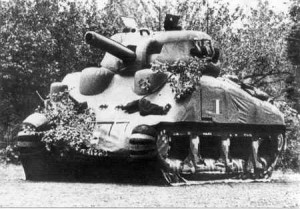
A dummy inflatable tank used by the Allies during WWIICamouflage was also an essential part of Operation Normandy, the Allied invasion of occupied France and Belgium in 1944. The Allied strategists went to great lengths to fool the Germans into thinking the Allied troops would depart from Dover and land in Calais. There were hundreds of fake plywood planes stationed on Kent airfields, as well as dummy landing craft floating on the Thames. They set up inflatable rubber tanks and lorries to make it look as though the Allies had more equipment than they actually possessed, and the 82nd Group Camouflage Company spent weeks making fake tyre marks in the grass so that it would appear that an enormous army had been practising manoeuvres. They also built a huge fake oil-storage tank in Dover, which was regularly ‘inspected’ by the King and Queen for the benefit of German spies.
One of the most famous camouflage experts of the war was magician Jasper Maskelyne, who was recruited into the British army at the same time as Julian Trevelyan. Maskelyne had been particularly bored during the animal-camouflage lectures of their training course (“a lifetime of hiding things on the stage had taught me more about the subject than rabbits and tigers will ever know”2), but he went on to disguise military equipment in the Western Desert and even claimed that he’d made the city of Alexandria temporarily ‘disappear’. He truly was a Master of Illusion.
Tomorrow: Publication day for The FitzOsbornes at War! Also, I talk about some of my favourite non-fiction books about wartime Britain.


 4. Westwood by Stella Gibbons