Same Book, But Different

There’s an interesting post at The Readventurer about the significant differences between the North American and Australian editions of Cath Crowley’s YA novel, Graffiti Moon*. The reviewer, who has read both editions, concludes that the American version “felt a bit…sanitized, which I didn’t like.”

Interesting. Especially as there didn’t seem to be anything particularly edgy or controversial in the Australian edition of Graffiti Moon, as I recall.

American publishers do tend to change spelling and punctuation when they publish Australian YA books, and they also change any vocabulary that might prove confusing to American teenage readers. I remember reading the American editions of some YA novels by Barry Jonsberg and Melina Marchetta, in which the settings were clearly Darwin or the inner western suburbs of Sydney – yet the characters talked about ‘dimes’ and ‘sidewalks’. Even J.K. Rowling’s first book was subjected to Americanisation, with her American publishers making more than eighty changes to Harry Potter and the Philosopher’s Stone, including the title. (And some of the changes seem pretty silly to me – surely American readers could work out that ‘multi-storey car park’ means the same as ‘multilevel parking garage’.)

For the record, the North American edition of A Brief History of Montmaray is very different to the Australian edition. Apart from a much-needed structural edit (for example, I completely re-wrote the final chapter), I spent a lot of time wrangling with my American copy-editor over words such as ‘biscuit’ and ‘jersey’. This was complicated by the fact that my narrator spoke a posh 1930s British version of English. But The FitzOsbornes in Exile and The FitzOsbornes at War are pretty much the same (apart from the spelling), wherever you buy a copy in the world. Maybe my American editors figured that readers who’d made it through the first book in the series would be able to cope with the characters eating ‘biscuits’ rather than ‘cookies’, and using ‘torches’ rather than ‘flashlights’, and so on. Or maybe my editors just got tired of arguing with me.

*Thanks to Bookshelves of Doom for the link to the Graffiti Moon discussion.

In Which I Take More Photographs

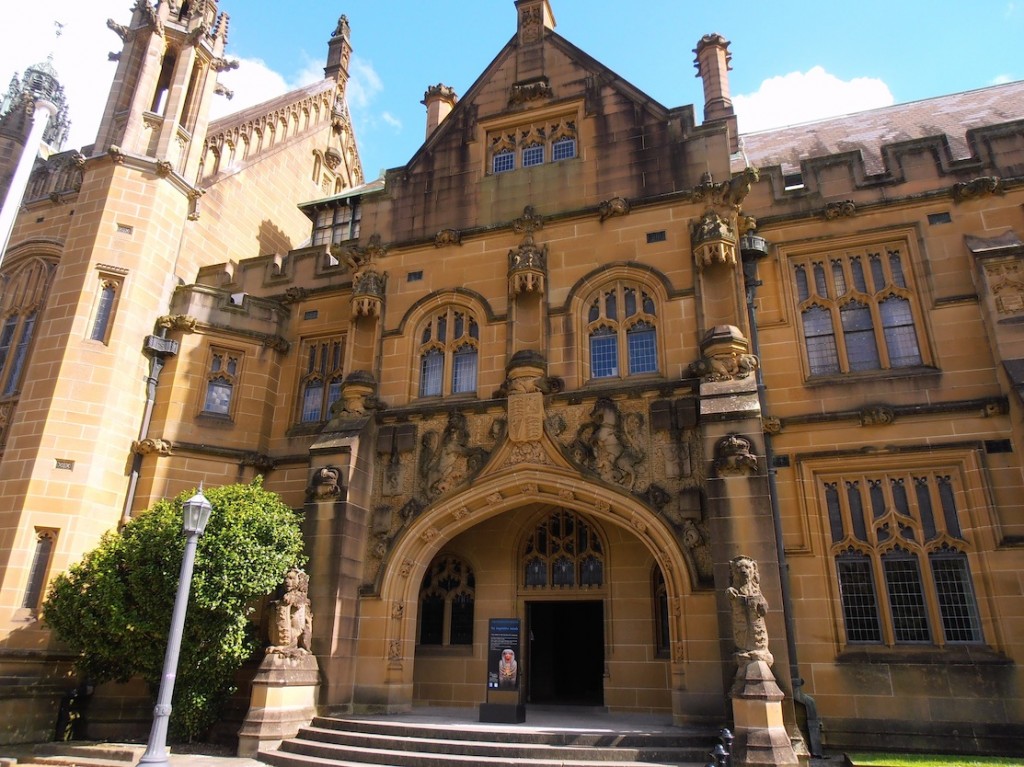
Yesterday, I posted some photographs of a Lion and a Unicorn. Here’s where they live:

Southern entrance to Main Quad

They’re over the southern entrance to the Main Quadrangle of the University of Sydney, which is Australia’s oldest university. On the left side of the photo you can see part of MacLaurin Hall, the original university library. Here’s another view of MacLaurin Hall:

MacLaurin Hall

I sat for exams in that building a couple of decades ago. (I blame the extremely distracting neo-Gothic architectural details for my poor results.)

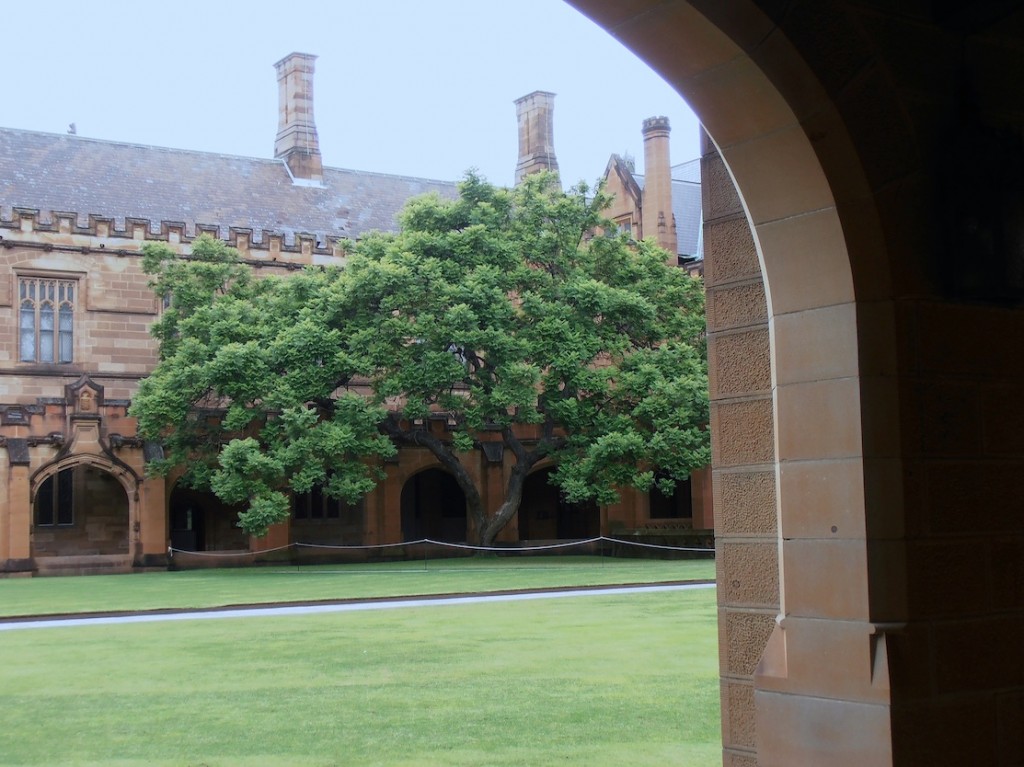
If you walk through the Lion and the Unicorn entrance, you’ll find yourself in the Main Quadrangle, which features a beautiful jacaranda tree:

Jacaranda tree, Main Quadrangle

The tree is covered in vivid purple flowers in late spring. It’s said that if you haven’t started studying by the time the jacaranda flowers, you’ll fail all your exams. Here’s another view of the Main Quad, showing the Clock Tower and Carillon:

Clock Tower, Main Quadrangle

According to Tess van Sommers, who wrote the text of University of Sydney Sketchbook, “If architect Edmund Blacket had had his way, this tower would have had even more ornate turrets than it has now; some almost deliriously convoluted pinnacles were among his rejected designs.”

At the left side of the photo, you can see a bit of the Great Hall, a “scaled-down version of Westminster Hall in London”. At the moment, most of it is covered in scaffolding, so I didn’t take a photo from the front, but it’s a fairly spectacular edifice. Apparently, its construction in the 1850s and 1860s did not go smoothly, with workmen often abandoning the site to join the latest gold rush, while politicians kept raising doubts about “the need for such frivolities as gargoyles”. Also, “for some years, the frontal majesty of the block was marred by an approach through cow pastures” and what is now Victoria Park featured a dam in which horses bathed and occasionally died.

But what, you may ask, does all this have to do with my current writing project? Good question. I don’t have a very detailed answer yet, but wait and see. It’s possible that something interesting and historical and book-shaped will (eventually) appear.

In Which I Take Some Photographs

Last month I bought my very first camera, so that I could take some photos of the setting of my next novel. This work-in-progress doesn’t even have a title yet. All I’ve done so far is read a lot of books about the subject, fill a folder with research notes and think up some fairly silly jokes and snippets of dialogue. The next step – organising all of this into some sort of coherent plot – seems so overwhelming that I’ve been avoiding it. However, today I decided to go for a long walk around the place in which the novel is set, in the hope that this would inspire me to do some work. I took my camera along and here are some of the results.

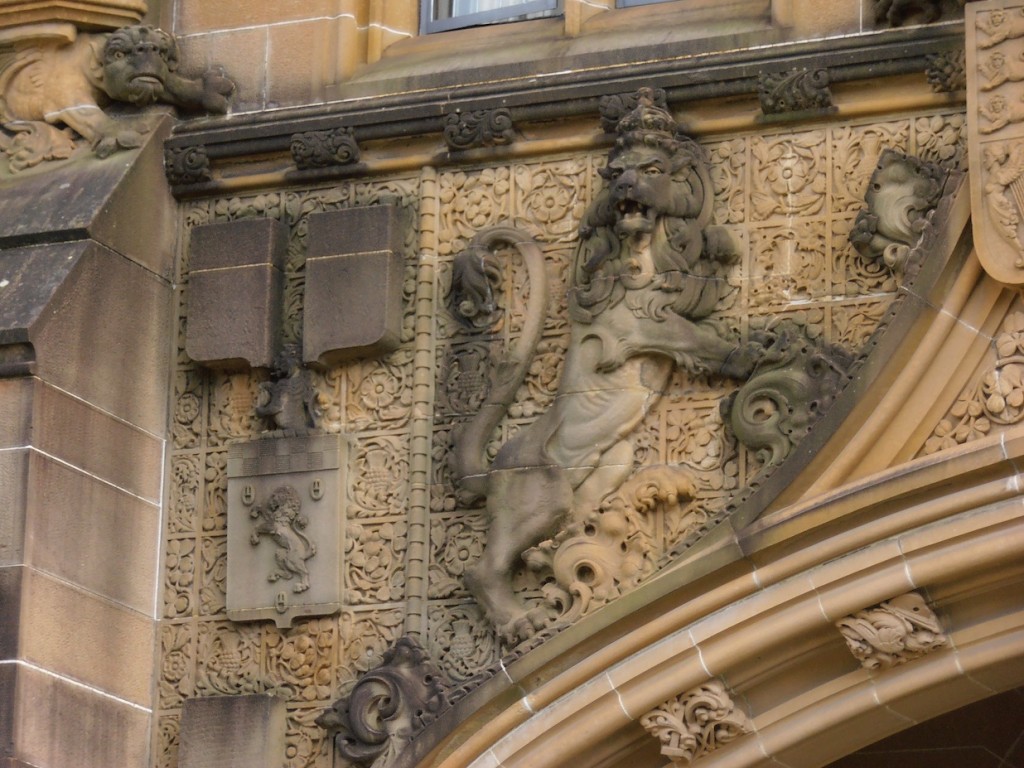
First, the Lion:

The Lion

His ferocity is slightly diminished by the fact that a few of his front teeth have fallen out. Actually, I’m not sure if the Lion is going to make it into my book, but the cute little gargoyle in the top left corner of the picture definitely is.

And then, the Unicorn:

The Unicorn

I’m assuming it is a Unicorn (and not just a horse with a weird lump on its forehead), because it’s helping the Lion hold up a coat of arms. Poor Unicorn has lost most of its horn, but hey, if you were a hundred and fifty years old, bits of you would probably be falling off, too.

Next is Mephistopheles, spitting into a fountain:

Mephistopheles

Unfortunately, he’s missing most of his nose, but he still looks quite evil. He was (supposedly) designed by Australian architect Leslie Wilkinson in 1925, and possibly inspired by Australian artist Norman Lindsay. (I accidentally typed ‘Normal Lindsay’ just then, which I’m sure he would have found highly insulting.)

And then there’s Gilgamesh, who is either hugging or strangling a lion:

Gilgamesh

I have to admit that I don’t yet know much about Gilgamesh, except that he was the king of Uruk (now Iraq and Kuwait) in about 2500 BC and was regarded as a demigod in Mesopotamian mythology. He also went on a ‘quest to seek immortality’, which is very useful for my purposes. I’m choosing to believe he is embracing the lion, even though the lion doesn’t look very happy, because Gilgamesh also found ‘compassion, friendship, courage, love and peace’ on his quest. That’s nice, isn’t it?

Tomorrow: More photographs from my expedition, and I’ll explain where you can find Gilgamesh and his friends. (Shh, Sydneysiders, I know you’ve already worked out where the photographs were taken! But I’m trying to create some suspense here!)

FitzOsbornes at War Excerpt And Other Exciting Things

'The FitzOsbornes at War' Australian paperbackI’ve just done a bit of work on my author website – given it a fresh coat of paint, swept the floors, polished the windows, that sort of thing. Oh, and I’ve also added a new annexe and arranged some shiny new articles on the shelves. There’s a photograph of the cover of my new book. There’s an excerpt from the book. There’s a bit of historical background information for readers who’d like to know more about England during the Second World War. There’s even a set of free downloadable Teaching Notes for the novel, if you happen to be a teacher, although the Teaching Notes won’t be available until the book is released in April.

Gosh, two blog posts in twenty-four hours. I don’t know what’s come over me. It must be all the excitement of having a new book out in seven weeks.

‘Dated’ Books, Part Five: Emil and the Detectives

‘Dated’ doesn’t have to mean ‘painful to read’ – sometimes it can mean ‘charming and sweet and nostalgic’. Emil and the Detectives, written by Erich Kästner in 1929, is an example of a children’s adventure story that is old-fashioned in the best sense of the word. Young Emil (age unknown, but he seems to be about ten or eleven) encounters a suspicious bowler-hatted man during a journey to Berlin. While Emil is asleep in the train carriage, the man steals a large sum of money that Emil is meant to deliver to his grandmother. Emil doesn’t feel he can report it to the police – he’s already afraid that he’s going to be arrested because he chalked a red nose and black moustache on an important statue in his home town. No, Emil must track down the missing money himself in Berlin. It’s a daunting task for a country boy – but luckily he encounters Gustav and his gang of friends, who are eager to be part of the adventure.

'Emil and the Detectives' by Erich KästnerAh, the good old days – when rural mothers sent their young sons off on unaccompanied, four-hour train trips to an unfamiliar city, and city parents allowed their boys to roam the streets of Berlin in the middle of the night. Unfortunately, they were also the days when girls weren’t allowed to have adventures. Emil’s female cousin, Pony, would love to help, but all she can do is bring refreshments to the boy detectives. On the few occasions she gets to speak, she says things like “I wish I could stay! I’d make you some coffee. But I can’t, of course. Nice girls like me have to be in bed in good time” and “I’m just doing the washing up. Women’s work is never done”. I’d love to have seen Pony run down the thief on her bicycle or something. Still, the boys – Gustav with his motor horn, the bespectacled Professor, little Tuesday and the rest – are so full of energy, fun and ingenious plans that the story skips along. It’s also nice to see a boy character who cares for his mother in lots of practical ways and isn’t afraid to discuss this with his new friends (although Emil does threaten to punch anyone who calls him a mummy’s boy).

I do wonder what today’s young readers, accustomed to fast-paced modern adventure stories, would make of a book that begins with Mrs Wirth, the baker’s wife, having her hair shampooed by Emil’s mother. It takes a few chapters before anything remotely suspenseful or adventurous happens, although the action speeds up once Emil reaches Berlin. Young readers may also struggle with some of the dialogue, unless they’re familiar with Enid Blyton. The edition I borrowed from my library was a 1959 English translation (see photograph above – although I must emphasise that Sydney City Library does stock other, more recent, children’s books). Gustav says things like “Cheerio, Emil. Gosh, I’m looking forward to this. It’s going to be smashing!” and the stolen 120 marks is translated into “seven pounds” (which still won’t mean much to young readers). I think a modern translator might have done a better job of conveying the original German text, although I suppose it’s always difficult to translate slang.

The edition I read also included a rather poignant introduction by Walter de la Mare which says, “There is nothing in it that might not happen (in pretty much the same way as it does happen in the book) in London or Manchester or Glasgow tomorrow afternoon.” This may have been true when he wrote it in 1931, but it certainly wasn’t ten years later. By that time, Britain and Germany were at war; the cities of Berlin, London, Manchester and Glasgow were being bombed; and young Emil and his friends were of age and probably conscripted into the Nazi war machine. Meanwhile, the author, a pacifist, had been interrogated by the Gestapo and had his books burnt by the Nazis. His home in Berlin was destroyed by bombs, but he survived the war to write more books for children and adults, including an autobiography called When I Was A Little Boy. Emil and the Detectives was made into several films, the most recent in 2001 (in which, apparently, Pony had a bigger role to play, hooray!).

Thank you, Alex, for drawing my attention to this book in one of your comments a few months ago. I think I might have read it as a child, but I had forgotten almost everything about it, so I thoroughly enjoyed all the plot twists and jokes.

More ‘dated’ books:

1. Wigs on the Green by Nancy Mitford
2. The Charioteer by Mary Renault
3. The Friendly Young Ladies by Mary Renault
4. Police at the Funeral by Margery Allingham
5. Emil and the Detectives by Erich Kästner
6. The Wind in the Willows by Kenneth Grahame
7. Swallows and Amazons by Arthur Ransome
8. Kangaroo by D. H. Lawrence