Vintage Classics Children’s Collection

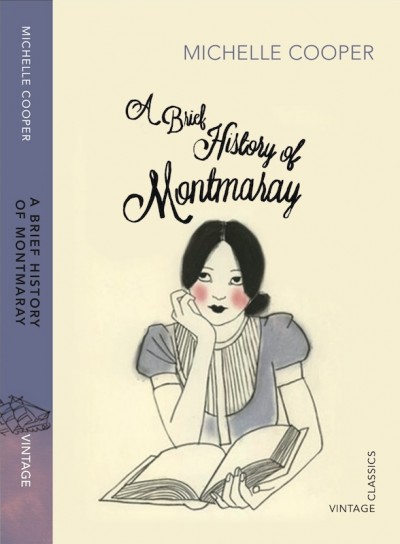
This week, Random House Australia announced the launch of a new series of classic children’s books, with the first twenty-one books to be published in August. It’s a wonderful list, including some of my favourite children’s books. Alice in Wonderland, Little Women, I Capture the Castle, What Katy Did, Treasure Island, Emil and the Detectives, The Railway Children . . . and guess what? One of the titles is A Brief History of Montmaray! It will have a lovely illustrated cover and will look like this:

'A Brief History of Montmaray' Vintage Classic edition

Pretty, isn’t it? The other Australian title on the list is Deborah Abela’s The Remarkable Secret of Aurelie Bonhoffen.

In other news, I’m still blogging away at Inside a Dog until the end of the month, so come over and say hello and read about life in wartime England.

‘Dated’ Books, Part Five: Emil and the Detectives

‘Dated’ doesn’t have to mean ‘painful to read’ – sometimes it can mean ‘charming and sweet and nostalgic’. Emil and the Detectives, written by Erich Kästner in 1929, is an example of a children’s adventure story that is old-fashioned in the best sense of the word. Young Emil (age unknown, but he seems to be about ten or eleven) encounters a suspicious bowler-hatted man during a journey to Berlin. While Emil is asleep in the train carriage, the man steals a large sum of money that Emil is meant to deliver to his grandmother. Emil doesn’t feel he can report it to the police – he’s already afraid that he’s going to be arrested because he chalked a red nose and black moustache on an important statue in his home town. No, Emil must track down the missing money himself in Berlin. It’s a daunting task for a country boy – but luckily he encounters Gustav and his gang of friends, who are eager to be part of the adventure.

'Emil and the Detectives' by Erich KästnerAh, the good old days – when rural mothers sent their young sons off on unaccompanied, four-hour train trips to an unfamiliar city, and city parents allowed their boys to roam the streets of Berlin in the middle of the night. Unfortunately, they were also the days when girls weren’t allowed to have adventures. Emil’s female cousin, Pony, would love to help, but all she can do is bring refreshments to the boy detectives. On the few occasions she gets to speak, she says things like “I wish I could stay! I’d make you some coffee. But I can’t, of course. Nice girls like me have to be in bed in good time” and “I’m just doing the washing up. Women’s work is never done”. I’d love to have seen Pony run down the thief on her bicycle or something. Still, the boys – Gustav with his motor horn, the bespectacled Professor, little Tuesday and the rest – are so full of energy, fun and ingenious plans that the story skips along. It’s also nice to see a boy character who cares for his mother in lots of practical ways and isn’t afraid to discuss this with his new friends (although Emil does threaten to punch anyone who calls him a mummy’s boy).

I do wonder what today’s young readers, accustomed to fast-paced modern adventure stories, would make of a book that begins with Mrs Wirth, the baker’s wife, having her hair shampooed by Emil’s mother. It takes a few chapters before anything remotely suspenseful or adventurous happens, although the action speeds up once Emil reaches Berlin. Young readers may also struggle with some of the dialogue, unless they’re familiar with Enid Blyton. The edition I borrowed from my library was a 1959 English translation (see photograph above – although I must emphasise that Sydney City Library does stock other, more recent, children’s books). Gustav says things like “Cheerio, Emil. Gosh, I’m looking forward to this. It’s going to be smashing!” and the stolen 120 marks is translated into “seven pounds” (which still won’t mean much to young readers). I think a modern translator might have done a better job of conveying the original German text, although I suppose it’s always difficult to translate slang.

The edition I read also included a rather poignant introduction by Walter de la Mare which says, “There is nothing in it that might not happen (in pretty much the same way as it does happen in the book) in London or Manchester or Glasgow tomorrow afternoon.” This may have been true when he wrote it in 1931, but it certainly wasn’t ten years later. By that time, Britain and Germany were at war; the cities of Berlin, London, Manchester and Glasgow were being bombed; and young Emil and his friends were of age and probably conscripted into the Nazi war machine. Meanwhile, the author, a pacifist, had been interrogated by the Gestapo and had his books burnt by the Nazis. His home in Berlin was destroyed by bombs, but he survived the war to write more books for children and adults, including an autobiography called When I Was A Little Boy. Emil and the Detectives was made into several films, the most recent in 2001 (in which, apparently, Pony had a bigger role to play, hooray!).

Thank you, Alex, for drawing my attention to this book in one of your comments a few months ago. I think I might have read it as a child, but I had forgotten almost everything about it, so I thoroughly enjoyed all the plot twists and jokes.

More ‘dated’ books:

1. Wigs on the Green by Nancy Mitford
2. The Charioteer by Mary Renault
3. The Friendly Young Ladies by Mary Renault
4. Police at the Funeral by Margery Allingham
5. Emil and the Detectives by Erich Kästner
6. The Wind in the Willows by Kenneth Grahame
7. Swallows and Amazons by Arthur Ransome
8. Kangaroo by D. H. Lawrence

Careful, He Might Hear You by Sumner Locke Elliott

There’s always a bit of trepidation when you re-read an old favourite from your teenage years. Will the book turn out to be No Good At All? Will it be obvious and sentimental and vacuous? Will it reveal that you used to have appalling taste in literature? Thankfully, Careful, He Might Hear You proved to be just as good as I remembered – perhaps even better, because I can now see the immense skill that went into the construction of its apparently effortless prose.

Careful, He Might Hear You was Sumner Locke Elliott’s first novel. It was published in 1963, but he’d been writing plays, radio serials and television scripts for decades before that, and it really shows in his writing. He knew all about plot and pacing, how to balance action with introspection and how to reveal character through dialogue. But writing a novel also allowed him to write beautiful descriptions of a setting he knew very well, that of Sydney during the Depression. The novel is based on his own childhood, in which he was the focus of a bitter custody battle between several aunts. His mother, a popular Australian writer, had died giving birth to him and his father, an irresponsible alcoholic, played no part in his upbringing. On one side of the battle was his anxious, motherly Aunt Lillian (named ‘Lila’ in the book), the wife of a hard-working but poor Labor politician; on the other was rich Aunt Jessie (‘Vanessa’), recently returned from England and determined to transform her nephew into a proper little gentleman. The situation was complicated by his odd Aunt Agnes, disciple of a bizarre American cult, and his bohemian Aunt Blanche (‘Vere’). The author does a superb job of narrating events from the perspective of six-year-old PS, who is by turns amused, baffled and angered by the grown-ups running his life. It’s a pleasure to watch him slowly gain some control over the adults, although the author also manages to evoke some sympathy for them. There is poor, over-worked Lila; her long-suffering husband, George; emotionally-repressed Vanessa; even exuberant Vere is revealed to have hidden sorrows. There are also gorgeous descriptions of Sydney in the 1930s – a cruise liner steaming into Sydney Harbour, a train trip to dusty Woronora Cemetery, Lila’s suburban backyard and Vanessa’s Point Piper mansion and Vere’s chaotic flat in King’s Cross:

“Vere poured the golden-coloured bubbles into two peanut butter glasses and handed one to Opal. They immediately forgot him and began talking about their friends who were all in a mess, thwarted, broke, maddened or suicidal, my dear. They had wonderful names like Dodo, Ukelele, Widget and Gussy. When they came to visit Vere, they brought her old shoe buckles, brooches, half-used pots of cold cream, combs and long, cool bottles because they were always dying of thirst, just dying of thirst, my dear, and their voices would grow brighter as the daylight faded, would fly around the small room like birds let out of cages telling about gay-sounding things, about parties and dancing, full of mysterious words that had to be spelled out in Lila’s house and which made his heart jump for the time when he would understand and be a part of the things they told about with such laughter.”

'Careful, He Might Hear You' by Sumner Locke Elliott and 'Sumner Locke Elliott: Writing Life' by Sharon Clarke

Careful, He Might Hear You was a huge success in the United States, Britain and Germany, but didn’t sell very well in Australia, as Sumner Locke Elliott explained:

“I distinctly remember that [his agent] told me 50,000 copies had already been sold in Germany, where there had been three editions in six months, and naturally I was elated. Then I asked about Australia and she said, ‘Seven.’ And I said, with some delight, ‘Well, 7,000, that’s not bad at all – it’s only a small country.’ But she said, ‘Not 7,000, just seven – seven copies.’ And you know, I just couldn’t believe it – my own country and only seven copies!”

Actually, it wasn’t his own country by then, because he’d moved to the United States in 1948, escaping a country that had banned his plays and had little tolerance for gay men. He lived in Los Angeles, and then New York, where he died in 1991. Several of his novels (Waiting for Childhood, Eden’s Lost and Water Under the Bridge) revisit the autobiographical themes of Careful, He Might Hear You, but it is his final novel, Fairyland, that’s probably the closest to his real life. Fairyland is the depressing tale of a young man growing up in Australia, desperately ashamed of his desires for other men but longing to find true love. It includes scenes taken from the author’s life, such as when he was bashed nearly to death in Wynyard railway station, and it shows the conservatism, violence and hypocrisy of the country where he grew up. Sharon Clarke wrote a good biography called Sumner Locke Elliott: Writing Life, which I recommend for anyone wanting to know more about the story behind Careful, He Might Hear You. There’s also an excellent film version starring Robyn Nevin and Wendy Hughes, which came out in 1983. (At least, I remember liking it when I saw it, but that was a very long time ago. It is possible I had terrible taste in movies then.)

Anyway, I was very pleased to see that Text is bringing out a new edition of Careful He Might Hear You as part of its Australian Classics series. This book deserves to find lots of new readers.

Cold Comfort Farm by Stella Gibbons

'Cold Comfort Farm' by Stella GibbonsI knew I was going to get along with Miss Flora Poste, the narrator of this novel, from the very first chapter, in which she explains that her “idea of hell is a very large party in a cold room, where everybody has to play hockey properly”. Flora also likes everything about her to be “tidy and pleasant and comfortable”. She is therefore presented with quite a challenge when she goes off to live with her relatives at Cold Comfort Farm, following the (unlamented) deaths of her parents.

The Starkadders have always lived at Cold Comfort Farm, even though the place is apparently cursed. The family is ruled over by mad Aunt Ada Doom, who conveniently “saw something nasty in the woodshed” as a child and so must have her every wish fulfilled, for fear she might go even madder. Her daughter Judith is sunk in gloom; Judith’s husband Amos spends all his time preaching hellfire at the Church of the Quivering Brethren; their inarticulate elder son Reuben tries to keep the farm going and obsesses about how many feathers his chickens have lost; Seth lounges about with his shirt unbuttoned to the waist, seducing the housemaids; and young Elfine writes terrible poetry and communes with Nature. Then there’s their ancient farmhand, Adam Lambsbreath, and his beloved cows (called Graceless, Pointless, Feckless and Aimless); Mrs Beetle the housekeeper and her “jazz quartet” of tiny, illegitimate grandchildren; and a confusion of dirt-encrusted Starkadder cousins, with names like Urk and Micah, who are constantly stealing one another’s wives and pushing each other down the well.

Fortunately, Flora enjoys a challenge and she cheerfully sets about improving the lives of all her relatives, whether they like it or not.

This is one of the funniest novels I have ever read. Stella Gibbons pokes fun at everyone and everything: Serious Literature, romance, evangelists, psychoanalysis, intellectuals, people who worship Nature, fashionable Society, the British aristocracy. As Rachel Cooke writes, “Gibbons was a sworn enemy of the flatulent, the pompous and the excessively sentimental.” The really clever thing, though, is how Gibbons manages to create over-the-top characters who are nevertheless completely recognisable. Mr Mybug, for example, who is convinced Branwell Brontë wrote Wuthering Heights:

“You see, it’s obvious that it’s his book and not Emily’s. No woman could have written that. It’s male stuff . . . There isn’t an intelligent person in Europe today who really believes Emily wrote the Heights.”

He sounds like V. S. Naipaul.

Although Cold Comfort Farm was first published in 1932, it is supposed to be set “in the near future”, sometime after the “Anglo-Nicaraguan wars of ’46”. Mayfair is now part of the slums of London, while Lambeth is a fashionable, expensive part of the city. The British railways have fallen into “idle and repining repair” because so many people travel in their own private aeroplanes, and telephones come equipped with a “television dial”. Some of this is quite prophetic, but it reads oddly in a novel that otherwise seems thoroughly part of the 1930s. (The excellent 1996 film version of the book wisely omitted these modernistic bits.) One extra note: make sure you read the author’s foreword before you read the novel. I didn’t, so I missed out on a running joke about literary criticism.

Stella Gibbons wrote two sequels to this book, Christmas at Cold Comfort Farm and Conference at Cold Comfort Farm, which unfortunately, I haven’t read. After being out of print for years, they have been republished this year by Vintage Classics, along with a dozen other novels from this author. I am particularly interested in reading Westwood, which is set during the Second World War and sounds fascinating.

More favourite 1930s/1940s British novels:

1. The Cazalet Chronicles by Elizabeth Jane Howard
2. The Charioteer by Mary Renault
3. The Friendly Young Ladies by Mary Renault
4. Love in a Cold Climate by Nancy Mitford

Oh, and don’t forget that my book giveaway is still on, until the 4th of December. Go and check out the excellent book recommendations from readers, and add a recommendation of your own!

Love In A Cold Climate by Nancy Mitford

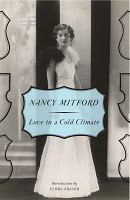
'Love in a Cold Climate' by Nancy MitfordI love this book. It’s a masterpiece of social comedy and it deserves to be more widely read, so that’s why I’ve decided to rave about it today. Imagine Pride and Prejudice set in the 1930s, and you’ll have some idea of the plot. Not that it’s really about the plot – which, for the record, involves posh English girls attempting to find suitable husbands. The real joy of this novel lies in the characters, particularly Lady Montdore, the wildly ambitious mother of beautiful Polly, who is ‘destined for an exceptional marriage’. Lady Montdore is a monster – self-centred, snobbish, bossy, greedy, completely deluded as to her value in the world – but she’s a very entertaining monster. She provides the author with numerous opportunities to send up the English aristocracy, as in this scene, when Lady Montdore berates our poor narrator, Fanny, the wife of a professor:

“‘You know, Fanny,’ she went on, ‘it’s all very well for funny little people like you to read books the whole time, you only have yourselves to consider, whereas Montdore and I are public servants in a way, we have something to live up to, tradition and so on, duties to perform, you know, it’s a very different matter . . . It’s a hard life, make no mistake about that, hard and tiring, but occasionally we have our reward – when people get a chance to show how they worship us, for instance, when we came back from India and the dear villagers pulled our motor car up the drive. Really touching! Now all you intellectual people never have moments like that.'”

Of course, things don’t go to plan, and Polly rebels in a manner calculated to drive her mother mad. This sets the scene for the introduction of another wonderful character, Cedric, the heir to the Montdore fortune. It was unusual enough in 1949 (the year the book was first published) for a novel to mention homosexuality, but it was revolutionary to have a happy and openly gay character who charms nearly everyone he meets. He even manages to dazzle the Boreleys, a family notorious for its intolerance:

“‘Well, so then Norma was full of you, just now, when I met her out shopping, because it seems you travelled down from London with her brother Jock yesterday, and now he can literally think of nothing else.’

‘Oh, how exciting. How did he know it was me?’

‘Lots of ways. The goggles, the piping, your name on your luggage. There is nothing anonymous about you, Cedric . . . He says you gave him hypnotic stares through your glasses.’

‘The thing is, he did have rather a pretty tweed on.’

‘And then, apparently, you made him get your suitcase off the rack at Oxford, saying you are not allowed to lift heavy things.’

‘No, and nor am I. It was very heavy, not a sign of a porter as usual, I might have hurt myself. Anyway, it was all right because he terribly sweetly got it down for me.’

‘Yes, and now he’s simply furious that he did. He says you hypnotised him.’

‘Oh, poor him, I do so know the feeling.'”

Then there are Fanny’s eccentric relatives – her wild Uncle Matthew, vague Aunt Sadie, hypochondriacal stepfather Davey, and exuberant little Radlett cousins – with many of these characters inspired by Nancy Mitford’s real family. In addition, the author provides a wickedly funny look at English politics, fashion, marriage and child rearing.

'The Pursuit of Love' and 'Love in a Cold Climate' by Nancy MitfordLove in a Cold Climate is actually the second book narrated by Fanny. The first, The Pursuit of Love, was published in 1945. I hesitate to call it a prequel, because that would suggest you need to read it first, and I don’t think you do. It stretches over a longer time period, and is mostly the story of Fanny’s cousin and best friend, Linda (Lady Montdore, Polly and Cedric don’t make an appearance in this one, unfortunately). Some readers prefer this first book to the second, but I think it really depends on whether you regard Linda as a tragic romantic heroine or a spoiled, self-centred brat. As you’ve probably guessed, I’m in the latter camp (I really can’t forgive Linda’s treatment of her hapless daughter). I also think this book ends too abruptly – as though the author suddenly got tired of typing. However, there’s a lot of enjoyment in the descriptions of the Radlett family, so if you adore Love in a Cold Climate, you’ll probably like The Pursuit of Love as well. There’s also a BBC television series based on both books, but I haven’t seen it (and it doesn’t appear to be available in Australia).

I’ve previously written about one of Nancy Mitford’s earlier novels, Wigs on the Green (1935), which is interesting for historical and political reasons, but doesn’t have much literary merit. I cannot recommend The Blessing (1951) at all, because it’s awful. However, it and Don’t Tell Alfred (1960) have recently been re-released with lovely illustrated covers.
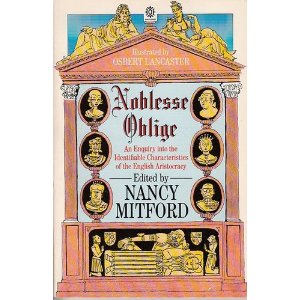
'Noblesse Oblige' edited by Nancy MitfordI can recommend Noblesse Oblige: An Enquiry into the Identifiable Characteristics of the English Aristocracy, a biased but very entertaining collection of essays and cartoons about ‘Upper-Class English Usage’, edited by Nancy Mitford and including contributions from Evelyn Waugh and John Betjeman. Laura Thompson has also written a biography of Nancy Mitford called Life in a Cold Climate, which discusses all her books and the influences for her novels.

See also: Meet The Mitfords

More favourite 1930s/1940s British novels:

1. The Cazalet Chronicles by Elizabeth Jane Howard
2. The Charioteer by Mary Renault
3. The Friendly Young Ladies by Mary Renault