What I’ve Been Reading : Ruth Prawer Jhabvala

For various reasons, I haven’t felt up to reading anything new lately, so I’ve been working my way through old favourites from my bookshelves. This has included a whole shelf of novels and short stories by Ruth Prawer Jhabvala. I find her work consistently engrossing, although I’m not sure why, because she wrote the same story over and over again. Generally a Westerner – someone from America or Britain, usually with German parents or grandparents – arrives in India with great enthusiasm and is either gradually or suddenly disillusioned. Often there is a guru involved, who may or may not be as benevolent as he initially seems. In her later work, the setting is New York or London and the master is a tempestuous Central European musician or psychiatrist or academic, but the theme is the same – that the characters must efface themselves to reach true fulfilment, which rarely turns out to equal true happiness.

Her fiction always seems very autobiographical and in her introduction to Out of India, entitled ‘Myself in India’, she wrote:

'Out of India' by Ruth Prawer Jhabvala

“I have lived in India for most of my adult life. My husband is Indian and so are my children. I am not, and less so every year […] There is a cycle that Europeans – by Europeans I mean all Westerners, including Americans – tend to pass through. It goes like this: first stage, tremendous enthusiasm – everything Indian is marvellous; second stage, everything Indian is not so marvellous; third stage, everything Indian abominable. For some people it ends there, for others the cycle renews itself and goes on. I have been through it so many times that now I think of myself strapped to a wheel that goes round and round and sometimes I’m up and sometimes I’m down.”

She was particularly interested in religion and “whether religion is such a potent force in India because life is so terrible, or is it the other way round – is life so terrible because, with the eyes of the spirit turned elsewhere, there is no incentive to improve its quality?” The heart of her problem, she said, was this:

“To live in India and be at peace, one must to a very considerable extent become Indian and adopt Indian attitudes, habits, beliefs, assume if possible an Indian personality. But how is this possible? […] Sometimes it seems to me how pleasant it would be to say yes and give in and wear a sari and be meek and accepting and see God in a cow. Other times it seems worthwhile to be defiant and European and – all right, be crushed by one’s environment, but all the same have made some attempt to remain standing.”

'The Nature of Passion' by Ruth Prawer JhabvalaThis author is probably best known for her Booker Prize-winning novel, Heat and Dust, and her Academy Award-winning script writing for the films of Merchant and Ivory. I like Heat and Dust, a book that contrasts historical and modern British attitudes towards India, and the film is pretty good, too. But my favourite Ruth Prawer Jhabvala novel about India would have to be The Nature of Passion. It’s a clever, droll, beautifully constructed story about a family in New Delhi in the 1950s. Lalaji is one of the new super-rich, a man who has acquired millions of rupees by a combination of ruthless scheming, graft and sheer hard work and believes his security lies in sticking to traditional Hindu values. His youngest offspring, however, have opposing ambitions. Chandra is trying to establish a squeaky-clean career in the Civil Service, Viddi wants to travel to Paris to be an art critic, and beautiful Nimmi longs to be modern and independent and marry for love. A crisis looms for Lalaji when a politician begins a campaign against bribery and corruption:

“Bribery and corruption! These were foreign words, it seemed to him, and the ideas behind them were also foreign. Here in India, he thought, one did not know such words. Giving presents and gratifications to Government officers was an indispensable courtesy and a respectable, civilised way of carrying on business. It was a custom, a tradition even, and hence should be respected; not tampered with by upstart Deputy Ministers who had been abroad and brought home unsuitable ideas.”

For those who prefer short stories, Out of India is a good representative collection of her work, although I also like A Stronger Climate because it divides the stories into two useful categories, ‘The Seekers’ and ‘The Sufferers’. I also enjoyed My Nine Lives: Chapters of a Possible Past, in which the nine stories, set in India, America and Britain, explore fictional “alternative destinies” for the author.
'Shards of Memory' by Ruth Prawer Jhabvala

When it comes to her novels set (mostly) outside India, the one I keep returning to is Shards of Memory, a family saga involving a wealthy Anglo-German-Indian family living in New York and linked to a mysterious spiritual Master. I don’t know why I like it so much, because it’s certainly not flawless (for one thing, it ends too abruptly). I think it must be the characters, who are so complicated and eccentric and oddly endearing. I especially like Henry, the young man who reluctantly accepts his destiny as the Master’s heir, and Henry’s grandfather Graeme, a cynical British diplomat – and also, possibly, a spy…

National Bookshop Day 2016

'Love your bookshop 2016' logo

Fellow Australians1, it’s National Bookshop Day this Saturday!

This celebration of our nation’s bookshops is especially important this year because the Australian Booksellers Association is one of the organisations campaigning against our government’s proposed changes to Australian copyright laws:

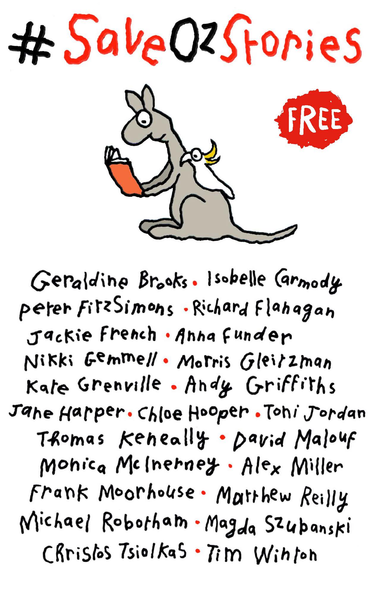
“That’s why this year the National Bookshop Day celebrations will coincide with the release of #SaveOzStories. Published by Melbourne University Press, #SaveOzStories is a collection of some of Australia’s finest authors writing about the threat the removal of PIRs poses to our local writing culture. #SaveOzStories will be available for free at all good bookshops on Saturday 13 August.”

That’s right, a free book, full of contributions from your favourite Australian writers. There’ll also be lots of cool events at bookshops around the country. For more information, see Love Your Bookshop on Facebook and NatBookshopDay on Twitter.

'Save Oz Stories'

_____

  1. If you’re not Australian, you are still allowed to visit a bookshop this Saturday. Especially if you’re planning to buy one of my books.

Miscellaneous Memoranda

– There’s a great interview with E.B. White in this 1969 edition of The Paris Review, which includes his thoughts on writing for children:

“Anyone who writes down to children is simply wasting his time. You have to write up, not down. Children are demanding. They are the most attentive, curious, eager, observant, sensitive, quick, and generally congenial readers on earth. They accept, almost without question, anything you present them with, as long as it is presented honestly, fearlessly, and clearly. I handed them, against the advice of experts, a mouse-boy, and they accepted it without a quiver. In ‘Charlotte’s Web’, I gave them a literate spider, and they took that.”

– I was also interested in this article at The Guardian about a new exhibition of Soviet-era children’s books. “The idea was to abolish fantasy literature and illustration because they were seen as bourgeois and unhelpful to the revolution,” says Olivia Ahmad, the curator of the exhibition:

“In one cautionary tale called ‘Ice Cream’, by writer Samuil Marshak and illustrator Vladimir Lebvedev, a bourgeois capitalist eats too much ice cream and freezes to death. In ‘Red Neck’, a poem by Nicolia Aseev, a faithful Young Pioneer (the Soviet youth group) refuses to take off his red neckerchief even when attacked by a raging bull, thus demonstrating doughty revolutionary commitment even in the face of an unpleasant goring.”

The Guardian is also running a series about recipes for fictional food, including strawberry and peanut butter ice cream from Harry Potter and the Chamber of Secrets and raspberry cordial from Anne of Green Gables. I also liked this blog post at Pop Goes The Page about a DIY Harry Potter party, complete with Hogwarts letters, house banners, snowy owl balloons, floating candles and of course, pumpkin pasties, chocolate frogs and butterbeer.

– From the world of publishing, here’s a depressingly accurate article about how authors who are “hard to look at” (that is, not conventionally attractive) are less likely to find a publisher for their work. This only applies to women writers, of course (as one commenter notes, “Only one name is needed to mention here: George R. R. Martin”). And here’s an essay by a New Zealand editor, Stephen Stratford, entitled “The book didn’t sell and yes, I was mean-spirited enough to rejoice”: An essay on the dark arts of book editing.

Copyright protection for creators has been in my thoughts lately, so I was interested to read this discussion of the “Monkey Selfie” case, in which a US judge eventually ruled that “a non-human was not capable of owning copyright under current US law”. (It is a great photo, though.)

– Finally, for those students feeling stressed about school and exams, “one Canberra school has invited a local kitten rescue to bring cats into the classroom in a unique bid to mitigate pre-exam anxiety”.

'The Globe kittens' by Ernest J Rowley (1902)

What I’ve Been Reading

I have not been reading much fiction lately as I’ve been distracted by ALL THE POLITICS, but two novels I recently read did provide some insight into race and immigration, which seems highly relevant to current events.

'Americanah' by Chimamanda Ngozi AdichieThe first was Americanah by Chimamanda Ngozi Adichie, a hugely ambitious, sprawling novel about the experiences of African immigrants, “none of them starving, or raped, or from burned villages, but merely hungry for choice and certainty”. The author’s observations on race felt true-to-life and were often quite funny, and it was particularly interesting to read her thoughts on the vast differences between ‘African-Americans’ (that is, the descendants of the African slaves sent to America many years ago) and ‘American-Africans’ (people from Nigeria and other African countries who have recently migrated to the United States). I also loved the sections set in Nigeria, which were beautifully described.

However, I had two problems with this novel. Firstly, it was not really a novel. Structurally, it was a mess – although perhaps this was meant to reflect the chaos of modern-day Nigerian life? It is supposedly the story of two lovers, Ifemelu and Obinze, who are cruelly torn apart by circumstances, except the narrative quickly wanders off in a variety of competing directions and so I lost all interest in the love story (which is abruptly and implausibly resolved in the final chapters). There is a cast of hundreds of characters, most of whom are introduced and then quickly disappear, never to be seen again. There are long sections in which nothing much happens. There are a lot of blog posts, written by Ifemelu, which say the same things the characters have already said. The whole book is unashamedly didactic, which makes me think it might have worked better as a memoir or a collection of essays.

A greater problem for me, though, was Ifemelu, who narrates most of the book. Ifemelu is the biggest Mary Sue I’ve encountered since Bella in Twilight. Ifemelu – or, as I came to think of her, ★ IFEMELU ★ – is perfect. She is beautiful (but naturally beautiful, not like those vain girls who straighten their hair and fuss over their clothes to attract men). She is smarter and wiser and has better taste than anyone else. She wins scholarships and fellowships and everything she attempts is a great success. She starts a blog about race and not only does it quickly become famous, she makes so much money from it that she’s able to buy a condo. Everyone adores her, especially rich men and small children, even though she never seems to do anything to help anyone else. Her rich boyfriends fall over themselves to shower her with whatever she desires – jobs, money, expensive clothes, overseas holidays. Not that she asks for those things, not like those other girls do, which again shows how much integrity she has! (In fact, she gets bored when her boyfriends are too nice to her, so she cheats on them or dumps them without a word of explanation, no doubt to teach them a valuable life lesson.) ★ IFEMELU ★ is also the best at pointing out other people’s flaws. She despises well-meaning white liberal Americans for being ignorant, African-Americans for not understanding how privileged their lives are compared to Africans, and Nigerians for being lazy and corrupt. All of this would be bearable if Ifemelu ever showed any self-awareness or made any attempt to change, but that never happens. The author has said that Ifemelu is autobiographical and suggests her flaws are meant to be endearing. I was not endeared and would much rather have spent more time with some of the other characters – Obinze, for example, who becomes an ‘undocumented’ immigrant in Britain, or Aunty Uju, who has much less luck than Ifemelu when it comes to choosing male partners, or Dike, the depressed teenager caught between two cultures in America. Despite these reservations, I did find the book interesting and it would be a great choice for a book club because there’s just so much to discuss.

'Breakfast with the Nikolides' by Rumer GoddenAfter that I read something very different, but also about cultural clashes – Breakfast with the Nikolides by Rumer Godden. This is a small, perfectly formed novel about the conflict between British colonials and Indians working and studying at an agricultural college in Bengal. The author drew strongly on her own life experiences and her view of Indian society is both compassionate and clear-eyed. The descriptions of places and people are wonderful. She’s particularly good at portraying sensitive, awkward, plain girls on the verge of adolescence – in this novel, it’s twelve-year-old Emily, whose feuding parents have been forced to re-unite due to the war in Europe. When Emily’s little dog appears to contract rabies, it sets off a chain of disasters that ends up involving the whole town. The plotting is very skillfully done and the conclusion is deeply satisfying. And considering this was written by a white British woman in the 1940s, it’s commendable for its lack of racism. What did make me wince was the depiction of domestic violence and marital rape. At one stage, the most sympathetic character is indignant that anyone should judge him harshly for smashing up his house and assaulting his wife – after all, both were his property to do what he liked with and anyway, she provoked him by being annoying. Of course, this is what most people believed at the time (and unfortunately, how some people still think), so it’s entirely plausible – just unpleasant to read. However, on the whole, this is a beautiful piece of writing and highly recommended for Rumer Godden fans. A good companion read would be Anne Chisholm’s excellent biography of Rumer Godden, so that you can see the parts of the novel that were inspired by real events in the author’s life.

What I’ve Been Reading

I don’t usually read horror fiction (if I want horror, I can read the newspapers), but I recently borrowed a huge pile of books, plucked pretty much at random off the shelves of my library because it was about to close down for SIX WEEKS1, and two of these books turned out to be Tales of Terror.

'Slade House' by David MitchellThe first is probably more speculative fiction than straight horror. Slade House by David Mitchell was an engrossing, if fairly silly, novel about a mysterious house in London. Once every nine years, a carefully selected person is lured to this house and provided with all he or she has ever desired – until these ‘guests’ realise they can never leave. It is probably not giving away too much to reveal that the story involves vampires, although not the sort who wear black capes and drink blood. The first ‘guest’ we meet is a sweet, awkward teenager who arrives at the house in 1979 and his fate is heartbreaking. He’s followed nine years later by a policeman investigating the boy’s disappearance, then some university students who belong to a paranormal society, then a grief-stricken relative of one of the university students, and finally, a psychiatrist researching patients who claim to have had paranormal experiences. Each of the ‘guests’ is beautifully portrayed and their emotional experiences felt very real. It was heartening to see them begin to fight back and the conclusion to the story was very satisfying. However, if the author was trying to create a deepening sense of dread, he probably shouldn’t have had the villains explain their fiendish plot in great detail to their supposedly helpless victims. The plot becomes more and more ludicrous with each passing chapter until even one of the characters says, “This is all sounding a bit Da Vinci Code to me.” Apparently Slade House also contains a lot of references to previous David Mitchell novels, particularly The Bone Clocks. I didn’t pick up on any of this as I’d only read Black Swan Green, but this didn’t detract from my enjoyment of the story at all. Recommended for those who want a fast, engrossing read that’s mysterious but not too spooky.

'The Haunted Hotel' by Wilkie CollinsI also read a more traditional horror tale, The Haunted Hotel by Wilkie Collins. This 1889 novel is what Catherine Morland in Northanger Abbey would approvingly call “an amazing horrid book”. The summary on the back of the Penguin Classics paperback that I read says it all:

“A sinister Countess is driven mad by a dark secret. An innocent woman is made the instrument of retribution. A murdered man’s fury reaches beyond the grave.”

No wait, there’s even more! There’s a decaying Venetian palace with a hidden chamber, an evil foreigner obsessed with discovering the Philosopher’s Stone, a play written to reveal the Countess’s “dark secret”, a floating disembodied head … Go on, you know you want to read this. It’s great. Maybe not quite as horrid as The Mysteries of Udolpho, but it’s a very quick and entertaining read. I hadn’t read any Wilkie Collins before, and now I’m interested in trying The Woman in White.

_____

  1. Of course, I devoured half of my pile of library books in the first week. Fortunately, the library staff have set up a little pop-up library in my neighbouring suburb.