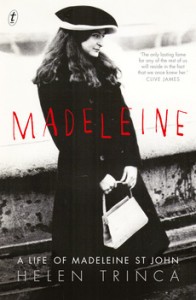
 Earlier this year, I enjoyed The Women in Black, Madeleine St John’s first novel, and became interested in learning more about this writer. I had vague memories of seeing interviews with her after she became the first Australian woman to be short-listed for the Booker Prize, for her third novel, The Essence of the Thing. She insisted at the time that she wasn’t Australian at all, she disparaged the existence of literary prizes and she claimed to loathe every second of this Booker-related publicity, and I remember thinking she was protesting a tad too much. And now, having just read Helen Trinca’s biography of the novelist, I’ve learned that, in fact, Madeleine St John was absolutely thrilled at all the attention. It was the highlight of her life – a life that, according to this biography, was desperately sad and bitter. She had a troubled relationship with her cold, autocratic father, the Australian politician Ted St John, and her alcoholic mother killed herself when Madeleine was twelve years old. This seems to have led to a lifelong state of insecurity. Her biographer notes,
“Over and over, she would draw people in with her loving charm, intelligence, creativity and high values. But before long, she would create a crisis or an argument, driving away friends who were left bewildered by her behaviour. Then, after a break, a card or phone call would signal a desire to resume relations. All her life, Madeleine made sure she rejected others before they could abandon her, then hauled them back on her terms.”
while her younger sister, Colette, said,
“She just had this talent for alienating people and it didn’t matter what you did. That’s what she did with relationships, she was terrified of intimacy.”
She struggled with depression most of her life, trying various forms of psychotherapy, medication and religion in an attempt to relieve the anguish, then died alone, aged sixty-four, of lung disease. It must be said that there isn’t much evidence of Madeleine’s “loving charm” in this biography, but the charm must have existed, otherwise why else would so many intelligent, creative and successful people have wanted to be her friend in the first place?1 Yet she was a terrible snob, keeping a copy of Debrett’s on her bedside table and constantly reminding people that her family was in it (her father was distantly related to Baron St John of Bletso). Perhaps that’s why she was so good at describing people in her novels – she’d spent so long observing other people’s language and manners in order to determine their ‘true’ position in society and work out whether they were worthy of her attention. And perhaps her “high values” help to explain why her first novel wasn’t published till she was in her fifties – perhaps she felt that none of her fiction was good enough to show anyone else until then.2 Michelle de Kretser gave this biography a lukewarm review in The Sydney Morning Herald, saying it was “carefully researched” but not “a work of literature”, and anyway, Madeleine St John was only a “minor writer”3, but I found it fascinating.
 However, I think Madeleine St John’s novels are even better, and I especially recommend A Pure Clear Light, her second novel. Ostensibly, it’s the story of a pair of middle-class Londoners (complete with three beautiful children, a Volvo and summers spent in France) whose marriage starts to unravel when the husband begins an affair, but it’s actually a chance for the author to poke fun at some very shallow, hypocritical people. Simon, the adulterous husband, is particularly awful, disparaging his wife’s forty-something unmarried friend who’s “missed the bus” (“loose-cogging around the scene, just getting in the way – it’s embarrassing . . . she’s just so pointless”), all the while relishing his mistress’s “autonomy” (naturally, he has fits of jealousy if she mentions any of her male friends). He’s also horrified when his wife turns to her local church for consolation, because he thought he’d successfully “talked her out of” Roman Catholicism (“having itemised the horrid ingredients of that scarlet brew – moral blackmail, misogyny, cannibalism and the rest”). Flora, his wife, is a little too good to be true – running her own business, managing the children (even her friend’s children) with good humour and good sense, and being endlessly supportive of her horrible husband – but it does make the reader care about what happens to her, and I found the novel’s conclusion to be both clever and plausible.
I also liked The Essence of the Thing, involving two characters who play minor roles in A Pure Clear Light. Again, an apparently solid relationship is revealed to have deep cracks, and this time, it breaks apart. Nicola simply can’t understand how Jonathan could abandon her so callously, but he’s such an inarticulate, repressed character that the reader can’t help thinking she’s much better off without him. In fact, I can’t understand why any of the women in Madeleine St John’s novels put up with their respective men, but their situations do provide lots of opportunity for thoughtful and often hilarious commentary on love, sex, marriage and modern life. This novel’s plot was a little too predictable and the lessons a little too obvious, but it’s still an enjoyable read. I haven’t read Madeleine St John’s final novel, A Stairway to Paradise, but it’s on my To Read list. I’m so glad I came across this writer. Even if some people regard her as “minor”.
_____
- Among her friends and advocates were Bruce Beresford and Clive James, who were her contemporaries at the University of Sydney in the early 1960s. ↩
- She worked for decades on a biography of Madame Blavatsky, the founder of the Theosophical Society, but destroyed the manuscript after it was rejected by a publisher. ↩
- What are the criteria that differentiate a “minor” from a “major” writer? Is a “minor” novel by a “major” writer superior to a “major” novel by a “minor” writer? And is Michelle de Kretser a “minor” or a “major” writer? Enquiring minds want to know. ↩
 Luckily, these readers don’t have to rely on librarians for recommendations, because there are a number of blogs and websites that review and recommend books based on such criteria. The most well-organised and thorough site seems to be