Bookshelf Neighbours

I loved this article1 by Geraldine Brooks about her method for shelving her books, which even she admitted was “eccentric”:

“I start out conventionally enough, alpha by author. But while I take account of the first letter of the writer’s surname, I have other ambitions for my shelves that transcend the conveniences of mere alphabetical accuracy. It’s impossible for me to place one book alongside another without thinking about the authors, and how they would feel about their spine-side companion.

I arrange my shelves as I would seat guests at a dinner party. Anne Tyler and Anthony Trollope both seem devoted to a diligent scrutiny of manners. So I imagine them, shelved side by side, comparing notes on the mores of their respective eras . . .”

This sent me off to examine my own bookshelves. As organised as I am in many other aspects of my life, I have never attempted to shelve my books alphabetically, or by any other method recognised by librarians. I do tend to arrange books about similar topics in the same general area. For example, here is part of my ‘Indian fiction’ section, containing Rohinton Mistry, Anita Desai, Ruth Prawer Jhabvala, Rumer Godden (well, her biography) and Meera Syal, with Hanif Kureishi and Salman Rushdie lurking just out of sight:

Bookshelf One

(Mind you, Vikram Seth and the remainder of my Ruth Prawer Jhabvala collection sit on various shelves below this. I have no idea why.) I also have a ‘YA fiction’ section, a ‘dictionaries and other reference books’ section and two shelves of 1930s and World War Two books. I also try to shelve books by the same author together:

Bookshelf Two

Oh, I seem to own a lot of Anne Tyler’s books. I’m not sure how she’d fare if seated next to Nancy Mitford at a dinner party (Nancy was not very fond of Americans), but perhaps Elizabeth Jane Howard, on the other side, could draw Nancy into a discussion about Paris fashions. I’d be more interested in eavesdropping on a dinner conversation between these three women:

Bookshelf Three

Especially if they were talking about writing historical fiction. I also have Germaine Greer sitting next to Gloria Steinem, and Stella Gibbons beside Mary Renault.

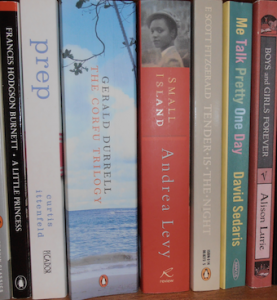
But the rationale for the shelving of other books may be less obvious. For example, what do Frances Hodgson Burnett, Curtis Sittenfeld, Gerald Durrell, Andrea Levy, F. Scott Fitzgerald, David Sedaris and Alison Lurie have in common?

Bookshelf Four

They’ve written books that are the same height, of course!

_____

  1. Thanks to Bookshelves of Doom for the link.

Why I Love Alice

'Alice's Adventures in Wonderland' by Lewis Carroll (The Alice who has Adventures in Wonderland, that is.) I’ve written a blog post about why I love Alice here to celebrate the release of the new Vintage Classics edition of this utterly brilliant book.

A confession: As much as I love Alice’s Adventures in Wonderland, my favourite Alice book is actually Through the Looking Glass. (The Red Queen! Humpty Dumpty! Jabberwocky! The White Knight! The Anglo-Saxon Messenger with his Anglo-Saxon attitudes and his bag of ham sandwiches and hay!) But sadly, there isn’t a Vintage Children’s Classics edition of Through the Looking Glass.

Extra note: if you know any artistic Australian students in Years Three to Six, you might like to draw their attention to this competition being run by Random House. Students are asked to choose their favourite title from the Vintage Children’s Classics collection, then send in a design for their own cover, with big book prizes for them and for their school. Entries close on the 1st of October. (If I were entering, I probably wouldn’t choose Black Beauty or The Wish Pony, because horses are really hard to draw. I would probably choose Treasure Island, because I like drawing pirates and parrots. Or maybe A Brief History of Montmaray, because it has pirates and puffins.)

A. A. Milne On Writing

“Writing, let us confess it unashamed, is fun. There are those who will tell you that it is an inspiration, they sing but as the linnet sings; there are others, in revolt against such priggishness, who will tell you it is a business like any other. Others, again, will assure you (heroically) that it is an agony, and they would sooner break stones – as well they might. But though there is something of inspiration in it, something of business, something, at times, of agony, yet, in the main, writing is just thrill; the thrill of exploring. The more difficult the country, the more untraversed by the writer, the greater (to me, anyhow) the thrill.”1

Of course, writing tends to be more of a thrill when the writer has a history of critical and commercial success, and knows his next work is eagerly awaited:

“He had always written what he wanted to write. His luck was that this was also what the public wanted to read.”2

A. A. Milne didn’t simply enjoy writing; he also believed writing (and writers) were of great value to society, and sometimes had the need to remind others of this:

“Authors have never been taken very seriously by their fellow-men. ‘A singer is a singer,’ the attitude seems to be, ‘a painter is a painter, and a sculptor sculpts; but dash it all, a writer only writes, which is a thing we all do every day of our lives, and the only difference between ourselves and Thomas Hardy is that Hardy doesn’t do anything else, whereas we are busy men with a job of real work to do.’ And since writing is, in a sense, the hobby, or at least the spare-time occupation of the whole world, it has become natural for the layman to regard the professional author as also engaged merely upon a hobby, the results of which, in accordance with the well-known vanity of the hobbyist, are free for the inspection of anyone kindly enough to take an interest in them.

For instance, you who read this would not think of asking a wine merchant, whose nephew had been at the same school as your son, for a free dozen of champagne on the strength of that slight connection; but you would not hesitate to ask an author, similarly connected, for a free article for some ephemeral publication in which you were interested, or for permission to perform his play without the usual payment of royalty. Indeed, you would feel that you would be paying him the same sort of compliment that I should be paying you if, dining at your house, I asked to see the fretwork soap-dish in your bathroom. ‘Oh, are you really interested?’ you would say. ‘Fancy your having heard about it. How awfully nice of you!”

This was after yet another of his tussles with the BBC, which paid nominal or no fees to authors when their works were broadcast, and took, according to him, the following attitude:

“If we pay you a fee, we won’t mention your name or your works or your publishers or anything about you, but if you will let us do it for nothing we will announce to our thousand million book-buying listeners where your book is to be bought. And if you don’t like it, you can leave it, because there are plenty of other authors about; and, if it came to the worst, we could write the things ourselves quite easily.”3

'A.A. Milne: His Life' by Ann ThwaiteWhat would Mr Milne have made of the internet?

All the above quotes are from Ann Thwaite’s excellent biography of A. A. Milne, who was the author of Winnie-the-Pooh, When We Were Very Young, Peace with Honour and dozens of poems, articles, essays, plays and short stories.

_____

  1. A. A. Milne, quoted in The Path Through the Trees by Christopher Milne, 1979
  2. The Enchanted Places by Christopher Milne, 1974
  3. Evening News article, reprinted in The Author, April, 1926

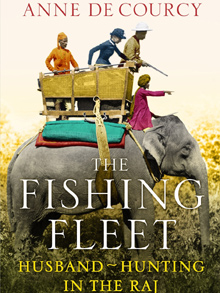
The Fishing Fleet: Husband-Hunting in the Raj by Anne de Courcy

'The Fishing Fleet' by Anne de CourcyI’ve enjoyed Anne de Courcy’s previous social histories and biographies, so when I saw her latest book was about India, I was keen to read it. As usual, her subject is posh English people, circa 1850 – 1950, but this time she has focussed on the young English women who sailed to India to find themselves husbands. The first such ‘Fishing Fleet’ arrived in Bombay in 1671, the women having been paid generous allowances by the East India Company. However, by the middle of the nineteenth century, there was no need to provide incentives to prospective brides. The only respectable career for a Victorian ‘gentlewoman’ was that of wife and mother, but there were far more unmarried women than eligible bachelors in England. Women who were neither rich nor pretty enough to snare a husband knew they’d have a much better chance in India, where white men outnumbered white women by four to one and were forbidden (by their terms of employment and social custom) from marrying females with any tinge of ‘native blood’.

Anne de Courcy uses memoirs, letters, diaries and interviews to provide fascinating details of these ‘husband-hunters’. First, there was the arduous sailing trip (all the way around Africa before the Suez Canal opened in 1869), the poor women having to contend with cramped living space, sea sickness, limited fresh food and other inconveniences:

“Fresh water for washing clothes was in such short supply that many women who knew they were going to travel saved their most worn underwear and then discarded it overboard on the voyage, leaving, one imagines, a trail of dirty, threadbare nightdresses across the Indian Ocean.”

Arriving in Bombay or Calcutta, the young woman was often overwhelmed by the heat, the dust, the smells, the “teeming mass of people”. She was then flung into India’s version of ‘the Season’, attending (depending on her social rank) Viceregal balls and banquets, dinner parties, tea dances, picnics, tennis parties and tiger-hunts. Couples often became engaged after only one or two brief meetings, the men desperate for companionship after years of celibacy, the women anxious to avoid the mortification of being sent home as a ‘Returned Empty’ (that is, a failed husband-hunter). Most military and Indian Civil Service men weren’t permitted to marry until they were at least thirty, which meant bridegrooms were often several decades older than their teenage brides and could be unwilling or unable to change their bachelor lifestyles. One beautiful and cosseted young woman, who wed in 1932, found herself living on a remote tea plantation, miles from her nearest white neighbour, with no transportation, no electricity and nothing to do. Her much older husband spent all his time working or hunting with his hounds and horses and forgot her twenty-first birthday, and her child was delivered by the local vet because there was no doctor available. Still, “Sheila was a true daughter of the Raj, brave and uncomplaining” and later told her daughter that she always dressed in an evening gown for dinner because “it was felt that one must keep up standards and not let oneself go native.”

Actually, Sheila had it relatively easy. Other women were shot at by mutinous ‘natives’, while some were caught in avalanches and earthquakes. Women died of cholera, smallpox, malaria and even bubonic plague. Infants were particularly vulnerable to diseases, and those who survived were routinely sent off to boarding school in England from the age of six, so their mothers had the agonising choice of being separated for years at a time from either their husband or their small children. And then there was the wildlife – panthers that snatched pet dogs from gardens and golf courses, snakes that slithered up through drainage holes into bathrooms, scorpions hidden in shoes, rats under the bed and monkeys that stole silver spoons from the table. One young woman awoke to find a civet cat drinking from her bedside glass of milk.

What I found most interesting was how British India was far more patriarchal and snobbish than Britain itself. By the twentieth century, it was possible for a working-class man with a great deal of intelligence, talent and luck to rise as high as Prime Minister, and for a well-born woman to become a Member of Parliament. This was impossible in India, where women had no status at all and “the hierarchy of the Raj position was fixed, according to service, rank and seniority in an unalterable grading . . . within which there was room for petty nuances that could be painful and damaging.”

Everyone was obsessed with their own and everyone else’s social precedence, and in a small society where nothing was private, it was thought essential to ‘keep up with the Joneses’. Those who could barely afford it still kept polo ponies, paid expensive subscriptions to clubs and held elaborate dinner parties, and there was little tolerance for those regarded as ‘intellectuals’.

The stories in this book are mostly of upper-class British women, rather than, say, the women who went to India as teachers, nurses and missionaries. There are also few mentions of Indians, apart from some anonymous, silent servants and the Maharajah of Patiala, who married Miss Florence Bryan in 18931. The author clearly feels that Britain’s colonisation of India was a very good thing – after all, most of the Indian rulers prior to colonisation were cruel despots (true, but so were the rulers of most countries in the eighteenth century) and the British “left India, after independence, with an enviable infrastructure, a democratic Government and a common language”. (The book makes only passing mention of the terrible famines that resulted from the British forcing Indian farmers to grow jute and cotton, rather than food2, and of the violent suppression of pro-independence Indians3.)

'Heat and Dust' by Ruth Prawer JhabvalaDespite these reservations, the book is recommended for those interested in reading about British women’s experiences in India. But I think novels can be just as useful for this purpose, so here are some of my favourites:

Heat and Dust by Ruth Prawer Jhabvala
A Passage to India by E. M. Forster
The Jewel in the Crown and other novels in the Raj Quartet by Paul Scott
Black Narcissus by Rumer Godden4
Coromandel Sea Change by Rumer Godden
(Actually, read all of Rumer Godden’s India books, because she’s brilliant. Anne Chisholm also wrote an excellent biography, Rumer Godden: A Storyteller’s Life.)
– And for a slightly different look at Europeans in India, there’s also Baumgartner’s Bombay by Anita Desai.

_____

  1. It was a “brief and unhappy” marriage. She was shunned by both Indians and Europeans, her infant son was poisoned, and she died of pneumonia three years later.
  2. Up to ten million Indians died in the famine of 1876-8, and a similar number in 1899-1900.
  3. For example, hundreds died at Amritsar in 1919, when British troops fired on unarmed protesters.
  4. Black Narcissus was made into a hilariously bad film in 1947. In one memorable scene, the mad nun flees through a Himalayan ‘jungle’ inhabited by kookaburras.

Saffy’s Angel by Hilary McKay

'Saffy's Angel' by Hilary McKayI absolutely loved this book. I’d order you all to read it, except most of you probably have 1. For those who haven’t, Saffy’s Angel is a clever, funny, touching story about the Casson family. The parental figures are all either vague, absent or dead, but fortunately, the children are resourceful and clever. The eldest, Caddy, is beautiful, kind and not nearly as dim as she first appears. When she’s not looking after the younger children, she’s tending to her guinea pigs (“occasionally they escaped and flocked and multiplied over the lawn like wildebeest on the African plains”) or having driving lessons. She has had ninety-six lessons and still can’t reverse or turn right (coincidentally, she’s in love with her gorgeous driving instructor). Indigo, the only boy, is gentle, sensitive and caring2, and keeps himself busy “curing himself of vertigo for when he becomes a polar explorer”. Rose, the youngest, is artistic, determined and very good at managing (or manipulating) their parents. Then there’s Saffy, who discovers that she’s adopted and refuses to believe the others when they insist she really is a Casson. With the help of her best friend, Wheelchair Girl, Saffy sets out to find the stone angel that her beloved grandfather bequeathed to her and she discovers just how much she means to her family.

I was filled with admiration for how well Hilary McKay told this story. The story’s structure, the pacing, the voice of the narrator – all worked brilliantly, in my opinion. The Cassons were quirky and entertaining, but never irritating or implausible3. Saffy’s search for her lost angel was moving, but never tipped over into soppy sentimentality. And I loved that Wheelchair Girl was neither a victim nor a saint, but a flawed, fiercely independent girl who’d learned to turn everyone else’s pity around to her own (Machiavellian) advantage.

Above all, this book was very, very funny. There was one part where I was laughing so hard that I was crying, and had to keep putting down the book to wipe my eyes so I could see 4. I am very happy that there are five more books about the Cassons, as well as another two series by the author, The Exiles and Porridge Hall.

_____

  1. as it was published more than a decade ago, and is quite well-known, and also won the 2002 Whitbread Children’s Book Award
  2. I love Indigo. He’s my favourite.
  3. Okay, I got irritated at Bill, the father, quite a lot, but he was meant to be annoying, and he was probably the most realistic character in the book. I know some men who are just like him.
  4. For those who’ve read the book, it’s the bit where Caddy takes them on a long car journey, and Indigo, who has “photographic ears”, is doing impressions of Michael (“Don’t call me darling, I’m a driving instructor”), while Rose holds up helpful signs for the other motorists, warning them about Caddy’s driving skills:
    THERE WAS A FOX
    SQUASHED FLAT
    POOR FOX
    SHE IS CRYING
    SO YOU HAD BETTER NOT
    TRY PASSING US YET
    I WILL TELL YOU WHEN IT IS SAFE
    IT WILL BE ALL RIGHT NOW
    HELLO
    WE ARE GOING TO WALES