
The Book Smugglers kindly invited me to write a guest post about my favourite books and TV of 2012. My chosen favourites won’t come as any surprise to regular readers of this blog, but you can read my post here. The Book Smugglers are also giving away a copy of the Vintage Classics edition of A Brief History of Montmaray, with entries closing on January 13, 2013.
Category: film and tv
Montmaray Book Giveaway
Jean BookNerd is giving away a hardcover edition of The FitzOsbornes at War this month. There’s an interview with me at her blog, too.
In more exciting news, Series Four of Horrible Histories has just been released on DVD! Ooh, I know what I’m getting myself for Christmas . . .
The RAF Pilots’ Song, Plus Some WWII Girl Power
Did you know that, during the Second World War, some of the brave fighter pilots of the Royal Air Force formed their own boy band? And, when not shooting down Luftwaffe bombers, would dance in front of their Spitfires, singing harmonies about, among other things, Douglas Bader’s legs (“They’re not real”)? No, neither did I!1 But I think Toby FitzOsborne would approve. Take that, Hitler!
And let’s not forget the contributions made by British women during the war. If you think they were all stuck in the kitchen, you haven’t seen this! Or read The FitzOsbornes at War, which is all about girls being awesome in wartime, and is published in North America next month, and looks like this:

_____
- Thank you to Kate Constable, whose informative and entertaining blog post alerted me to the fact that the Horrible Histories books have now been turned into a TV series. I had no idea! I would have left a comment on her blog post as well, but Blogspot doesn’t like me and refuses to accept my comments. ↩
The Fishing Fleet: Husband-Hunting in the Raj by Anne de Courcy
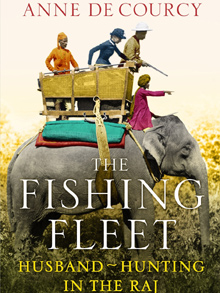 I’ve enjoyed Anne de Courcy’s previous social histories and biographies, so when I saw her latest book was about India, I was keen to read it. As usual, her subject is posh English people, circa 1850 – 1950, but this time she has focussed on the young English women who sailed to India to find themselves husbands. The first such ‘Fishing Fleet’ arrived in Bombay in 1671, the women having been paid generous allowances by the East India Company. However, by the middle of the nineteenth century, there was no need to provide incentives to prospective brides. The only respectable career for a Victorian ‘gentlewoman’ was that of wife and mother, but there were far more unmarried women than eligible bachelors in England. Women who were neither rich nor pretty enough to snare a husband knew they’d have a much better chance in India, where white men outnumbered white women by four to one and were forbidden (by their terms of employment and social custom) from marrying females with any tinge of ‘native blood’.
Anne de Courcy uses memoirs, letters, diaries and interviews to provide fascinating details of these ‘husband-hunters’. First, there was the arduous sailing trip (all the way around Africa before the Suez Canal opened in 1869), the poor women having to contend with cramped living space, sea sickness, limited fresh food and other inconveniences:
“Fresh water for washing clothes was in such short supply that many women who knew they were going to travel saved their most worn underwear and then discarded it overboard on the voyage, leaving, one imagines, a trail of dirty, threadbare nightdresses across the Indian Ocean.”
Arriving in Bombay or Calcutta, the young woman was often overwhelmed by the heat, the dust, the smells, the “teeming mass of people”. She was then flung into India’s version of ‘the Season’, attending (depending on her social rank) Viceregal balls and banquets, dinner parties, tea dances, picnics, tennis parties and tiger-hunts. Couples often became engaged after only one or two brief meetings, the men desperate for companionship after years of celibacy, the women anxious to avoid the mortification of being sent home as a ‘Returned Empty’ (that is, a failed husband-hunter). Most military and Indian Civil Service men weren’t permitted to marry until they were at least thirty, which meant bridegrooms were often several decades older than their teenage brides and could be unwilling or unable to change their bachelor lifestyles. One beautiful and cosseted young woman, who wed in 1932, found herself living on a remote tea plantation, miles from her nearest white neighbour, with no transportation, no electricity and nothing to do. Her much older husband spent all his time working or hunting with his hounds and horses and forgot her twenty-first birthday, and her child was delivered by the local vet because there was no doctor available. Still, “Sheila was a true daughter of the Raj, brave and uncomplaining” and later told her daughter that she always dressed in an evening gown for dinner because “it was felt that one must keep up standards and not let oneself go native.”
Actually, Sheila had it relatively easy. Other women were shot at by mutinous ‘natives’, while some were caught in avalanches and earthquakes. Women died of cholera, smallpox, malaria and even bubonic plague. Infants were particularly vulnerable to diseases, and those who survived were routinely sent off to boarding school in England from the age of six, so their mothers had the agonising choice of being separated for years at a time from either their husband or their small children. And then there was the wildlife – panthers that snatched pet dogs from gardens and golf courses, snakes that slithered up through drainage holes into bathrooms, scorpions hidden in shoes, rats under the bed and monkeys that stole silver spoons from the table. One young woman awoke to find a civet cat drinking from her bedside glass of milk.
What I found most interesting was how British India was far more patriarchal and snobbish than Britain itself. By the twentieth century, it was possible for a working-class man with a great deal of intelligence, talent and luck to rise as high as Prime Minister, and for a well-born woman to become a Member of Parliament. This was impossible in India, where women had no status at all and “the hierarchy of the Raj position was fixed, according to service, rank and seniority in an unalterable grading . . . within which there was room for petty nuances that could be painful and damaging.”
Everyone was obsessed with their own and everyone else’s social precedence, and in a small society where nothing was private, it was thought essential to ‘keep up with the Joneses’. Those who could barely afford it still kept polo ponies, paid expensive subscriptions to clubs and held elaborate dinner parties, and there was little tolerance for those regarded as ‘intellectuals’.
The stories in this book are mostly of upper-class British women, rather than, say, the women who went to India as teachers, nurses and missionaries. There are also few mentions of Indians, apart from some anonymous, silent servants and the Maharajah of Patiala, who married Miss Florence Bryan in 18931. The author clearly feels that Britain’s colonisation of India was a very good thing – after all, most of the Indian rulers prior to colonisation were cruel despots (true, but so were the rulers of most countries in the eighteenth century) and the British “left India, after independence, with an enviable infrastructure, a democratic Government and a common language”. (The book makes only passing mention of the terrible famines that resulted from the British forcing Indian farmers to grow jute and cotton, rather than food2, and of the violent suppression of pro-independence Indians3.)
 Despite these reservations, the book is recommended for those interested in reading about British women’s experiences in India. But I think novels can be just as useful for this purpose, so here are some of my favourites:
– Heat and Dust by Ruth Prawer Jhabvala
– A Passage to India by E. M. Forster
– The Jewel in the Crown and other novels in the Raj Quartet by Paul Scott
– Black Narcissus by Rumer Godden4
– Coromandel Sea Change by Rumer Godden
(Actually, read all of Rumer Godden’s India books, because she’s brilliant. Anne Chisholm also wrote an excellent biography, Rumer Godden: A Storyteller’s Life.)
– And for a slightly different look at Europeans in India, there’s also Baumgartner’s Bombay by Anita Desai.
_____
- It was a “brief and unhappy” marriage. She was shunned by both Indians and Europeans, her infant son was poisoned, and she died of pneumonia three years later. ↩
- Up to ten million Indians died in the famine of 1876-8, and a similar number in 1899-1900. ↩
- For example, hundreds died at Amritsar in 1919, when British troops fired on unarmed protesters. ↩
- Black Narcissus was made into a hilariously bad film in 1947. In one memorable scene, the mad nun flees through a Himalayan ‘jungle’ inhabited by kookaburras. ↩
Vintage Classics Book Giveaway

A Brief History of Montmaray is being re-published as a Vintage Classic Children’s book next month. This new edition has a lovely illustrated cover by Samantha Battersby and features the original illustrated introduction page by Zoë Sadokierski:

And there are some added extras – historical background information, reading group discussion questions and information about some of Sophie’s own favourite classics. It goes on sale in Australia and New Zealand on the first of August, but I’m also giving away three copies here. For all those North American readers who were curious about the original text of A Brief History of Montmaray before it was edited for American readers – here it is! And for Australian and New Zealand readers who already have the Australian edition – um . . . oh look, pretty cover! And cute sketches of puffins and teapots and cats inside the covers! (Note: if an Australian or New Zealander wins a book and would actually prefer a copy of the North American paperback, I’ll send them that instead.)
Usually, when I hold a book giveaway on my blog, I ask people for book recommendations, but I thought I’d do something a bit different this time. To enter this book giveaway, leave a comment below about your favourite film (or television series) adapted from a book you’ve loved. I’ll start you off with some of my favourites.
1. Brideshead Revisited, 1981 television series. One of those rare examples of a television series being better than the book, in my opinion. All those pompous sermons in the final section of the novel were turned into poignant monologues or the sort of dialogue that real people might actually speak. Special mention must go to Jeremy Irons for transforming snobby, wife-abandoning Charles into a sympathetic character. And the bear who played Aloysius did a pretty good job, too. (Let’s just ignore that 2008 film version, shall we?)
2. Cold Comfort Farm, 1995 film. This has a dream cast – Ian McKellen, Eileen Atkins, Miriam Margolyes, Rufus Sewell (in unbuttoned shirt), Stephen Fry, Joanna Lumley and Kate Beckinsale. The film’s almost as funny as the book, and that’s high praise.
3. Harry Potter and the Goblet of Fire, 2005 film. I think this was my favourite Harry Potter film. The Yule Ball! Draco as a ferret! Hedges that eat people! A Voldemort who was even scarier than in the book! (They shouldn’t have killed the dragon, though – that was just mean.)
4. The Hitch Hiker’s Guide to the Galaxy, 1981 television series. Admittedly, it’s been a long time since I watched it and I’m sure today’s teenagers would scoff at the low-tech special effects, but I really loved this series. It probably helped that quite a few of the cast members had been part of the original radio series, but I can’t imagine a better Arthur Dent than Simon Jones. (And no, I haven’t seen the 2005 film version.)
5. Careful, He Might Hear You, 1983 film. A lovely film with a stellar Australian cast (including Robyn Nevin, Wendy Hughes and Geraldine Turner), based on Sumner Locke Elliott’s beloved novel.
So, what is your favourite film or television series, adapted from a book you’ve loved? Comment below for a chance to win one of three signed copies of the new Vintage Classics edition of A Brief History of Montmaray.
Conditions of entry:
1. This is an international giveaway. Anyone can enter.
2. Make sure the e-mail address you enter on the comment form is a valid one, so I can contact you if you win (no one will be able to see your e-mail address except me, and I won’t show it to anyone else). Please don’t include your real residential or postal address anywhere in the comment. However, it would be nice if you mentioned which country you live in, because I’m curious about who reads this blog.
3. The three winners will be chosen at random, unless there are three or fewer comments – in which case, it won’t be random and all will win prizes.
4. This contest and/or promotion is not sponsored or authorised by Random House Australia. Random House Australia bears no legal liability in connection with this contest and/or promotion. (My Australian publishers say I have to put this bit in. This is the first time I’ve ever given away any of my Australian books on my blog.)
5. Entries close on the 1st of August, 2012, when the Vintage Classics edition of A Brief History of Montmaray goes on sale in Australia. The winners will be e-mailed then, and I will send off the winners’ books as soon as possible after that.
Note: This book giveaway is now closed. Click here to see the names of the lucky book winners.