What I’ve Been Reading

'The Death of Lucy Kyte' by Nicola Upson I liked The Death of Lucy Kyte by Nicola Upson, a murder mystery set in the 1930s, featuring a fictional version of the real-life mystery writer, Josephine Tey, as well as several other famous people (for instance, Dodie Smith and Wallis Simpson both make brief appearances). In this book, the fifth in a series, Josephine has to unravel the mystery of her godmother’s death and strange bequest. Could this possibly be linked to the famous, real-life murder of Maria Marten, a local servant girl who’d died a hundred years before? Well, yes, of course it is, but it also ends up being far more complicated and terrifying than I’d expected (admittedly, I am easily spooked). The story reminded me quite a lot of The Little Stranger by Sarah Waters, although I think The Death of Lucy Kyte was more successful at handling the ‘supernatural’ elements of the plot (which may or may not be truly supernatural). I don’t read a lot of murder mysteries, because they so often use violent death as a mere plot device, without much acknowledgement of the terrible suffering it causes to the people who knew the victim. However, in this book, each of the characters was a plausibly complicated person, each violent incident had tragic repercussions, and there was nothing neat or painless about the conclusion. I hadn’t read the previous books in the series and this one worked well as a stand-alone novel, although I did become curious about the background of Josephine’s lover (who presumably is the subject of one of the earlier books). I believe the first book is called An Expert in Murder and it’s now on my To Read list.

Dogsbody by Dianna Wynne Jones was a clever and charming children’s book about Sirius the Dog Star, who is wrongfully accused of murder and sentenced to live in the body of a dog on Earth. I am not very interested in mythology or astronomy (or fantasy), but I loved the descriptions of Sirius’s doggy life and particularly his interactions with the other animals he encountered. Sirius is taken in by Kathleen, a young Irish girl with her own problems, and I liked the way the author didn’t hold back from showing that truly awful things can happen to children – but also that children can be brave and resilient and that hope can be found in unexpected places.

'Goodbye to Berlin' by Christopher IsherwoodGoodbye to Berlin by Christopher Isherwood was a fascinating look at Germany in the early 1930s. The author insists in his introduction that it’s not “purely autobiographical”, but given the narrator is a young Englishman called ‘Christopher Isherwood’ who is living and working in Berlin at the same time that the author did, I think it’s fair to say it’s a reasonably accurate portrayal of his real experiences. Christopher drifts about Berlin, giving English lessons, hanging out in coffee shops and seedy bars and meeting a lot of interesting people. These include Sally Bowles, only nineteen and hopelessly naïve and romantic, even if she does refer to herself as an “old whore”; Peter, an Englishman besotted with a working-class boy called Otto; Otto’s impoverished family, living in a decrepit attic; and the Landauers, a wealthy Jewish family who own a department store. At first Christopher seems quite detached (“I am a camera with its shutter open, recording, not thinking . . .”), but he becomes closer to the people he’s observing, even when he disapproves of them and despairs for their future (“these people could be made to believe in anybody or anything”). He shows clearly how poverty and despair created by high unemployment and the collapse of the banking system after the First World War made it easy for Hitler to rise to power. The film Cabaret is based on the Sally Bowles section of Goodbye to Berlin, but the film doesn’t have a lot in common with the book. Both are interesting, though, in their different ways.

Old Filth wasn’t as immediately warm and engaging as most of Jane Gardam’s novels, perhaps because it was about a snobby, emotionally-repressed old Englishman. However, the story of how Edward came to be that way was engrossing and involved a variety of interesting settings. Edward spends his early years in a remote Malayan village before being sent to an abusive foster home in Wales, then on to several English boarding schools, whereupon war breaks out and he finds himself on an evacuee ship . . . and he hasn’t even made it to adulthood yet. The plot is very clever, moving back and forth in time to reveal information at exactly the right pace, with characters reappearing at strategic points (although occasionally in a way that strains credibility). It was fascinating to watch the decline of the British Empire through the eyes of a ‘Raj orphan’ who ended up a judge in Hong Kong before retiring to an England that was no longer Home. I believe there are several books about the same set of characters, and I’d be especially interested to read more about Edward’s wife Betty, who seemed to have led a very busy life (even if Edward was unaware of most of it).
'Bad Science' by Ben GoldacreFinally, some non-fiction. Bad Science by Ben Goldacre takes aim at the pharmaceutical companies, vitamin pill manufacturers, homeopaths, nutritionists, politicians and journalists who ignore scientific evidence in their quest to make money or become famous. Some of his examples will probably make more sense to UK readers (for example, he devotes a chapter each to Gillian McKeith and Patrick Holford, apparently famous in the UK although I’d never heard of them), but there are also good general discussions about statistics, the placebo effect and how to analyse a scientific research paper. If you’re familiar with Dr Goldacre’s website or you read a lot of sceptic-based blogs, there won’t be a lot here that’s new to you, but I still found this to be an entertaining and interesting summary of some major issues in modern medical science (or at least, how medical science is reported in newspapers, magazines and on television).

My Holiday Reading

I wasn’t supposed to be doing any holiday reading – I was meant to be finishing writing a book – but there’s just something about the week between Christmas Day and New Year’s Day in Australia that forces you to lie about in a hammock, eating grapes and reading novels (and by ‘you’, I mean ‘me’). They were pretty good novels, though, and I guess I could argue that, as a writer, reading novels is an essential part of developing my professional skills. See, I wasn’t lazing about, I was working. Anyway, here’s what I read:

'All Change' by Elizabeth Jane HowardAll Change by Elizabeth Jane Howard was the fifth and final volume of the Cazalet Chronicles, a family saga set around the time of the Second World War. Although I’ve enjoyed this series very much, the fourth volume was the least compelling and I wasn’t sure a fifth novel was really necessary. It seemed to me as though the Cazalets had finally sorted out their lives for good – but no, in this book, everything falls apart, just as it did for a lot of wealthy English families in that post-war decade of upheaval. In All Change, bankruptcy looms for the Cazalets, although I must admit it was hard for me to feel much sympathy for them. The brothers have inherited a thriving timber business and numerous valuable properties from their father, but are too stubborn to accept business advice from their social inferiors (Hugh), too extravagant (Edward) or too indecisive (Rupert) to manage it effectively. Meanwhile, the women succumb to depression, dementia and terminal illnesses, have unhappy affairs and are exhausted by the demands of their badly-behaved children. There’s a whole new generation of characters that had me constantly referring to the family tree in the front of the book and there were quite a few continuity errors (for instance, Simon is described as having a dead twin, when that’s actually Will, who is mostly absent from this book). But I didn’t care! I devoured all six hundred pages in two days, thoroughly engrossed in the Cazalets’ story and sad that this was truly the end, as Elizabeth Jane Howard died last week at the age of ninety. She left behind a number of excellent novels and a lot of devoted fans of her work.

I also read Journey to the River Sea by Eva Ibbotson, an excellent children’s novel about an orphaned girl sent to live in Brazil in 1910. Among the characters Maia encounters are a stalwart governess with a mysterious past, a travelling troupe of actors, a kindly scientist, a missing heir to an English estate, a Russian count and a couple of evil (but fortunately, incompetent) private investigators. As always with Eva Ibbotson’s books, the heroine is a little too good to be true (beautiful, intelligent, a talented musician, a skilled dancer, friendly and kind to all people and animals, etc), but the story and setting were fascinating and I enjoyed following Maia’s adventures.

'A Long Way From Verona' by Jane GardamHowever, my favourite holiday read would have to be A Long Way From Verona by Jane Gardam, a brilliant coming-of-age novel set during the Second World War. Jessica is a bright, imaginative, melodramatic twelve-year-old who is utterly tactless and incapable of dissembling, yet convinced that she alone is able to understand others perfectly (meanwhile, wondering why she isn’t more popular at school). She gets into trouble constantly – for handing in a forty-seven-page essay that is not actually about ‘The Best Day of the Summer Holidays’, for eating potato chips on the train in an unladylike fashion, for hiding out in the library and reading ‘unsuitable’ books such as Jude the Obscure – and her idiosyncratic observations of her world are clever and hilarious. Here, for example, is her description of a stranger’s front parlour, in which she and her friends find themselves after a prank goes wrong:

“We tiptoed over it into a fearfully clean front room with the coals arranged on the sticks like a jigsaw, and the arm-chairs made out of brown skin and never sat on, and a terrified-looking plant standing eyes right in the window, wishing it were dead.”

Jessica is told by a visiting author that she is A WRITER BEYOND ALL POSSIBLE DOUBT, and although there are moments when her self-confidence falters, she triumphs in the end. I can’t recommend this novel too highly – it’s a work of genius. And it’s the first book I read in 2014, which I think is a GOOD OMEN.

My Favourite Books of 2013

It’s not quite the end of the year, but here are the books I read in 2013 that I loved the most. But first – some statistics!

I’ve finished reading 69 books so far this year and I suspect I’ll squash another two or three novels in before New Year’s Eve. This total doesn’t include the two novels I gave up on (one because it was awful, the other because I just wasn’t in the right mood for it) or the novel I’m halfway through right now (Kangaroo by D. H. Lawrence, which deserves a blog post all of its own). So, what kind of books did I read this year?

Books read in 2013

Authors' nationality for books read in 2013

My reading this year was more culturally diverse than this pie chart would suggest – for example, I read quite a few books by writers who’d migrated from Asian countries to Australia or the UK, and I found those books really interesting. (I also read a couple of books by white writers about Aboriginal Australians and Pacific Islanders, which were less successful.)

Authors' gender for books read in 2013

This was the year of women writers, it seems.

Now for my favourites.

My favourite children’s and picture books
'Wonder' by R. J. Palacio
I really enjoyed Wonder by R. J. Palacio, even though it made me cry. Honourable mentions go to Girl’s Best Friend by Leslie Margolis, the first in a fun middle-grade series featuring Maggie Brooklyn, girl detective and dog walker, and Call Me Drog by Sue Cowing, an odd but endearing story about a boy who gets a malevolent talking puppet stuck on his hand. Picture books that entertained me this year included This Is Not My Hat by Jon Klassen, Mr Chicken Goes To Paris by Leigh Hobbs and The Oopsatoreum by Shaun Tan.

My favourite Young Adult novels

I loved Girl Defective by Simmone Howell and Two Boys Kissing by David Levithan. I was also impressed with Mary Hooper’s historical novel, Newes from the Dead (subtitled, Being a True Story of Anne Green, Hanged for Infanticide at Oxford Assizes in 1650, Restored to the World and Died Again 1665, which pretty much tells you what it’s about), although I’m not sure it was truly Young Adult, despite being published as such – some of the content seemed horrifyingly Adult to me.

My favourite novels for adults

'Lives of Girls and Women' by Alice MunroI read some great grown-up novels this year. This may have been because I abandoned my usual method of choosing novels from the library (that is, selecting them at random from the shelves based on their blurbs) and started reserving books via my library’s handy online inter-library loan system, basing my choices on reviews, award short-lists and personal recommendations. I was happy to discover the novels of Madeleine St John and I especially liked The Women in Black and A Pure, Clear Light. I also enjoyed The Body of Jonah Boyd by David Leavitt (a very clever piece of writing which included some apt and cynical reflections on the business of creative writing), The Flight of the Maidens by Jane Gardam and Mrs Dalloway by Virginia Woolf. However, my favourite novel of the year would have to be Lives of Girls and Women by Alice Munro, who was recently awarded the Nobel Prize for Literature.
My favourite non-fiction for adults

Among the memoirs I enjoyed this year were Births, Deaths, Marriages: True Tales by Georgia Blain and Growing Up Asian In Australia, edited by Alice Pung. I also liked Helen Trinca’s biography of Madeleine St John. The most interesting science-related books I read were Knowledge is Power: How Magic, the Government and an Apocalyptic Vision inspired Francis Bacon to create Modern Science by John Henry and I Wish I’d Made You Angry Earlier: Essays on Science, Scientists and Humanity by Max Perutz.

Hope you all had a good reading year and that 2014 brings you lots of great books. Happy holidays!

More favourite books:

Favourite Books of 2010
Favourite Books of 2011
Favourite Books of 2012

What I’ve Been Reading

I don’t have to do disclaimers for any of these books, because I don’t know any of the authors.

Growing Up Asian In Australia, edited by Alice Pung, was a fascinating collection of memoirs, short stories, essays and poems by a range of Asian-Australian writers, some of them famous (Shaun Tan, Tony Ayres, Cindy Pan, Benjamin Law and Kylie Kwong), some of them less well-known, but nearly all of them with interesting things to say about racism, cross-cultural communication and family life in Australia. As in any anthology, the quality of the writing was variable, but overall, I think the editor did a fine job of balancing powerful (and often depressing) pieces of writing with lighter, more entertaining, tales. I did wonder how ‘Asian’ would be defined and it turned out to mean mostly Australians of Chinese or Vietnamese descent, with a few writers whose families were from Korea or Thailand, which probably reflects the relative proportions of these ethnic groups in the Australian population. There were also a couple of Indians1 and I may have been biased towards them, but my favourite piece in the book was a short memoir by Shalini Akhil, in which she discusses her love of Wonder Woman with her Indian grandmother (“You can fight all the crime in the world, she said, but if you leave the house without putting your skirt on, no one will take you seriously”). They go on to imagine their own Indian version of Wonder Woman who “could wear a lungi over her sparkly pants, and that way if she ever needed seven yards of fabric in an emergency, she could just unwind it from her waist.” The grandmother also explains that rolling perfectly round rotis is a magic power, then cooks super-hero eggs with chilli for her granddaughter’s lunch. It was a very endearing piece of writing and now I need to track down this author’s novels.

'A Few Right Thinking Men' by Sulari GentillA Few Right Thinking Men by Sulari Gentill has been on my To Read list for a while because, hey, a novel about 1930s Fascism, set in Sydney? Yes, please! And this turned out to be meticulously researched and absolutely fascinating, so I’m glad I finally got around to reading it. It’s the first in a historical crime series starring Rowland Sinclair, a gentleman artist with some disreputable friends, who sets out to investigate the murder of his beloved uncle and finds himself entangled in the conflict between Communists, Fascists and the authorities. I knew a little bit about the New Guard due to their hijacking of the opening of the Sydney Harbour Bridge, but had no idea about their rival Fascist organisation, the Old Guard, or about how violent some of the confrontations became. It was also interesting to me to compare the Australian Fascist organisations to their British counterparts (with which I’m more familiar). While both had charismatic, upper-class leaders and were obsessed with nutty schemes, conspiracy theories and ridiculous uniforms, the New Guard forbade any female involvement, whereas women (many of them former suffragettes) were a significant part of Mosley’s British Union. I think that says something about how blokey Australia was (and is). I have to say that the writing in this novel was slightly clunky – a bit too much tell-not-show, a few too many information dumps – and I never quite worked out whether the leisurely pace of the mystery plot and the verbosity of the prose was a homage to early twentieth century literature or simply inadequate editing. However, Rowland and his friends were very appealing characters and the historical background was intriguing enough for me to consider reading more of this series.

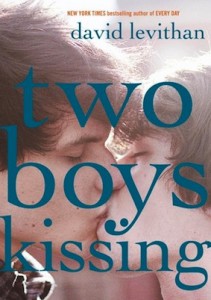
'Two Boys Kissing' by David LevithanTwo Boys Kissing by David Levithan was a novel I didn’t expect to love as much as I did. Firstly, it has a stupid premise – two boys try to break the world record of more than thirty-two hours of continuous kissing2. Secondly, it’s a YA novel narrated by a chorus of old dead people in the second person. Thirdly, as much as I admire David Levithan’s prose, none of his books will ever pass the Bechdel test. He writes exclusively about gay, white, middle-class American boys3. Sympathetic girl characters, if they exist at all, are merely support crew (literally, in this particular novel). Despite all these ominous signs, I found myself engrossed in this book and was reduced to tears at several points where the dead men talked about their lives in an earlier, less tolerant society. I’m a bit older than David Levithan, old enough to remember the early years of the AIDS epidemic, when each edition of Sydney’s gay newspaper contained pages of obituaries and every community social function was a meeting about the Quilt Project or a fund-raiser for the HIV/AIDS ward at the local hospital, and this book brought back those days vividly for me. The chorus in Two Boys Kissing is there to explain to the teenage characters how much easier life is in the twenty-first century, and while I wholeheartedly agree (life is easier for most gay teenagers now than it was twenty-five years ago), I did wonder what teenage readers might think about this. So I was interested to read Anna Ryan-Punch’s review of the book in the latest edition of Viewpoint, in which she states:

“The use of their commentary comes off as heavy-handed, mawkish, and often didactic . . . there’s a patronising sense of authority, which is likely to put many readers on the defensive: ‘They are young. They don’t understand.'”

I can see that this book might not work for all readers, but it really had an impact on me. And I do agree with Anna Ryan-Punch that this book’s cover is “a literal and lovely picture of progress”.

Finally, I decided to start reading Lives of Girls and Women the day before the author, Alice Munro, won the 2013 Nobel Prize for Literature. This is because I am psychic. Not really. She’d been on my To Read list for ages, and now I’m kicking myself for not picking up one of her books sooner because this novel was utterly brilliant and I think it would have changed my life if I’d read it as a teenager. Her writing is so lucid and honest, each sentence beautiful and full of meaning – this is Serious Literature without being pretentious or incomprehensible or self-consciously ‘literary’. I was torn between wanting to linger upon each page to savour her wisdom and racing ahead to the next chapter to find out what would happen to Del, the teenage narrator, who is growing up in rural Canada in the 1940s and 1950s. I especially liked how the author described the limitations placed on women then (often by other women, not men) and how Del could so easily be a girl of today, her sexual desires clashing with what society determines is ‘correct’ for girls. This book was a bit like Anne Tyler combined with Margaret Atwood’s autobiographical short stories and they’re two of my favourite authors, so I think I should now read everything Alice Munro has ever written.

_____

  1. Although I don’t tend to think of India as being part of Asia – to me, it’s geographically and culturally closer to the Middle East than to places like Japan and Singapore. But I’m aware most journalists, politicians and diplomats have a different viewpoint on this.
  2. I hate the whole idea of world records, but especially when it involves stretching enjoyable activities into ridiculous feats of endurance. Seriously, do something more constructive with your time and energy, people.
  3. It was nice to come across this interview with Malinda Lo, which suggests David Levithan has an awareness of this issue.

Books To Make You Laugh

A lot of Australians are currently feeling very depressed after one of the longest, most vacuous, federal election campaigns in recent memory1. What we need now are some books to make us laugh2. Here are five books that have made me laugh out loud (or at least produced embarrassing muffled snorting noises, if I happened to be reading them on public transport).

1. My Family and Other Animals by Gerald Durrell, featuring the eccentric Durrell family and the ridiculous situations they find themselves in, often caused by their various dogs, birds, snakes, scorpions and other animal companions. For example, here’s Roger the dog’s reaction to Mother’s elaborate new bathing-costume:

“He seemed to be under the impression that the bathing-costume was some sort of sea monster that had enveloped Mother and was now about to carry her out to sea. Barking wildly, he flung himself to the rescue, grabbed one of the frills dangling so plentifully round the edge of the costume and tugged with all his strength in order to pull Mother back to safety. Mother, who had just remarked that she found the water a little cold, suddenly found herself being pulled backwards. With a squeak of dismay she lost her footing and sat down heavily in two feet of water, while Roger tugged so hard that a large section of the frill gave way. Elated by the fact that the enemy appeared to be disintegrating, Roger, growling encouragement to Mother, set to work to remove the rest of the offending monster from her person . . . “

2. Saffy’s Angel by Hilary McKay, which I have previously gushed about here. The scene in which the siblings drive to Wales is especially funny.

3. Me Talk Pretty One Day by David Sedaris, and specifically, the story entitled Jesus Shaves, in which Mr Sedaris attends French classes in Paris, and his fellow students attempt to explain Easter, in their extremely limited French, to a Moroccan student:

“The Poles led the charge to the best of their ability. ‘It is,’ said one, ‘a party for the little boy of God who call his self Jesus and . . . oh, shit.’ She faltered and her fellow countryman came to her aid.

‘He call his self Jesus and then he be die one day on two . . . morsels of . . . lumber.’

The rest of the class jumped in, offering bits of information that would have given the pope an aneurysm.

‘He die one day and then he go above of my head to live with your father.’

‘He weared of himself the long hair and after he die, the first day he come back here for to say hello to the peoples.’

‘He nice, the Jesus.’ “

Unable to translate complicated phrases such as “to give of yourself your only begotten son”, they end up talking about chocolate, which is delivered, of course, by “the rabbit of Easter”. Or rather, as it turns out, the bell of Rome.

There’s also a very funny story about young David’s battles with his speech therapist (although, as a trained speech pathologist, I have to emphasise that we’re not like that at all now).

4. King Dork by Frank Portman, which I don’t have in my possession, so I can’t provide any quotes, but I remember becoming helpless with laughter over the effort the teenage boys put into their band names and album concepts. Favourite band name: We Have Eaten All The Cake. (Unfortunately they don’t put as much effort into writing songs or rehearsing, so their first big gig is a disaster. I should also point out that parts of this novel, especially the conclusion, are not funny at all, although it’s also completely plausible that the narrator and his friend would be as unconcerned about these particular issues as they are.)

5. Cold Comfort Farm by Stella Gibbons, which I have written about here, is so full of hilarity that it’s impossible to choose just one scene. The cows, named Graceless, Pointless, Feckless and Aimless? Adam clettering the dishes with his twig? The Starkadders pushing each other down the well? The Quivering Brethren’s hymn-singing being conducted by the poker-wielding Brother Ambleforth? Seth lounging in doorways, with his shirt unbuttoned? Mr Mybug’s ludicrous theories about how all the Brontës’ novels were actually written by Branwell? Or those “finer passages”, helpfully marked by the author with one, two or three stars?

Of course, humour is completely subjective and dependent on context, so it’s possible you won’t find these books as amusing as I did. Please feel free to add your own funny book recommendations in the comments. We need all the laughter we can get around here.

_____

  1. I couldn’t even bear to listen to the vote counting on the radio, so I spent Saturday night watching Series Two of The Thick of It. For those not familiar with this BBC production, it’s about a stupid, bigoted and hypocritical MP named Abbot, who’s inexplicably promoted far beyond his levels of competence into the Cabinet. Each episode involves his spin doctors running around, desperately trying to cover up his blunders.
  2. so we don’t cry.