Why I Love Alice

'Alice's Adventures in Wonderland' by Lewis Carroll (The Alice who has Adventures in Wonderland, that is.) I’ve written a blog post about why I love Alice here to celebrate the release of the new Vintage Classics edition of this utterly brilliant book.

A confession: As much as I love Alice’s Adventures in Wonderland, my favourite Alice book is actually Through the Looking Glass. (The Red Queen! Humpty Dumpty! Jabberwocky! The White Knight! The Anglo-Saxon Messenger with his Anglo-Saxon attitudes and his bag of ham sandwiches and hay!) But sadly, there isn’t a Vintage Children’s Classics edition of Through the Looking Glass.

Extra note: if you know any artistic Australian students in Years Three to Six, you might like to draw their attention to this competition being run by Random House. Students are asked to choose their favourite title from the Vintage Children’s Classics collection, then send in a design for their own cover, with big book prizes for them and for their school. Entries close on the 1st of October. (If I were entering, I probably wouldn’t choose Black Beauty or The Wish Pony, because horses are really hard to draw. I would probably choose Treasure Island, because I like drawing pirates and parrots. Or maybe A Brief History of Montmaray, because it has pirates and puffins.)

A. A. Milne On Writing

“Writing, let us confess it unashamed, is fun. There are those who will tell you that it is an inspiration, they sing but as the linnet sings; there are others, in revolt against such priggishness, who will tell you it is a business like any other. Others, again, will assure you (heroically) that it is an agony, and they would sooner break stones – as well they might. But though there is something of inspiration in it, something of business, something, at times, of agony, yet, in the main, writing is just thrill; the thrill of exploring. The more difficult the country, the more untraversed by the writer, the greater (to me, anyhow) the thrill.”1

Of course, writing tends to be more of a thrill when the writer has a history of critical and commercial success, and knows his next work is eagerly awaited:

“He had always written what he wanted to write. His luck was that this was also what the public wanted to read.”2

A. A. Milne didn’t simply enjoy writing; he also believed writing (and writers) were of great value to society, and sometimes had the need to remind others of this:

“Authors have never been taken very seriously by their fellow-men. ‘A singer is a singer,’ the attitude seems to be, ‘a painter is a painter, and a sculptor sculpts; but dash it all, a writer only writes, which is a thing we all do every day of our lives, and the only difference between ourselves and Thomas Hardy is that Hardy doesn’t do anything else, whereas we are busy men with a job of real work to do.’ And since writing is, in a sense, the hobby, or at least the spare-time occupation of the whole world, it has become natural for the layman to regard the professional author as also engaged merely upon a hobby, the results of which, in accordance with the well-known vanity of the hobbyist, are free for the inspection of anyone kindly enough to take an interest in them.

For instance, you who read this would not think of asking a wine merchant, whose nephew had been at the same school as your son, for a free dozen of champagne on the strength of that slight connection; but you would not hesitate to ask an author, similarly connected, for a free article for some ephemeral publication in which you were interested, or for permission to perform his play without the usual payment of royalty. Indeed, you would feel that you would be paying him the same sort of compliment that I should be paying you if, dining at your house, I asked to see the fretwork soap-dish in your bathroom. ‘Oh, are you really interested?’ you would say. ‘Fancy your having heard about it. How awfully nice of you!”

This was after yet another of his tussles with the BBC, which paid nominal or no fees to authors when their works were broadcast, and took, according to him, the following attitude:

“If we pay you a fee, we won’t mention your name or your works or your publishers or anything about you, but if you will let us do it for nothing we will announce to our thousand million book-buying listeners where your book is to be bought. And if you don’t like it, you can leave it, because there are plenty of other authors about; and, if it came to the worst, we could write the things ourselves quite easily.”3

'A.A. Milne: His Life' by Ann ThwaiteWhat would Mr Milne have made of the internet?

All the above quotes are from Ann Thwaite’s excellent biography of A. A. Milne, who was the author of Winnie-the-Pooh, When We Were Very Young, Peace with Honour and dozens of poems, articles, essays, plays and short stories.

_____

  1. A. A. Milne, quoted in The Path Through the Trees by Christopher Milne, 1979
  2. The Enchanted Places by Christopher Milne, 1974
  3. Evening News article, reprinted in The Author, April, 1926

Rosalind Franklin: The Dark Lady of DNA by Brenda Maddox

I’ve just finished reading an excellent biography of Rosalind Franklin, the scientist who received no credit (at least, not during her lifetime) for her work on the structure of DNA. James Watson and Francis Crick appropriated her data without her knowledge or consent, and used it to construct their double helix model of DNA. When they published their work in Nature in 1953, they mentioned the DNA research being carried out at her lab in King’s College, but falsely claimed that they “were not aware of the details of the results presented there when we revised our structure”. They were awarded the Nobel Prize in 1962, but neglected to mention Rosalind Franklin’s name in their speeches, and Watson’s 1968 book, The Double Helix, portrayed her as a dowdy shrew who couldn’t understand her own data.

'Rosalind Franklin: The Dark Lady of DNA' by Brenda MaddoxHowever, Rosalind Franklin was far more than “the Sylvia Plath of molecular biology, the woman whose gifts were sacrificed to the greater glory of the male”. Brenda Maddox paints a vivid portrait of the woman who

“achieved an international reputation in three different fields of scientific research while at the same time nourishing a passion for travel, a gift for friendship, a love of clothes and good food, and a strong political conscience [and who] never flagged in her duties to the distinguished Anglo-Jewish family of which she was a loyal, if combative, member.”

Rosalind was an “alarmingly clever” girl, the eldest daughter in a family of philanthropists that had made a fortune from banking and publishing. Her father was politically conservative, but there were a number of left-wing rebels in the family1. The book contains wonderful descriptions, often from Rosalind’s own letters, of her childhood in Notting Hill and of her time at St Paul’s Girls’ School, which was then one of the few schools that prepared girls for a career. She went up to Cambridge in 1938, as bomb shelters were being dug in Hyde Park and her family were taking in Jewish refugees from Austria. By the end of the war, she had a PhD in physical chemistry and was working on war-related research about coal. After a few years in Paris, she returned (reluctantly) to London, where the focus of her research changed to the structure of DNA, and then the structure of viruses.

Don’t be put off, thinking this book is filled with Difficult Science. I’m hardly an expert in X-Ray crystallography, but I was able to follow the progress of Rosalind’s research quite easily, thanks to Maddox’s clear descriptions and diagrams. It probably helps to have some interest in DNA, but you can skim the scientific descriptions if you must. What is really fascinating (and infuriating) is Maddox’s account of the experiences of women scientists in the 1940s and 1950s – how they were refused admission to the Royal Society until 19452, missed out on nominations for awards and research positions, were paid less than men for equal work, and were refused admission to university common rooms and research facilities3. Rosalind, who was a perfectionist and was widely regarded as ‘prickly’, often antagonised senior male researchers. For example, Norman Pirie, a specialist in plant viruses, wrote her a patronising letter in 1954, criticising her data that showed tobacco mosaic virus rods were all the same length. As it turned out, she was right and he was wrong. But he was also friends with the head of the council that was funding her research, which subsequently refused to provide any more money, even though her work had the potential to lead to a cure for a range of viral diseases, including polio.

Despite her constant battles at work, Rosalind comes across as a woman who embraced life. She was wonderful with children, she loved to cook elaborate dinners for her friends, and her greatest joy was hiking trips into the mountains. She made two journeys across the United States in the 1950s, and her letters about her travels are affectionate and amusing. She died tragically young, at the age of only thirty-seven, of ovarian cancer. The head of her research facility, J.D. Bernal, wrote that it was “a great loss to science”. He praised her “single-minded devotion to scientific research”, noting that

“As a scientist Miss Franklin was distinguished by extreme clarity and perfection in everything she undertook. Her photographs are among the most beautiful X-Ray photographs of any substance ever taken.”

Despite James Watson’s4 many attempts to belittle Rosalind’s intelligence and personality after her death, the world eventually came to recognise the value of her work. Buildings at St Paul’s Girls’ School, Newnham College and King’s College are now named after her, and her portrait hangs in the National Portrait Gallery in London – below those of Watson and Crick, of course.

Highly recommended if you’re interested in science, or feminism, or simply want to read the story of a fascinating, forthright young woman.

_____

  1. One uncle was “a pro-suffragist who in 1910 had accosted the then Home Secretary Winston Churchill on a train and attempted to strike him with a dogwhip because of Churchill’s opposition to women’s suffrage. (Churchill was unharmed by the attack and continued on to the dining car.)” One aunt was a “socialist with cropped hair and pinstriped clothes” (and a girlfriend), while another aunt was a trade unionist who married a diplomat and caused a scandal by “driving her own car”.
  2. In 1902, Hertha Ayrton, engineer and physicist, was refused admittance to this “citadel of Britain’s scientific elite … on the ground that as a married woman, she was not a legal person”.
  3. This wasn’t just in Britain. Women were not allowed to set foot inside the physics building at Princeton in the 1950s, and were banned from working as physics instructors at Harvard until the 1970s.
  4. Apart from his misogyny, Watson also refuses to hire “fat people” and thinks Africans are less intelligent than white people. What a charming man.

Saffy’s Angel by Hilary McKay

'Saffy's Angel' by Hilary McKayI absolutely loved this book. I’d order you all to read it, except most of you probably have 1. For those who haven’t, Saffy’s Angel is a clever, funny, touching story about the Casson family. The parental figures are all either vague, absent or dead, but fortunately, the children are resourceful and clever. The eldest, Caddy, is beautiful, kind and not nearly as dim as she first appears. When she’s not looking after the younger children, she’s tending to her guinea pigs (“occasionally they escaped and flocked and multiplied over the lawn like wildebeest on the African plains”) or having driving lessons. She has had ninety-six lessons and still can’t reverse or turn right (coincidentally, she’s in love with her gorgeous driving instructor). Indigo, the only boy, is gentle, sensitive and caring2, and keeps himself busy “curing himself of vertigo for when he becomes a polar explorer”. Rose, the youngest, is artistic, determined and very good at managing (or manipulating) their parents. Then there’s Saffy, who discovers that she’s adopted and refuses to believe the others when they insist she really is a Casson. With the help of her best friend, Wheelchair Girl, Saffy sets out to find the stone angel that her beloved grandfather bequeathed to her and she discovers just how much she means to her family.

I was filled with admiration for how well Hilary McKay told this story. The story’s structure, the pacing, the voice of the narrator – all worked brilliantly, in my opinion. The Cassons were quirky and entertaining, but never irritating or implausible3. Saffy’s search for her lost angel was moving, but never tipped over into soppy sentimentality. And I loved that Wheelchair Girl was neither a victim nor a saint, but a flawed, fiercely independent girl who’d learned to turn everyone else’s pity around to her own (Machiavellian) advantage.

Above all, this book was very, very funny. There was one part where I was laughing so hard that I was crying, and had to keep putting down the book to wipe my eyes so I could see 4. I am very happy that there are five more books about the Cassons, as well as another two series by the author, The Exiles and Porridge Hall.

_____

  1. as it was published more than a decade ago, and is quite well-known, and also won the 2002 Whitbread Children’s Book Award
  2. I love Indigo. He’s my favourite.
  3. Okay, I got irritated at Bill, the father, quite a lot, but he was meant to be annoying, and he was probably the most realistic character in the book. I know some men who are just like him.
  4. For those who’ve read the book, it’s the bit where Caddy takes them on a long car journey, and Indigo, who has “photographic ears”, is doing impressions of Michael (“Don’t call me darling, I’m a driving instructor”), while Rose holds up helpful signs for the other motorists, warning them about Caddy’s driving skills:
    THERE WAS A FOX
    SQUASHED FLAT
    POOR FOX
    SHE IS CRYING
    SO YOU HAD BETTER NOT
    TRY PASSING US YET
    I WILL TELL YOU WHEN IT IS SAFE
    IT WILL BE ALL RIGHT NOW
    HELLO
    WE ARE GOING TO WALES

My Book Journal

A few years ago, I stopped working at a Proper Job* and on my final day, my colleagues had a little party and presented me with a farewell gift – a lovely silver pen and a blank journal. I’d just had my first novel accepted for publication and my colleagues said I could use the pen and book to write my next novel. It was a lovely idea, and in fact, I did use the pen to take notes for A Brief History of Montmaray (and indeed, I still use that pen nearly every day, because it really is a very nice pen, of exactly the right size and weight and ink colour to suit my tastes). But as for the blank journal – well, I type my novels on a computer, and when I take research notes, they’re scribbled on cheap lecture pads and technicoloured Post-It notes. I couldn’t imagine writing a novel (with all the crossing-out and page-tearing-out that that involves) in a beautiful journal with gilt-edged pages, decorated with a detail from a Charles Rennie Mackintosh painting**.

book journal cover

gilt-edged pages of book journal

blank book pages in journal

The book was simply too pretty to sully with my scribblings, so it sat in a cupboard for a couple of years.

However, at the start of 2011, I decided it would be handy to keep a record of all the books I read and to make brief notes on the books I found interesting (either interestingly good or interestingly bad). I suppose I could have just joined Goodreads or LibraryThing, as everyone else does, but I wanted to keep my notes private. I considered setting up some sort of spreadsheet on my computer, but that sounded too much like hard work. And then I remembered my ‘Blank Note Book’.

Readers, it is blank no more.

entry in book journal

Note: Photo is artfully blurred so you can’t see what I wrote about Insignificant Others and Dead Until Dark – although I did enjoy both those books, for different reasons.

I write down the title and author of each book I read and what I thought of the book. Sometimes I only write a sentence; sometimes I write pages. I often write about the book’s structure and the effectiveness of the literary devices used, because analysing other books helps me to become a better writer. But just as often, my book journal reflects how I was feeling and what was going on in my world at the time I read the book, so I guess it is a bit like a personal diary. The books I really loved get a star, and I use the stars to compile my Favourite Books blog post at the end of each year. Sometimes I also stick in the review that prompted me to try the book in the first place.
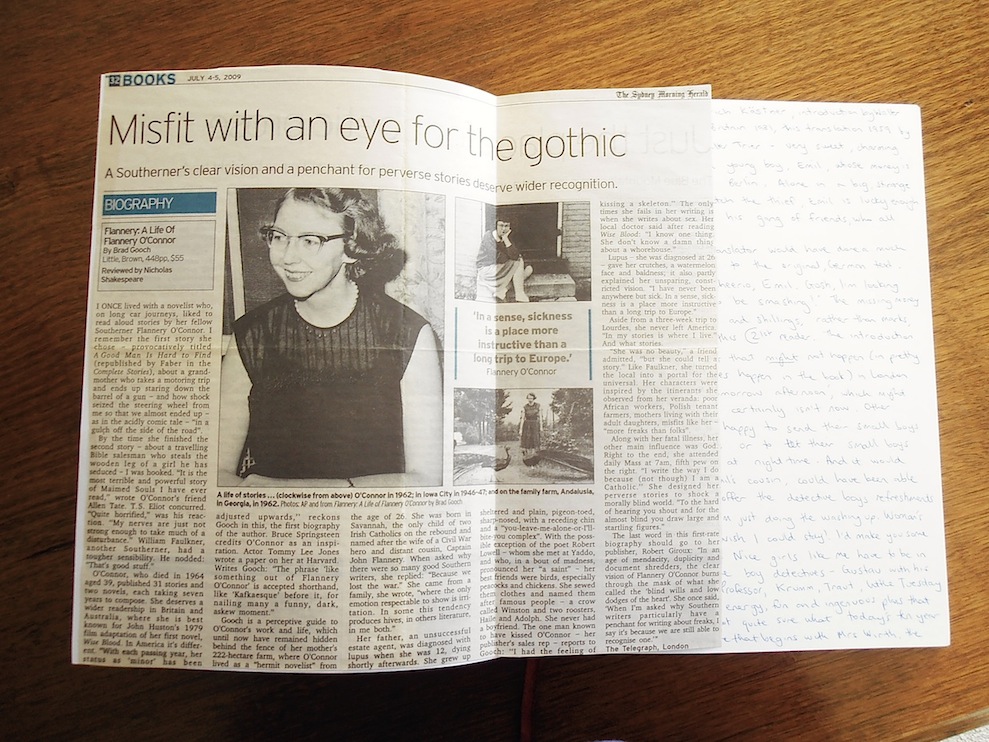
book review in journal

At the front of my journal, I keep clippings of book reviews and Post-It notes of titles that have caught my attention. When I start to run out of books to read, I consult these notes and reviews, and track the books down at the library or the bookstore (usually the library, because I am now an impoverished writer lacking a Proper Job). My current To Be Tracked Down book list includes:

The Uninvited Guests by Sadie Jones
A Few Right Thinking Men by Sulari Gentill
Cold Light, the final book in the Edith Campbell Berry trilogy, by Frank Moorehouse
Backwater War by Peggy Woodford
Lettie Fox by Christina Stead
A Pattern of Islands by Arthur Grimble

There are also quite a few books on my list that have not been treated to very much investigation at all. For example, I have a Post-It note that says ‘Hilary McKay – Casson family?’, which means I haven’t actually got around to looking up the book titles, let alone reserving them from the library. I also got stuck on Patrick Melrose’s novels, because the library catalogue informed me it only had the fourth book in a five-book series. (Does anyone know if I need to read Never Mind/Bad News/Some Hope before Mother’s Milk? Or are the books so depressing that I’ll regret reading any of them?) Still, it’s not as though I have a dearth of reading material at the moment.

Now that I’ve started a book journal, I wish I’d kept a record of all the books I’d ever read. It would be fascinating to see what I thought of The Famous Five and Trixie Belden and What Katy Did and all those other books I loved to pieces (literally) in my early reading years. Or maybe it would just be really embarrassing.

* That is, a job which involved me commuting by train to an office, often while wearing a suit, and having someone else pay me each fortnight and even pay me when I went on holiday or got sick . . . Oh, those were the good old days.
** It’s a detail from Part Seen, Imagined Part (1896), which apparently can be viewed at the Kelvingrove Art Gallery and Museum in Glasgow.
*** One day I will figure out how to do proper footnotes in WordPress.

For those of you who keep book journals, I’d also like to remind you that my book giveaway is still open, till the end of the month. You could win a copy of the Vintage Classics edition of A Brief History of Montmaray and then write about it in your journal! (Note: Those who don’t have book journals are also welcome to enter the giveaway.)