The FitzOsbornes at War, Plus My Favourite Non-Fiction About WWII Britain

The final book in the Montmaray Journals trilogy, The FitzOsbornes at War, is released in North America today. Hooray!

'The FitzOsbornes at War' North American edition
‘The FitzOsbornes at War’, published in North America on October 9, 2012
This edition is pretty much the same as the Australian edition (apart from the cover art and the American spelling and punctuation, of course), but one difference is that it contains a family tree for the FitzOsborne family, dated 1955. As I don’t want those who bought the Australian edition to miss out, I’ve now posted a version of that family tree on my author website. (Please note that the family tree contains plot spoilers for all three books, so it’s not a good idea to click on that link until you’ve read all three books. Unless you’re the sort of reader who always reads the last pages of a novel first – in which case, go ahead and click.)

Now that the trilogy is finished, does anyone want to ask me any questions about the Montmaray books? I could set up a separate page on this blog with a big spoiler warning. If anyone thinks that’s a good idea, leave a comment below, and I’ll start a Montmaray Q & A page. (Of course, you can continue to email me with questions, but I thought it might be more efficient if everyone could read the questions and answers, especially as people tend to ask the same questions.)

Meanwhile, if you’re interested in how I went about researching, planning and writing The FitzOsbornes at War, I wrote a series of blog posts about it earlier this year. And here are my five favourite non-fiction books about Britain during WWII:

1. Debs at War 1939-1945: How Wartime Changed Their Lives by Anne de Courcy

The privileged young British women who joined the services, drove ambulances, built aircraft in factories, nursed the wounded and worked on farms during the war tell their stories.

'Wartime Britain 1939-1945' by Juliet Gardiner2. Wartime Britain 1939-1945 by Juliet Gardiner

A meticulously researched account of every aspect of life on the Home Front, from the blackout, rationing and the Blitz, to the experiences of ‘enemy aliens’ and prisoners of war in Britain.

3. Voices from the Home Front: Personal Experiences of Wartime Britain 1939-1945 by Felicity Goodall

Moving stories taken from the letters and diaries of ordinary British people living through extraordinary hardships.

4. Keep Smiling Through: The Home Front 1939-45 by Susan Briggs

A fascinating and well-organised collection of wartime photos, cartoons, advertisements, posters, pamphlets and songs.

5. Sea Dog Bamse: World War II Canine Hero by Angus Whitson and Andrew Orr

The story of Bamse, a charismatic St Bernard who was an official crew member of the minesweeper Thorodd and a mascot to the Free Norwegian Forces stationed in Scotland during the war.

Tomorrow: The Home Guard

Britain at War: Masters of Illusion

This week, to mark the release of the North American edition of The FitzOsbornes at War, I’m going to be blogging about Britain during the Second World War. Today, it’s all about the artists who used their skills to camouflage buildings, guns, lorries, tanks, canals – and even entire cities – to protect them from Nazi attacks. Among these artists was the surrealist painter Julian Trevelyan, who was sent on a military camouflage training course in 1940. He learned how animals camouflage themselves in the wild with protective colouring, then was sent off with his paint tins and brushes to work in Cornwall, where he disguised concrete forts as cottages, public toilets and chicken houses, and used careful countershading to render anti-tank guns invisible against hedges. He also gave lectures to soldiers, showing them slide shows of how to camouflage themselves from air attacks (making sure he included slides “of nude girls under a camouflage net to wake up the men when they had dropped off”1). He was later stationed in North Africa and Palestine, where he disguised military tanks and created a dummy army to deceive the German Afrika Korps.

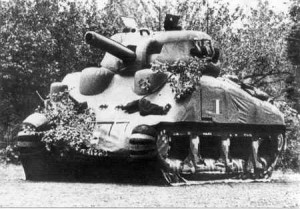
Inflatable dummyTank
A dummy inflatable tank used by the Allies during WWII
Camouflage was also an essential part of Operation Normandy, the Allied invasion of occupied France and Belgium in 1944. The Allied strategists went to great lengths to fool the Germans into thinking the Allied troops would depart from Dover and land in Calais. There were hundreds of fake plywood planes stationed on Kent airfields, as well as dummy landing craft floating on the Thames. They set up inflatable rubber tanks and lorries to make it look as though the Allies had more equipment than they actually possessed, and the 82nd Group Camouflage Company spent weeks making fake tyre marks in the grass so that it would appear that an enormous army had been practising manoeuvres. They also built a huge fake oil-storage tank in Dover, which was regularly ‘inspected’ by the King and Queen for the benefit of German spies.

One of the most famous camouflage experts of the war was magician Jasper Maskelyne, who was recruited into the British army at the same time as Julian Trevelyan. Maskelyne had been particularly bored during the animal-camouflage lectures of their training course (“a lifetime of hiding things on the stage had taught me more about the subject than rabbits and tigers will ever know”2), but he went on to disguise military equipment in the Western Desert and even claimed that he’d made the city of Alexandria temporarily ‘disappear’. He truly was a Master of Illusion.

Tomorrow: Publication day for The FitzOsbornes at War! Also, I talk about some of my favourite non-fiction books about wartime Britain.

_____

  1. Julian Trevelyan, Indigo Days, quoted in Juliet Gardiner’s Wartime Britain 1939-1945
  2. Jasper Maskelyne, Magic – Top Secret, quoted in Gardiner

The RAF Pilots’ Song, Plus Some WWII Girl Power

Did you know that, during the Second World War, some of the brave fighter pilots of the Royal Air Force formed their own boy band? And, when not shooting down Luftwaffe bombers, would dance in front of their Spitfires, singing harmonies about, among other things, Douglas Bader’s legs (“They’re not real”)? No, neither did I!1 But I think Toby FitzOsborne would approve. Take that, Hitler!

And let’s not forget the contributions made by British women during the war. If you think they were all stuck in the kitchen, you haven’t seen this! Or read The FitzOsbornes at War, which is all about girls being awesome in wartime, and is published in North America next month, and looks like this:

'The FitzOsbornes at War' North American edition
‘The FitzOsbornes at War’, published in North America on October 9, 2012

_____

  1. Thank you to Kate Constable, whose informative and entertaining blog post alerted me to the fact that the Horrible Histories books have now been turned into a TV series. I had no idea! I would have left a comment on her blog post as well, but Blogspot doesn’t like me and refuses to accept my comments.

Rosalind Franklin: The Dark Lady of DNA by Brenda Maddox

I’ve just finished reading an excellent biography of Rosalind Franklin, the scientist who received no credit (at least, not during her lifetime) for her work on the structure of DNA. James Watson and Francis Crick appropriated her data without her knowledge or consent, and used it to construct their double helix model of DNA. When they published their work in Nature in 1953, they mentioned the DNA research being carried out at her lab in King’s College, but falsely claimed that they “were not aware of the details of the results presented there when we revised our structure”. They were awarded the Nobel Prize in 1962, but neglected to mention Rosalind Franklin’s name in their speeches, and Watson’s 1968 book, The Double Helix, portrayed her as a dowdy shrew who couldn’t understand her own data.

'Rosalind Franklin: The Dark Lady of DNA' by Brenda MaddoxHowever, Rosalind Franklin was far more than “the Sylvia Plath of molecular biology, the woman whose gifts were sacrificed to the greater glory of the male”. Brenda Maddox paints a vivid portrait of the woman who

“achieved an international reputation in three different fields of scientific research while at the same time nourishing a passion for travel, a gift for friendship, a love of clothes and good food, and a strong political conscience [and who] never flagged in her duties to the distinguished Anglo-Jewish family of which she was a loyal, if combative, member.”

Rosalind was an “alarmingly clever” girl, the eldest daughter in a family of philanthropists that had made a fortune from banking and publishing. Her father was politically conservative, but there were a number of left-wing rebels in the family1. The book contains wonderful descriptions, often from Rosalind’s own letters, of her childhood in Notting Hill and of her time at St Paul’s Girls’ School, which was then one of the few schools that prepared girls for a career. She went up to Cambridge in 1938, as bomb shelters were being dug in Hyde Park and her family were taking in Jewish refugees from Austria. By the end of the war, she had a PhD in physical chemistry and was working on war-related research about coal. After a few years in Paris, she returned (reluctantly) to London, where the focus of her research changed to the structure of DNA, and then the structure of viruses.

Don’t be put off, thinking this book is filled with Difficult Science. I’m hardly an expert in X-Ray crystallography, but I was able to follow the progress of Rosalind’s research quite easily, thanks to Maddox’s clear descriptions and diagrams. It probably helps to have some interest in DNA, but you can skim the scientific descriptions if you must. What is really fascinating (and infuriating) is Maddox’s account of the experiences of women scientists in the 1940s and 1950s – how they were refused admission to the Royal Society until 19452, missed out on nominations for awards and research positions, were paid less than men for equal work, and were refused admission to university common rooms and research facilities3. Rosalind, who was a perfectionist and was widely regarded as ‘prickly’, often antagonised senior male researchers. For example, Norman Pirie, a specialist in plant viruses, wrote her a patronising letter in 1954, criticising her data that showed tobacco mosaic virus rods were all the same length. As it turned out, she was right and he was wrong. But he was also friends with the head of the council that was funding her research, which subsequently refused to provide any more money, even though her work had the potential to lead to a cure for a range of viral diseases, including polio.

Despite her constant battles at work, Rosalind comes across as a woman who embraced life. She was wonderful with children, she loved to cook elaborate dinners for her friends, and her greatest joy was hiking trips into the mountains. She made two journeys across the United States in the 1950s, and her letters about her travels are affectionate and amusing. She died tragically young, at the age of only thirty-seven, of ovarian cancer. The head of her research facility, J.D. Bernal, wrote that it was “a great loss to science”. He praised her “single-minded devotion to scientific research”, noting that

“As a scientist Miss Franklin was distinguished by extreme clarity and perfection in everything she undertook. Her photographs are among the most beautiful X-Ray photographs of any substance ever taken.”

Despite James Watson’s4 many attempts to belittle Rosalind’s intelligence and personality after her death, the world eventually came to recognise the value of her work. Buildings at St Paul’s Girls’ School, Newnham College and King’s College are now named after her, and her portrait hangs in the National Portrait Gallery in London – below those of Watson and Crick, of course.

Highly recommended if you’re interested in science, or feminism, or simply want to read the story of a fascinating, forthright young woman.

_____

  1. One uncle was “a pro-suffragist who in 1910 had accosted the then Home Secretary Winston Churchill on a train and attempted to strike him with a dogwhip because of Churchill’s opposition to women’s suffrage. (Churchill was unharmed by the attack and continued on to the dining car.)” One aunt was a “socialist with cropped hair and pinstriped clothes” (and a girlfriend), while another aunt was a trade unionist who married a diplomat and caused a scandal by “driving her own car”.
  2. In 1902, Hertha Ayrton, engineer and physicist, was refused admittance to this “citadel of Britain’s scientific elite … on the ground that as a married woman, she was not a legal person”.
  3. This wasn’t just in Britain. Women were not allowed to set foot inside the physics building at Princeton in the 1950s, and were banned from working as physics instructors at Harvard until the 1970s.
  4. Apart from his misogyny, Watson also refuses to hire “fat people” and thinks Africans are less intelligent than white people. What a charming man.

Inside a Dog Index

I’ve just finished a month of blog posts at Inside a Dog, the website of the Centre for Youth Literature, so I thought I’d post the links to each post here, for my own reference and for the benefit of anyone else who might be interested.

Introduction

How To Write a Historical Novel in Seven Easy Steps

1. Think up a good idea for a story
2. Do lots of research
3. Get organised
4. Write lots of words
5. Edit, edit, edit
6. Gaze upon the efforts of the designer and typesetter
7. Admire your finished book

More About Writing a Historical Novel

'Sitting Rough Collie', frontispiece in 'His Dog' (1922) by Albert Payson TerhunePlanning vs Not Planning
Real People in Historical Fiction
Same Book, But Different (editing for an international readership)

Life in Wartime

Keep Calm and Carry On
Looking Good in Wartime, Part One
Looking Good in Wartime, Part Two
Eating Well in Wartime
Blackout
Animals at War

An End and a Beginning

I promise my next blog post will not mention the FitzOsbornes. Or the Second World War.