The Years of Grace: Sport

Each section of The Years of Grace begins with some verse, and the introduction to ‘Sport’ is the worst by far:

'Sport' by Anna Zinkeisen from 'The Years of Grace'

Every girl ought
To love sport
But if she wants to be wise and adorable
and completely feminine
She will let meniwin
ALWAYS

Apparently Fifties Man was so fragile that if he was ever Beaten By A Girl, he’d crumple into a heap.

This section is the shortest in the book, partly because Noel Streatfeild admits she was always “the lowest-class rabbit at games”, but mostly because there are only three sports in which Fifties Girl is allowed to participate: lawn tennis, horse riding and swimming. There’s also golf, but “in many parts of the British Isles it is such an expensive game that few can afford it”, so I guess it’s fair enough that Noel chose to omit it from the book. Of course, there’s also ‘Watching Sport With Your Brother And His Friends’. Watching sport played by men, naturally. I spent the entire section desperately wanting to watch Fifties Man getting trounced by Serena Williams at Wimbledon.

The next and final section of The Years of Grace is ‘Careers’. But what possible career could Fifties Girl be qualified to do, given that she spent her school years concentrating on being “well-groomed” and is forbidden from ever competing with a man? Chapter titles such as ‘You Might Be A Secretary’ and ‘Shop-Keeping’ give some indication, although ‘On Her Majesty’s Service’ looks intriguing. The Foreign Office? MI5? I will report back.

You might also be interested in reading:

1. The Years of Grace : You
2. The Years of Grace : Your Home
3. The Years of Grace : Leisure
4. The Years of Grace : Sport
5. The Years of Grace : Careers

The Years of Grace: Leisure

I meant to post this earlier, but have been experiencing major technological difficulties1. Sorry about that. Anyway, according to The Years of Grace, Fifties Girl had many different options when it came to her leisure hours. She could go to the pictures and sigh over Stewart Granger (although Virginia Graham cautions her to pay careful attention to the film’s production values, if only to be able to say, “Look how beautifully he acted, in spite of that appalling script”). She could listen to records on her gramophone (Christopher Stone recommends Elgar, Sibelius and Szymanowski, but warns her to “always test a new record in the shop before taking it home”). She could watch the ballet (Rumer Godden provides useful tips) or go to the theatre (in her best “party frock”) or listen to a concert (provided it featured “good music” by Beethoven or Mendelssohn, and not any of that terrible “jazz or light music”). Even reading was expected to be an exercise in self-improvement, with Howard Spring recommending that girls read “classics”:

“… it will sometimes happen, when you come to read them, that they seem a little difficult, their meaning is not on the surface, and you wonder why other people think them supreme. Now please have the grace to wait a little, to believe that you are not seeing them aright because your own vision is not yet clear. Go on reading them, and, as life itself teaches you what living means, the day will come when you will suddenly see what it is all about: the book will become an eye-opener, and you will cry with Job: ‘Now mine eye seeth Thee.'”

Fortunately, Noel Streatfeild provides some comfort to girls who like pulp fiction and jazz:

“Never care what any kind of art snob says or looks. If you like a book, like it and say so. If you like a certain sort of music, own up to it, don’t pretend you only enjoy something that actually bores you stiff.”

Mind you, even Noel is wary of some modern developments in popular culture:

“Wireless and television are scientific marvels, but like many other marvels they want careful handling. Television can be a joy, but, my goodness, it can be a horror. America, where of course all programmes over the air are paid for by manufacturers, nearly put me off television for good.”

Still, leisure isn’t just about watching others being creative. Kitty Barne has a great chapter on ‘Producing a Play’ and Cora Gordon almost inspired me to take up ‘Sketching’, with both writers providing lots of practical tips and emphasising how fun these activities can be. John Pudney also contributes an entertaining chapter on summer holidays, which can range from camping in the back garden and exploring old Roman roads in the local area, to boating on the Thames and drawing a map of your adventures (“There is a special mark, of course, for the spot where Father fell in”). However, he hopes he is not being unpatriotic when he declares that “holidays abroad with or without parents are the best holidays of all”. He gives examples of his own family trips to Ireland, featuring airsick passengers (“Half-way over the Irish Channel, Elizabeth, our youngest, said in a loud voice to the stewardess, who was bringing round lunch: ‘If that lady over there is too sick to eat her dinner, can I have hers too?'”) and in France, involving adventures with Customs officials (“Anne was so excited by it all, I remember, that she infuriated us by insisting that the nice man should examine her bags”).

Another illustration by Anna Zinkeisen from 'The Years of Grace'
One of these girls slouches, dresses in a slovenly manner and reads trashy books. The other learns tap dancing, so she has Poise.

And Marguerite Vacani (yes, the Miss Vacani who taught Princesses Elizabeth and Margaret – and Sophie FitzOsborne – how to dance) describes how enjoyable ballroom dancing can be:

“I have taught a baby of two a polka in the morning, and finished the day by teaching her grandparents the samba, and all three enjoyed themselves equally.”

Of course, dancing is not merely about enjoyment. It gives a girl “that most useful quality – poise” and furthermore, if a girl is “not naturally well made”, it will improve her shape. Also, dancing improves the complexion, eradicates shyness and gives one’s face “a contented look”. Tap dancing is especially good, because men love “the gayness and fascinating timing”. Well, if tap dancing can do all that, imagine how much good sport would do to Fifties Girl. Accordingly, the next section in The Years of Grace is Sport.

You might also be interested in reading:

1. The Years of Grace : You
2. The Years of Grace : Your Home
3. The Years of Grace : Leisure
4. The Years of Grace : Sport
5. The Years of Grace : Careers

_____

  1. Did Fifties Girl ever have to face a WordPress admin screen on which most of the buttons had suddenly decided to stop functioning for no apparent reason? No, I don’t believe she did. Readers, if you’ve tried to comment on this blog in the past two weeks, I’m very sorry, but your comment has been lost in the ether. However, commenting is back to normal now. I hope.

The Years of Grace: Your Home

In my previous discussion of the opening section of The Years of Grace, I neglected the fabulous illustrations, so I’ll make sure to include some here. Each section of this book has an introduction by Noel Streatfeild, and in this second section, ‘Your Home’, she admits that she was a “menace” as a teenager, “scowling round the house, saying ‘Why should I?’ about everything I was asked to do” and bringing home an unsuitably un-English friend called Consuelo (“Girls from Latin countries grow up faster than girls from cold countries. Consuelo probably held the record for fast growing-up even in a Latin country.”).

The first chapter, by Margaret Kennedy, discusses the difficulties of sharing a house with parents and siblings:

John Verney illustration from 'The Years of Grace'

“The mother must manage to make room for her daughter’s wider life without letting the others feel that the whole house now belongs to an ENORMOUS GIRL who seems to be everywhere at once – locked in the bathroom when her brother wants to shave, telephoning in the hall at the top of her voice, pressing a dress on the kitchen table and dancing to the radio in the sitting-room.”

(By the way, I thought that illustration’s dense cross-hatched style seemed familiar and it turned out to be the work of John Verney, author of Friday’s Tunnel.)

Margaret Kennedy provides some sensible advice about reaching compromises with parents, including the need to be nice to your parents’ dull old friends (“It is highly mortifying for a mother if the refreshments at her bridge party are brought in by a daughter who looks as though she were dispensing alms to a colony of lepers”) and having to explain your own friends to them (“Parents do not always understand their daughters’ friendships or see where the attraction lies”). This is further explored in an article by Richmal Crompton, who gives useful tips for being a good friend (you need tact, generosity, lack of possessiveness, common but not identical interests, and a shared sense of humour).

Next comes Magdalen King-Hall with a chapter about community service and social justice, even if she doesn’t call it that. Although the examples she provides are a little dated (Elizabeth Fry, William Wilberforce, Florence Nightingale), the message is still relevant today:

“We are linked together, not only with the other people in our own country, but with all the other people in the world. It is like a stone dropped into a pond, the ripples spread out in widening circles – you, your family, your school, your community, your country, your world. This feeling of world citizenship is only in its infancy, but it has been born, and two devastating world wars have not destroyed it.”

She even mentions The League of Nations. Veronica FitzOsborne would approve. But Veronica probably wouldn’t think much of Mary Dunn’s article, ‘The Queen Was in the Kitchen’. Mrs Dunn explains that men reserve their greatest admiration for a girl who can cook:

Anna Zinkeisen illustration from 'The Years of Grace'

“Pretty, helpless women are very nice in the fiancée stage, to take to the pictures and to dance with, but after marriage, unless a girl is feminine in the right way, not just to look at but a homemaker, there is going to be trouble. Of course, after he has married her a man still wants a girl to look pretty and to have time to do things with him, but he wants as well to be quite certain that she looks after him better than the wives of all the other chaps in the street, and that he can brag that he is the best-fed man he knows.”

Mrs Dunn despairs because British housewives are letting down the side, compared to their glamorous counterparts in France, Scandinavia and especially the United States. You might think those Hollywood films depicting pretty housewives creating beautiful meals in dazzling kitchens are just Hollywood fantasies. But you would be wrong:

“Most American kitchens are like that and nearly all American girls really are splendid cooks, and really do whisk up superb meals and appear five minutes later in their living rooms looking too glamorous to be true. This business of looking smart when doing housework or cooking is something that we in this country really ought to turn our attention to … I feel sorry for tradesmen; how depressing when they call, to be greeted by a bedraggled object …”

Fortunately, the next article, by Janet Farwell, involved a vet talking to a family about the advantages and disadvantages of various pets (dogs, cats, rabbits, tortoises, fish, hamsters, budgies, silkworms) and included some adorable puppy illustrations, so my blood pressure returned to normal.

Finally, Elizabeth Cadell gave a lot of practical advice on hosting teenage parties, including hints on venues (turn your bedroom into “a very attractive bed-sitting room” by scattering cushions on the floor and covering the dressing table with a tablecloth), refreshments (sausage rolls, trifle, ice-cream, cider cup and “in cold weather, provide Bovril”) and games (cards, Tiddlywinks, charades). Which leads nicely to the next section of The Years of Grace: Leisure.

You might also be interested in reading:

1. The Years of Grace : You
2. The Years of Grace : Your Home
3. The Years of Grace : Leisure
4. The Years of Grace : Sport
5. The Years of Grace : Careers

Adventures in Research: Schoolgirls in the 1950s and 1960s, Part Two

My copy of Truth, Dare or Promise: Girls Growing up in the Fifties was finally delivered and proved to be interesting, although not terribly useful for my research purposes and possibly not worth the three-month wait. I am far more excited by the arrival of this book:

'The Years of Grace', edited by Noel Streatfeild

The Years of Grace: A Book for Girls, edited by Noel Streatfeild, was recommended to me by Penni and is a marvellous guide to 1950s Girl Life. As the jacket proclaims,

The Years of Grace is a book for growing-up girls who are too old for children’s books and are just beginning to read adult literature. It is a difficult age – difficult for parents and friends, but more difficult for the girls themselves. What are they going to do when they leave school? How should they dress? What is a good hobby? How can they make the right sort of friends? The problems are endless, and here in The Years of Grace is to be found the wisdom of many of our greatest writers and most distinguished people of our time.”

There are sections on ‘You’, ‘Your Home’, ‘Leisure’, ‘Sport’ and ‘Careers’, all beautifully illustrated. I’ve only read the first section, but can already tell I’m going to find this book highly entertaining. The first chapter of ‘You’, for instance, is written by “a Woman Doctor” who has chosen the interesting pseudonym of ‘Cannula’. She begins by stating,

“When I become Prime Minister, I shall introduce a law: the study of glamour will become a compulsory subject for all girls at school. Science and algebra are all very well, but they will not be much use to you in life unless you also know all about glamour … I declare firmly that you will do much better if you have glamour without learning than if you have learning without glamour.”

The rest of her chapter consists of stern advice on posture (“no girl who holds herself badly can look really smart”) and grooming (make sure you change your knickers “two or three times a week at least” and use deodorant once a week).

This is followed by an amusing chapter by Marguerite Steen, mostly about the history of undergarments, although she does have some advice on modern-day underwear:

“Nothing on earth looks more sluttish than mended nylons (unless they are invisibly mended) with darns down the ladders. The ‘next worst’ is moth-eaten suspenders, a single glimpse of which is quite enough to ruin the effect of your handsomest hand-knitted sports stockings.”

Also, make sure you’re wearing nice underwear, in case you get run over by a bus:

“I remember being told by a friend of mine, who was in an accident, that the fact of having on her best pin-spot chiffon step-ins went quite a long way to offsetting the pain of her fractured thigh when they were taking her away in the ambulance!”

Then comes James Laver on the history of women’s hairstyles and Elizabeth Arden on ‘The Care of the Skin and Hair’ (strangely enough, this requires a lot of cleansing creams, skin tonics, foundation creams, face powders and outfit-coordinated lipsticks, all no doubt available at the nearest Elizabeth Arden counter). Digby Morton’s contribution is ‘Pretty Girls All in a Row’, full of words of wisdom on fashion (for instance, “school is a place where your reputation is built, a place to look trim and well-groomed always” and “the wisest thing a girl can do is to take a dress-making and millinery course”). He also wishes to be Prime Minister, so he could “make it compulsory for every girl to have a grey flannel suit”. (These writers seem to have a peculiar view of the role of the British Prime Minister.) But as much as I want to make fun of Digby Morton, I have to admit he provides some very good advice on colours, fabrics and styles, and a fifties girl who followed his advice on building a wardrobe would look quite fabulous. And Alison Settle’s ‘Making the Best of Yourself’ is a terrific, timeless article on teenage anxieties regarding emotions, making and keeping friends, falling in love, dealing with annoying siblings and managing parents. I am very much looking forward to the remaining sections of this book – if anyone’s interested, I’ll post my thoughts about them here.

You might also be interested in reading:

1. The Years of Grace : You
2. The Years of Grace : Your Home
3. The Years of Grace : Leisure
4. The Years of Grace : Sport
5. The Years of Grace : Careers

Adventures in Research: Schoolgirls in the 1950s and 1960s

Generally my Adventures in Research are not all that adventurous, given that they tend to involve nothing more arduous than a fifteen-minute stroll to my local library or second-hand book store and then some concentrated reading. This time, though, there is an actual story to go with the research. Well, not really a story, because it doesn’t have a conclusion. More of a series of events.

So – Sydney City Council has about a dozen branch libraries scattered around the centre of the city, each with a special collection relevant to the particular neighbourhood it services. For example, the Haymarket Library, in the middle of Chinatown, has lots of Mandarin books and DVDs; Customs House, near the Opera House and the Harbour Bridge and other places frequented by tourists, has a large collection of international newspapers and magazines; my own branch has lots of LGBT fiction and non-fiction, handily marked with little rainbow stickers on the spines. Generally, these items can be transported between branches, arriving at your local branch within a day or two of your request – it’s really convenient and easy for library members. Anyway, a while back, I was browsing the library computer catalogue and came upon some potentially useful books about women’s lives in post-war Britain. There were histories, biographies and memoirs, including an intriguing book called Truth, Dare or Promise: Girls Growing up in the Fifties. All of the books were marked as “Non-Circulating Reference Books”, located at Ultimo Library, which did seem slightly odd – why would Ultimo, of all places, have a collection of non-fiction about women, and why would such books, mostly paperbacks, be regarded as so precious that they couldn’t leave the library? Never mind, I would visit Ultimo myself!

So one fine autumn morning, I gathered up my notebook, pen, Gregory’s Street Directory, bus timetable, multicoloured Post-It notes, packed lunch, compass, water bottle, pith helmet and spare pen, and set off on my quest. Due to my excellent map-reading skills, I got off at the wrong bus stop and had to ascend Ultimo’s steepest hill (who even knew they had hills in Ultimo?) before arriving, puffing slightly, at Ultimo Library – the reference section of which turned out to contain a small shelf of books about local council history, but not much else. I searched the general collection, then asked the librarian at the front desk, who frowned.

“Are you sure these books are here?” she asked.

“Yes, they’re in the Sydney City Libraries catalogue,” I said. “Listed as being held in Ultimo Library in the Non-Circulating Reference section.”

She summoned her colleague and I showed them the list of call numbers.

“Ah!” said the colleague. “Those books! No, they aren’t here. They’re in the National Women’s Library. I wish they’d take those books out of our catalogue, because we often have people coming in here looking for them.”

“Then…why are they listed in Sydney City Libraries catalogue?” I asked, quite reasonably. ‘And why does it say they’re here?”

Who knows? Although it turned out the National Women’s Library wasn’t far away – in the very same block, actually. The helpful librarians gave me a set of directions that sounded almost exactly like Arthur Dent in The Hitch Hiker’s Guide To The Galaxy looking for the plans to demolish his house, which are on display at the council planning department:

“On display? I eventually had to go down to the cellar to find them.”
“That’s the display department.”
“With a torch.”
“Ah, well, the lights had probably gone.”
“So had the stairs.”
“But look, you found the notice didn’t you?”
“Yes,” said Arthur, “yes I did. It was on display in the bottom of a locked filing cabinet stuck in a disused lavatory with a sign on the door saying ‘Beware of the Leopard’.”

Except my situation didn’t involve a leopard. (Pity, it would have made this story far more exciting.) So I went down the stairs, turned right, went past the table-tennis tables and the courtyard and the kitchen and down more stairs and found the locked doors of the National Women’s Library. This was during its listed ‘opening hours’, but there didn’t seem to be anyone around. I spied another door at the back, so I went back outside and around the building and tried that door and it was locked too1. So I gave up.

As it was such a beautiful day, I decided to walk all the way home, which would give me a chance to do some sightseeing. Ultimo used to be mostly old warehouses and factories, but now there’s the Powerhouse Museum, the Australian Broadcasting Corporation headquarters and the rapidly expanding University of Technology, Sydney (UTS). It was the latest UTS building that I was most interested in, because it was designed by Frank Gehry and the photos made it look so spectacular – a bit too spectacular, really, a bit show-offy and grandstanding, all wrong for a battered, industrial area like Ultimo, I’d thought. But that building was lovely. It nestled into its space, not overwhelming any of the surrounding buildings, and the famous ‘bulges’ in the brickwork made it look as though it was breathing. The bricks were golden-brown and glowed in the sunlight, and there were a lot of square, nicely-proportioned windows that reflected the blue sky, so the whole thing looked like a squat, friendly creature with a lot of big blue eyes. I didn’t go inside, so I don’t know how functional it is, but apparently it uses a lot of natural light and has loads of environmentally-friendly features. Officially, it’s named the Dr Chau Chak Wing Building, because he gave the university twenty million dollars to build it, although I’m pretty sure all the students just call it the ‘crumpled paper-bag building’. Anyway, it’s a vast improvement on the main UTS building on Broadway, which looks like a Weetbix box covered in brown pebble-dash. Then I wandered up towards Broadway, noticing that a lot of the old warehouses along the way had been turned into trendy coffee shops and advertising agencies and such, and I had a look at One Central Park, which was recently named Best Tall Building in the World by someone or other. All of the outside walls are covered in vertical gardens, which I didn’t think would work out very well, given the vehicle fumes and the often harsh weather, but the huge variety of plants seemed to be thriving. It probably helps that it’s done nothing but rain in Sydney for the past six months.

When I arrived home an hour later, I went online and discovered that there were multiple copies of Truth, Dare or Promise: Girls Growing up in the Fifties on sale for less than ten dollars from various British second-hand bookshops. This seemed a lot easier than trying to gain access to the National Women’s Library, so I placed an order. And waited. And waited some more. Then I gave the bookseller an extra couple of days, due to Easter. Then I emailed them, more than a month after I’d ordered the book. The bookseller was very polite and apologetic. The book must have been lost by the postal service. They would send me another copy. So I waited. And waited. Then I emailed them again. They were very, very sorry. The replacement book must have been lost in the post, too. They didn’t have any more copies of the book, so they would give me a refund.

I can understand that one book might get lost in the post, but TWO? I had a vision of their new office boy, keen but not very bright, being sent off with an armful of parcels and diligently posting each one in a rubbish bin instead of a post box. I waited another week for the refund to arrive, then used the money to order a copy of the book from a different bookseller. I’m still waiting. You know what’s going to happen, don’t you? This one will get lost, too. Or all three copies will arrive simultaneously in my mail box.
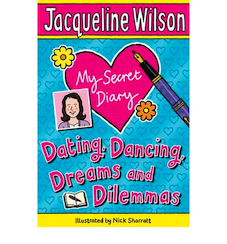
'My Secret Diary' by Jacqueline WilsonAnyway, in the meantime, I bought a copy of Jacqueline Wilson‘s My Secret Diary: Dating, Dancing, Dreams and Dilemmas. This is an account, aimed at teenage readers, of the author’s life in 1960, when she was a boy-crazy fourteen-year-old schoolgirl in suburban Surrey. It included lots of great black-and-white snapshots, as well as some excerpts from her real diary, which are as hilariously earnest and angst-ridden as you’d expect. I took notes on the clothes and records and films she liked, and the food, and the ridiculous school regulations and horrible uniforms, although I’m not sure how similar her life would have been to an upper-class London schoolgirl. In fact, I couldn’t quite figure out just where her family fitted into England’s rigid class system. Jacqueline’s family lived in a small council flat, but in a ‘genteel’ new block, rather than the rough council estate up the hill. They had a car, a TV, a telephone and a brand-new record player, but no washing machine or fridge. Jacqueline walked several miles to and from school (she was in the grammar stream at the local girls’ comprehensive) to save on bus fares, but there always seemed to be enough money for new clothes, cinema tickets, hairdressing appointments, pocket money and Christmas presents, and the family went on holidays (although not abroad) once a year. I couldn’t figure out what her father did for a living – he worked “at the Treasury” in Westminster, but doing what? Her mother worked locally, as a book-keeper. So, maybe lower-middle class – but could you live in a council flat in the 1960s and be regarded as middle-class? Maybe aspiring, ambitious working class, about to move into the middle class?

I was also interested to read about her favourite books – The Diary of Anne Frank, Dodie Smith’s I Capture the Castle and Rumer Godden’s The River and The Greengage Summer. She secretly borrowed Peyton Place from a friend and thought it was “sheer trash”, but was impressed with Lolita (“I wasn’t particularly shocked, just enormously interested”), although the author adds that “nowadays I find the whole story so troubling, so distressingly offensive, that I can’t bear to read it. I strongly recommend that you don’t read it either.” She was also determined to be a writer, so she bought a book called How To Be A Writer by Kathleen Betterton. This advised that “the writer for children must not attempt subtlety of character in which good and bad are blended”, so Jacqueline vowed, “If I ever write, I won’t write for children.” Fortunately for her many fans, she changed her mind, ignored that advice and went on to sell twenty-five million copies of her children’s books. (Teenage Jacqueline was also unimpressed with the writing advice doled out by Enid Blyton in her autobiography – “surely her books are not all that great”). I found this to be an entertaining, informative read – and if my other book about schoolgirls ever arrives, I’ll be able to figure out how typical Jacqueline’s experiences were.

You might also be interested in reading:

Adventures in Research: Schoolgirls in the 1950s and 1960s, Part Two

_____

  1. Later I discovered the National Women’s Library is run by volunteers, so it’s understandable that the opening hours would be limited and unpredictable. And I guess the books aren’t allowed out because they’re all donated and many are out of print and not easily replaced.