‘Indonesia Etc: Exploring the Improbable Nation’ by Elizabeth Pisani

This is a fascinating book about a year spent travelling around the Indonesian archipelago, written by a multilingual British woman who has spent much of her adult life in this diverse nation. She began her career as a journalist, then became an epidemiologist employed by the Indonesian Ministry of Health. In 2011, she decided to take time off to travel and learn more:

'Indonesia Etc' by Elizabeth Pisani“I only had one rule: ‘Just say yes’. Because Indonesians are among the most hospitable people on earth, this made for a lot of yesses. Tea with the Sultan? Lovely! Join a wedding procession? Yes please! Visit a leper colony? Of course! Sleep under a tree with a family of nomads? Why not? Dog for dinner? Uuuuh, sure. This policy took me to islands I had never heard of. I was welcomed into the homes of farmers and priests, policemen and fishermen, teachers, bus drivers, soldiers, nurses. I travelled mostly on boats and rickety-but-lurid buses that blared Indo-pop and had sick-bags swinging from the ceiling. Sometimes, though, I lucked into a chartered plane or rode cocooned in a leather car-seat behind tinted glass. I can count on one hand the number of times I was treated with anything other than kindness. I can also count on one hand the number of days that I did not have a conversation about corruption, incompetence, injustice and the slings and arrows of outrageous fortune.”

This is saved from being one of those ‘patronising white person blogging about their year of backpacking though a developing nation’ books by the author’s wide-ranging and first-hand knowledge of Indonesia. She displays genuine curiosity and warmth as she visits each community, but she’s also able to draw on her previous experiences. For example, there’s an excellent chapter on Aceh, the province that’s been wracked with separatist violence for decades. She provides a good summary of its complex post-colonial history, explaining why Aceh’s separatist movement is completely different to those in East Timor and West Papua, but she also relates anecdotes from working as a journalist in Aceh in the 1990s:

“At the time, it was impossible to tell who was behind the attacks. Only once, we saw a letter addressed to Indonesian newspaper editors, claiming responsibility for this wave of raids. Written entirely in lower-case, the letter was an eccentrically spelled mish-mash of anti-Javanese invective, childish threats, wounded pride and separatist rhetoric […] People called the troublemakers the GPK, just as the government did, and they had many theories about who they were. Most involved some combination of the following: disgruntled former soldiers who had been fired in a short-lived campaign against corruption in the military; thugs who wanted a bigger share of the marijuana trade (saus ganja was once a common ingredient in the cuisine of the region, and Aceh remained a centre of production for the crop); hot-blooded separatists back from training in Libya. It seemed wildly improbable to me that an organisation that didn’t have a shift key on its typewriter and couldn’t spell its own name would be linked to international terror training networks; it was only years later that I found that some of the fighters were indeed graduates from Middle Eastern training camps, though all the other theories also proved to be true.”

Much of the conflict in Indonesia that’s reported in the Australian media as being due to ‘the rise of Islam’ turns out to have a more complex, but also more prosaic, explanation. For example, the gangs of leather-jacketed, motorbike-riding thugs previously employed by politicians in Jakarta to attack student demonstrators have now

“begun to appear in turbans or knitted skullcaps, long white robes and straggly beards [to] selectively smash up those bars, nightclubs and brothels that don’t pay them protection money. A friend in the music business told me they demonstrated against Lady Gaga only after her promoters refused to pay them to provide security for her concert. But they do not choose their targets indiscriminately. They never vent their wrath on the porn industry, for example, because it is said to be controlled by the military.”

Most of the book, though, is not explicitly about politics but about the lives of ordinary Indonesians, trying to earn enough money to raise their families while dealing with a corrupt and incompetent bureaucracy, but also doing what people all over the world do – attending school, playing games, visiting friends, celebrating birthdays and weddings, and, even in the remotest islands, Facebooking on their mobile phones. It’s all related in a warm, entertaining style by an intrepid traveller. I think even readers who aren’t much interested in Indonesia will enjoy this book.
When People Declare That Historical Novels Are Neither Interesting Nor Relevant To Modern Life …

… I think of Winston Churchill after the war:

Churchill worried not so much that those who forget the past are condemned to relive it, but that the loss of the past would mean ‘the most thoughtless of ages. Every day headlines and short views.’

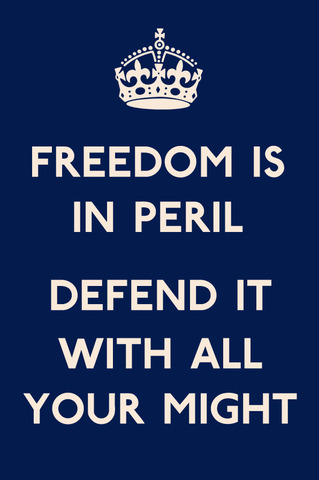
'Freedom is in peril' WWII poster

‘The Book That Made Me’, edited by Judith Ridge

Disclaimer: I’m acquainted with several of the people involved with the creation of this book. But I wouldn’t be writing about it here if I didn’t like it – I’d just pretend I hadn’t read it.

'The Book That Made Me' edited by Judith RidgeThe Book That Made Me is an interesting collection of personal stories by thirty-one authors and artists (mostly Australian, mostly writers for children and teenagers) about the books that “made them” – made them think, feel, laugh, made them want to create their own books. As with most anthologies, there’s a wide variety of pieces and I found some more compelling than others. Shaun Tan contributes a thoughtful essay about books that disturbed him, starting at the age of seven or eight with his mother reading him Animal Farm as a bedtime story, under the mistaken impression that it would be a charming fairytale (he decided it was “no more disturbing than stuff I witnessed at school each day”). His charming, whimsical illustrations can also be found throughout the book.

Other favourite pieces were those which had something in common with my own experiences. Simmone Howell writes about how she tried (and failed) to become a proper teenager using the wisdom contained in the Sweet Dreams and Sweet Valley High series. Catherine Johnson explains how she “never expected to see [herself] in a book … everyone back then knew only white people lived in books and had adventures”. Jaclyn Moriarty discovered, aged six, how her secret rage at the injustices of life had been transformed into a book called The Magic Finger. I also enjoyed Fiona Wood’s discussion of the helpful life lessons contained in Anne of Green Gables; Emily Maguire’s description of how Edith in Grand Days encouraged her to take risks and celebrate her teenage mistakes; and Julia Lawrinson’s entertaining account of her obsessive identification with Laura Ingalls Wilder. Most of these writers were already familiar to me, but I’d never heard of Catherine Johnson and now I feel a pressing need to read some of her children’s books, in which she says she “made sure to put children like me [that is, mixed-race kids] right in there, riding horses, wearing those amazing frocks, and mostly having adventures, just like everyone else.”

There was plenty of book nostalgia for me to wallow in (Dr Seuss! Little Women! Trixie Belden!) and I’ve added some recommended books to my To Read list, including Tom’s Midnight Garden by Phillipa Pearce, The House on Mango Street by Sandra Cisneros and Displaced Person by Lee Harding. This book contains potted biographies of all the contributors and I was pleased to see a thorough index. The Book That Made Me is published in Australia by Walker Books and will be published in North America this year by Candlewick Press, with all royalties going to the Indigenous Literacy Foundation.

‘Mad World: Evelyn Waugh and the Secrets of Brideshead’ by Paula Byrne

I really enjoyed Mad World by Paula Byrne, which is an engrossing account of the people who inspired Evelyn Waugh’s novels – specifically, the troubled Lygon family of Madresfield Court, so similar to the Flyte family in Brideshead Revisited.

'Mad World' by Paula ByrneThe true story of the Lygons turns out to be even more dramatic and tragic than that of their fictional counterparts. Lord Beauchamp, a very grand earl, didn’t merely choose to live away from England with his lover because he disliked his pious wife – he was forced into permanent exile in 1931 to evade arrest for “committing acts of gross homosexual indecency” with his servants. While aristocratic men of the time often got away with flouting this law, Lord Beauchamp had been flagrant in his disregard for social and legal conventions. This became a problem when it appeared one of his daughters, Lady Mary, might marry Prince George. The King took action and recruited Beauchamp’s brother-in-law, Bendor, the Duke of Westminster, who’d long resented Beauchamp:

“It seemed grotesquely unfair that his brother-in-law should have three sons, a loyal wife, a string of homosexual lovers, a glittering career and great standing in politics, while he himself had got through three wives without producing a single male heir … Bendor set about his task with great relish and ruthless dispatch.”

The Lygon family was torn apart, with most of the children taking their father’s side and refusing to forgive their mother for divorcing him. The girls, previously the most eligible debutantes of their time, were unable to make ‘good’ marriages, due to the scandal. Lady Mary, the most beautiful, eventually married a philandering Russian aristocrat, who left her penniless and battling mental illness, alcoholism and loneliness. The heir, Lord Elmley, married a much older woman and had no children; Hugh, the model for Sebastian Flyte, quickly lost his good looks and his money and spent the remainder of his short life in a drunken stupor, trying to block out the guilt and shame of his own homosexuality; only Lady Dorothy, portrayed as Cordelia Flyte, seemed to live a relatively happy and productive life, although she had her own brief and disastrous marriage.

The author says that she wrote this book because she believed “that Evelyn Waugh had been persistently misrepresented as a snob and a curmudgeonly misanthropist.” However, I finished this book disliking Waugh, as a person, even more than I already did, which I didn’t think was possible. He was a snob. He spent his life attaching himself to a series of rich, aristocratic families, happy to be their court jester if he got to stay in grand country houses for extended periods at their expense, especially if it also provided him with good writing fodder. From his earliest years, he was spiteful and nasty, bullying anyone he regarded as his inferior in either social status or intelligence. He may have possessed wit and humour, but it always had a sharp edge. There is a lot of description of his idiotic drunken escapades with friends, which we are meant to admire:

“…to an outsider, the banter and play that characterised Mad World [that is, life at Madresfield Court with the Lygon siblings] appear frivolous and jejune, but in reality the comedy was a means of survival and a manifestation of love.”

'Brideshead Revisited' by Evelyn WaughHmm. Waugh at least had some self-awareness and admitted, when proposing to the woman who would become his second wife, “I am restless and moody and misanthropic and lazy and have no money…” (It reminded me of Mr Mybug in Cold Comfort Farm trying to appear more interesting to Flora by hinting at his dark depths.) Perhaps the poor woman thought he was joking, but she agreed to marry him and then spent years living in the country, perpetually pregnant, looking after their huge brood of children while he caroused around London. Despite his fervent Roman Catholicism, he had no moral qualms about buying the services of prostitutes, including “little Arab girls of fifteen and sixteen, for ten francs each” in Morocco. Even his brief military service during the war was marked by impropriety, when he falsified the official record of his battalion’s withdrawal from Crete in 1941. He told his friend Nancy Mitford that his behaviour would have been even worse if he hadn’t been under the moral influence of the Church. The mind boggles.

Paula Byrne provides an interesting analysis of most of Waugh’s books, including Vile Bodies, A Handful of Dust and the Sword of Honour trilogy, but I found her detailed chapter on Brideshead Revisited the most fascinating. She examines his descriptions of Oxford, homosexuality, Roman Catholicism and aristocratic life, linking the major characters in the novel to their real-life counterparts. I think readers who love Waugh’s writing will find this book rewarding – but don’t expect to feel very fond of Waugh by the end of it.

My Favourite Books of 2016

It’s not quite the end of the year, but here are the books I’ve read in 2016 (so far) that I loved the most. But first, some statistics.

I only read 46 new books this year (new to me, that is), fewer than I usually read. This was partly because I was studying for most of the year, plus I’d started a new job, both of which took up lots of mental energy. I also read a great deal of (mostly depressing) political news in newspapers, magazines and blogs. So when I wasn’t doing that, I escaped into the comfort of old favourites from my bookshelves, including a dozen of Ruth Prawer Jhabvala’s books and a re-read of all the Rivers of London novels in preparation for the release of Book Six in that series.

So, what type of new books did I read this year?

Type of books 2016

Author nationality for books read in 2016

It was the year of British literature, it seems.

Author gender for books read in 2016

And women writers dominate, yet again.

Now for my favourites.

My Favourite Adult Fiction

My favourite novels this year included Breakfast with the Nikolides by Rumer Godden, Olive Kitteridge by Elizabeth Strout, Slade House by David Mitchell and the latest installment of the Rivers of London series, The Hanging Tree by Ben Aaronovitch.

My Favourite Non-Fiction

It was non-fiction that really captured my interest this year. Favourites included The Genius of Birds by Jennifer Ackerman, Bird By Bird: Some Instructions on Writing and Life by Anne Lamott, Party Animals: My Family and Other Communists by David Aaronovitch, and two of Bill Bryson’s books, At Home: A Short History of Private Life and The Road to Little Dribbling. I’m only halfway through Stalin Ate My Homework by Alexei Sayle, but I’m really enjoying it so far. However, my absolute favourite of the year was Cordelia Fine’s Delusions of Gender, a brilliantly incisive yet accessible discussion of neurocognitive research into sex differences, which I realise I didn’t actually review on this blog because I was too busy writing assignments at the time. I will try to remedy that at some stage in the near future, but in the meantime, here’s a good review.

My Favourite Books for Children and Teenagers

I loved Iris and the Tiger by Leanne Hall and Howl’s Moving Castle by Diana Wynne Jones. I was also beguiled by the first book in Antonia Forest’s Marlow series, Autumn Term.

My Favourite Picture Books and Graphic Novels

I was entertained (and occasionally enraged) by a collection of First Dog on the Moon’s political cartoons, A Treasury of Cartoons. I also enjoyed Night Witch, a graphic novel in the Rivers of London series, by Ben Aaronovitch, Andrew Cartmel, Lee Sullivan and others (although it wasn’t as good as the prose novels).

Thank you to everyone who contributed to Memoranda in 2016. I hope you’ve all had a good reading year and that 2017 brings you lots of inspiring, informative and entertaining books. Happy holidays!

More favourite books:

Favourite Books of 2010
Favourite Books of 2011
Favourite Books of 2012
Favourite Books of 2013
Favourite Books of 2014
Favourite Books of 2015