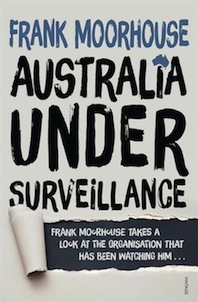
Australia Under Surveillance by Frank Moorhouse was an interesting collection of essays about ASIO (Australia’s version of MI5 and the FBI) and the conflict between national security and individual privacy within a democracy. Moorhouse himself was targeted by ASIO when he was a young man because he was briefly a member of his university’s Labour Club, which was believed to have “Communist influences”, and he eventually acquired a thirteen-volume ASIO file. In this book, he provides evidence that Prime Minister Robert Menzies used ASIO against political adversaries – for example, Menzies ordered ASIO to investigate Australian writers, to prevent Communist-sympathising writers from receiving any Commonwealth funding. (This was after Menzies’ legislation to ban the Communist Party was overturned by the High Court, and after the 1951 referendum showed a majority of Australian voters agreed with the High Court’s decision. It’s never been illegal for Australians to belong to the Communist Party.) But all of this happened during the Cold War, when paranoia about “Reds under the bed” was rampant. Surely things are different now?
 Well, certainly ASIO’s target has changed. Instead of Communists, it’s Muslims suspected of being terrorists, or of supporting terrorists, or of attending a mosque or community centre at which someone discussed something that might suggest support of terrorist activities, and Moorhouse outlines a number of cases where ASIO and the police have interrogated and detained innocent people without charges ever being laid, often due to inaccurate information or mistakes on the part of the authorities. He then interviews ASIO’s Director-General, David Irvine, who downplays ASIO’s historical abuses of power and emphasises ASIO’s current need for more legal powers and resources due to the “terrorist threat” (even though “less than 1000” Australians have been killed in wars and terrorist attacks during the last fifty years, including the Vietnam, Korea, Gulf, Afghan and Iraq wars, compared to 134,548 people killed on Australian roads in the same period). I was also horrified to read about ASIO’s interference in the National Archives, with ASIO blocking access to or destroying decades-old historical records on the grounds of ‘national security’.
Moorhouse goes on to discuss privacy and censorship in Australia. He notes that the people fighting against censorship (Communists during the Cold War, Muslim fundamentalists now) are “often hostile to free speech in their own organisations, but need it to achieve other ends. Similarly, fundamentalist Christians are likely to advocate censorship of sexual and blasphemous material” but want free speech powers so they can attack Muslims. Moorhouse’s opinion is that even the most offensive anti-Western jihadist material should be freely available in Australia, because the public need to understand how terrorists think and exposing offensive material to criticism decreases its power. He has similar views on hate-speech laws (he agrees with Attorney-General George Brandis that people should have “the right to be bigots”) and privacy laws (he believes that keeping ‘private’ behaviour secret simply makes the behaviour seem more shameful and increases the stigma attached to it). He doesn’t seem aware that his perspective is that of a very privileged person in society – he’s not, for example, a domestic violence victim trying to hide from a violent ex-husband, or an employee who wants to keep his personal hobbies private from his employer, and Moorhouse is unlikely ever to be the victim of racist or sexist hate campaigns. Some readers may also be frustrated by the rambling, personal nature of the book – it’s certainly not for those who want a methodical, analytical approach (or an index) – but I found it a very interesting read.
The Two Faces of January by Patricia Highsmith set me to wondering about how useful genre labels are. Is this book crime or literary fiction? Is it a thriller, or a psychological study, or a classical tragedy? I sat up far too late one night finishing it because I just had to see how the plot would play out, even though I was fairly sure how it would end (and was right about that), so it was certainly a success as a thriller, in my opinion. It is fairly typical of Highsmith’s novels, in that it features an American man, bold and shrewd but without much of a conscience, who has fallen into a life of petty crime, becomes involved in a murder, then spends the rest of the novel desperately trying to cover this up (and somehow the reader sympathises with him and urges him on, despite his lack of morals). This novel, set mostly in Greece, features two such characters, one older and out of his depth in a country where he doesn’t speak the language; the other younger, easier to like, but with murkier motives, which turn out to be related to his hated dead father. There is also a young, beautiful woman who doesn’t have a very large part to play in the book (also typical of Highsmith’s novels), some vivid descriptions of the European settings and a number of exciting chase scenes. Recommended for those who enjoyed the Ripley books (or the Ripley films, or Strangers on a Train, or any Hitchcock films, really).
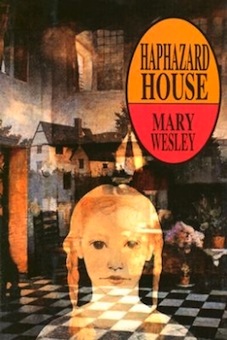 Haphazard House by Mary Wesley was a strange, often beautiful, children’s novel about a family who move to a haunted house in a remote village where time proves to be “a bit askew”. The eleven-year-old narrator, Lisa, observes her mother and grandfather becoming younger; the family dog Bogus is recognised by a villager as Rags, the dog who’d lived in the house more than forty years earlier; someone is observed waving to them from the windows of a room that doesn’t exist; an invisible gardener supplies them with fresh vegetables, and an invisible maid rearranges the furniture, and the fire in the hearth never goes out. There is a lot of rich description of setting and character and some genuinely spooky moments, but the eventual ‘explanation’ is crammed into the last chapter and left a lot of my questions unanswered. The first few pages were also some of the most confusing I’ve ever seen in a children’s book, which I think was due to poor editing, rather than design. I suspect this would, unfortunately, put off some child readers who’d ultimately enjoy the book. I’d recommend it for fans of Diana Wynne Jones or those who’ve enjoyed time-slip novels such as Penelope Farmer’s Charlotte Sometimes and Kate Constable’s Cicada Summer.
I picked up A Candle for St Jude by Rumer Godden mistaking it for The Kitchen Madonna, which I’d wanted to re-read, and then thinking it would be one of her lives-of-nuns books like In This House of Brede. It actually turned out to be the story of a small ballet school in London, celebrating the founder’s jubilee by putting on a grand performance. It was first published in 1948 and it depicts the shabby, war-battered reality behind the gilt facade very well. There are some lovely character studies, including those of the tempestuous ageing Madame, nostalgic about her once glittering career, now bitterly jealous of her talented pupil Hilda. Not being a ballet fan, I felt the passions and tumult leading up to the performance were somewhat misplaced, but I still found this an enjoyable read. I especially admired Godden’s technical skills as I read this – the way she managed to slip between Madame’s memories and the present day so smoothly, the adroit handling of multiple points of view, and how she ended the story at exactly the right place.
 Finally, an adorable children’s book called The Girl Who Brought Mischief, by Katrina Nannestad. Set in Denmark in 1911, it’s the story of a ten-year-old orphan sent to live with her grandmother on the remote island of Bornholm, where nearly everyone is old and nobody is allowed to play or dance or have any fun. Inge Maria arrives with lopsided hair (a goat on the ferry ate one of her plaits) and a talent for attracting trouble, and she proceeds to knock out her grandmother’s turkey with a stray clog, pull a line of freshly-washed clothes into the mud, antagonise her stern teacher and scandalise the village churchgoers. I preferred the first half of the book, in which Inge Maria causes general mayhem. The second half, in which Inge Maria warms the hearts of all the grumpy old people, was far too saccharine for my tastes – but keep in mind, I’m a cynical grown-up! Children who enjoyed the film versions of Anne of Green Gables or Heidi but were daunted by the length and old-fashioned language of those books would probably adore The Girl Who Brought Mischief. And I did love all the descriptions of life on a Danish island a hundred years ago.
 Anyway, in the meantime, I bought a copy of
  Girls can read as well as boys! I should add that he was addressing a jury that included three women (all of whom were required to read the book). He was also horrified that the novel seemed to treat sensuality “almost as a virtue”. In reply, Penguin argued that the book had genuine literary merit and was neither obscene nor depraved. Penguin asked more than three hundred literary figures to appear as expert witnesses, and among those who agreed to defend the book’s literary merits were Rebecca West, E. M. Forster, Cecil Day Lewis and T. S. Eliot, with Sylvia Plath watching excitedly from the press gallery. A few, though, declined to help, including Evelyn Waugh, Robert Graves, Doris Lessing and Iris Murdoch, as well as one particular bestselling female author. Guess who said the following:
 by most of their subjects and all of the press. Nowadays, of course, we’re used to the British royals exposing themselves (in various unflattering ways) in newspapers and on television, but at the time, the Queen Mother was furious at ‘Crawfie’, as the governess was known, for breaking the code of silence that surrounded the royals and as a result, poor old Crawfie was ostracised
 And finally, a novel written by an Elizabeth – Mrs Palfrey at the Claremont by Elizabeth Taylor (the English novelist, not the Hollywood star, although the novelist frequently had to deal with people who’d confused her with the actress). This is a brilliant, but bleak, look at ageing and death in genteel English society in late 1960s London. Elderly Mrs Palfrey is not rich enough to stay in her own home with servants to look after her, not poor enough to move into a state-assisted home for the elderly, and not ill enough for a private hospital or nursing home, but is too polite and independent to impose herself on her middle-aged daughter in Scotland, so she decides to set herself up in a respectable London hotel to wait out her final years. There she meets the other permanent residents, including bitter, arthritic Mrs Arthbuthnot; dim, timid Mrs Post; Mr Osmond, who keeps himself busy writing outraged letters to the newspapers and telling disgusting jokes to the waiters; and mauve-haired, drunken Mrs Burton (named, according to one review I read, after the actress). When she has a fall in the street, Mrs Palfrey is rescued by a young, impoverished writer called Ludo, which leads to a strange sort of friendship between them. Each is using the other – Mrs Palfrey now has a handsome, charming ‘grandson’ to show off to the hotel residents and someone to make her feel needed, while Ludo gains a more satisfactory ‘mother’ than his real mother, and also accumulates a lot of useful material for the novel he’s writing (about old people living at a hotel, entitled They Weren’t Allowed To Die There). Elizabeth Taylor’s observations of character are astute and very funny but also very sad. The residents are all bored, lonely and frightened, but feel unable to admit to this, let alone try to help themselves, so they spend their days obsessing over the hotel menus, spreading spiteful gossip, and complaining about modern life. The author has been called a twentieth-century Jane Austen and for once, that’s not an exaggeration. Mrs Post, for example, is described as “too vague, too bird-brained to achieve real kindness. She had always meant well – and it was the thing people most often said about her – but had managed very seldom to help anyone”, while snobby Lady Swayne manages to irritate even mild-mannered Mrs Palfrey, with “all of [Lady Swayne’s] most bigoted or self-congratulatory statements prefaced with ‘I’m afraid’. I’m afraid I don’t smoke. I’m afraid I’m just common-or-garden Church of England. (Someone had just mentioned Brompton Oratory.) I’m afraid I’d like to see the Prime Minister hanged, drawn and quartered. I’m afraid I think the fox revels in it. I’m afraid I don’t think that’s awfully funny.” I won’t provide any plot spoilers, but I will say that if you’re hoping for a sweet, sentimental look at old age, this is not the book for you. I loved it, but it was rather depressing. And now I’m off to find some more Elizabeth Taylor novels to read.