I don’t have to do disclaimers for any of these books, because I don’t know any of the authors.
Growing Up Asian In Australia, edited by Alice Pung, was a fascinating collection of memoirs, short stories, essays and poems by a range of Asian-Australian writers, some of them famous (Shaun Tan, Tony Ayres, Cindy Pan, Benjamin Law and Kylie Kwong), some of them less well-known, but nearly all of them with interesting things to say about racism, cross-cultural communication and family life in Australia. As in any anthology, the quality of the writing was variable, but overall, I think the editor did a fine job of balancing powerful (and often depressing) pieces of writing with lighter, more entertaining, tales. I did wonder how ‘Asian’ would be defined and it turned out to mean mostly Australians of Chinese or Vietnamese descent, with a few writers whose families were from Korea or Thailand, which probably reflects the relative proportions of these ethnic groups in the Australian population. There were also a couple of Indians and I may have been biased towards them, but my favourite piece in the book was a short memoir by Shalini Akhil, in which she discusses her love of Wonder Woman with her Indian grandmother (“You can fight all the crime in the world, she said, but if you leave the house without putting your skirt on, no one will take you seriously”). They go on to imagine their own Indian version of Wonder Woman who “could wear a lungi over her sparkly pants, and that way if she ever needed seven yards of fabric in an emergency, she could just unwind it from her waist.” The grandmother also explains that rolling perfectly round rotis is a magic power, then cooks super-hero eggs with chilli for her granddaughter’s lunch. It was a very endearing piece of writing and now I need to track down this author’s novels.
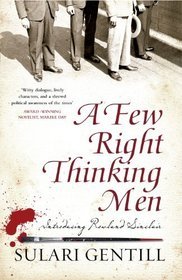 A Few Right Thinking Men by Sulari Gentill has been on my To Read list for a while because, hey, a novel about 1930s Fascism, set in Sydney? Yes, please! And this turned out to be meticulously researched and absolutely fascinating, so I’m glad I finally got around to reading it. It’s the first in a historical crime series starring Rowland Sinclair, a gentleman artist with some disreputable friends, who sets out to investigate the murder of his beloved uncle and finds himself entangled in the conflict between Communists, Fascists and the authorities. I knew a little bit about the New Guard due to their hijacking of the opening of the Sydney Harbour Bridge, but had no idea about their rival Fascist organisation, the Old Guard, or about how violent some of the confrontations became. It was also interesting to me to compare the Australian Fascist organisations to their British counterparts (with which I’m more familiar). While both had charismatic, upper-class leaders and were obsessed with nutty schemes, conspiracy theories and ridiculous uniforms, the New Guard forbade any female involvement, whereas women (many of them former suffragettes) were a significant part of Mosley’s British Union. I think that says something about how blokey Australia was (and is). I have to say that the writing in this novel was slightly clunky – a bit too much tell-not-show, a few too many information dumps – and I never quite worked out whether the leisurely pace of the mystery plot and the verbosity of the prose was a homage to early twentieth century literature or simply inadequate editing. However, Rowland and his friends were very appealing characters and the historical background was intriguing enough for me to consider reading more of this series.
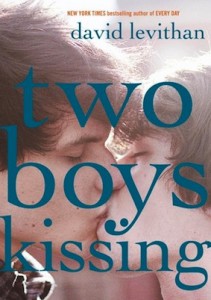 Two Boys Kissing by David Levithan was a novel I didn’t expect to love as much as I did. Firstly, it has a stupid premise – two boys try to break the world record of more than thirty-two hours of continuous kissing. Secondly, it’s a YA novel narrated by a chorus of old dead people in the second person. Thirdly, as much as I admire David Levithan’s prose, none of his books will ever pass the Bechdel test. He writes exclusively about gay, white, middle-class American boys. Sympathetic girl characters, if they exist at all, are merely support crew (literally, in this particular novel). Despite all these ominous signs, I found myself engrossed in this book and was reduced to tears at several points where the dead men talked about their lives in an earlier, less tolerant society. I’m a bit older than David Levithan, old enough to remember the early years of the AIDS epidemic, when each edition of Sydney’s gay newspaper contained pages of obituaries and every community social function was a meeting about the Quilt Project or a fund-raiser for the HIV/AIDS ward at the local hospital, and this book brought back those days vividly for me. The chorus in Two Boys Kissing is there to explain to the teenage characters how much easier life is in the twenty-first century, and while I wholeheartedly agree (life is easier for most gay teenagers now than it was twenty-five years ago), I did wonder what teenage readers might think about this. So I was interested to read Anna Ryan-Punch’s review of the book in the latest edition of Viewpoint, in which she states:
“The use of their commentary comes off as heavy-handed, mawkish, and often didactic . . . there’s a patronising sense of authority, which is likely to put many readers on the defensive: ‘They are young. They don’t understand.'”
I can see that this book might not work for all readers, but it really had an impact on me. And I do agree with Anna Ryan-Punch that this book’s cover is “a literal and lovely picture of progress”.
Finally, I decided to start reading Lives of Girls and Women the day before the author, Alice Munro, won the 2013 Nobel Prize for Literature. This is because I am psychic. Not really. She’d been on my To Read list for ages, and now I’m kicking myself for not picking up one of her books sooner because this novel was utterly brilliant and I think it would have changed my life if I’d read it as a teenager. Her writing is so lucid and honest, each sentence beautiful and full of meaning – this is Serious Literature without being pretentious or incomprehensible or self-consciously ‘literary’. I was torn between wanting to linger upon each page to savour her wisdom and racing ahead to the next chapter to find out what would happen to Del, the teenage narrator, who is growing up in rural Canada in the 1940s and 1950s. I especially liked how the author described the limitations placed on women then (often by other women, not men) and how Del could so easily be a girl of today, her sexual desires clashing with what society determines is ‘correct’ for girls. This book was a bit like Anne Tyler combined with Margaret Atwood’s autobiographical short stories and they’re two of my favourite authors, so I think I should now read everything Alice Munro has ever written.
_____