Miscellaneous Memoranda

'Drei neugierige Katzen' by Arthur Heyer (1931)
Fluffy indicates the time of the crime, while his assistants, Muffin and Smokey, examine the evidence carefully for further clues
I think I’m writing the wrong sort of books. Apparently, cat mysteries, a “subgenre of detective novels in which crimes are solved either by cats or through feline assistance” are selling “millions upon millions of copies”. I tend to agree with the author of the article, who suggests cats are “more likely to commit crimes than to detect them”. (To appease any cat fanciers who may be reading this, here’s a cat comic.)

Those who regularly use Wikipedia may be interested in this article, which points out that only nine percent of Wikipedia editors are women and that male editors frequently try to delete articles seen as not culturally “significant” enough (that is, too “girly”). This leads, for example, to an article on Kate Middleton’s wedding dress being flagged for deletion for being a “trivial” topic – although somehow, Wikipedia manages to find the space to include more than a hundred articles on Linux.

I love What Was That Book?, a community on LiveJournal in which readers write in to ask for help finding books they’ve read so long ago that they’ve forgotten the titles and authors. I’m constantly amazed at how quickly the community is able to identify a book, based on very vague clues. For example:

“The last radish in the world (galaxy? universe?) goes up for auction. The person who wins the radish is underwhelmed by the experience of eating the legendary vegetable. It might be a science fiction short story or a scene in a novel.”

And, within twenty-four hours, a reader had let us know that the book was Beauty by Sheri S. Tepper.

Kill Your Darlings is hosting a YA Championship, in which their “ten favourite YA fanatics – authors, buyers, publishers, readers, writers – [will] champion their favourite Australian YA book from the last 30 years”. The public will then vote on the selected shortlist, although there’s also a People’s Choice category allowing the public to nominate their own favourite books, with book packs as prizes.

– And my own Vintage Classics book giveaway is still on, with entries closing on Wednesday.

My Book Journal

A few years ago, I stopped working at a Proper Job* and on my final day, my colleagues had a little party and presented me with a farewell gift – a lovely silver pen and a blank journal. I’d just had my first novel accepted for publication and my colleagues said I could use the pen and book to write my next novel. It was a lovely idea, and in fact, I did use the pen to take notes for A Brief History of Montmaray (and indeed, I still use that pen nearly every day, because it really is a very nice pen, of exactly the right size and weight and ink colour to suit my tastes). But as for the blank journal – well, I type my novels on a computer, and when I take research notes, they’re scribbled on cheap lecture pads and technicoloured Post-It notes. I couldn’t imagine writing a novel (with all the crossing-out and page-tearing-out that that involves) in a beautiful journal with gilt-edged pages, decorated with a detail from a Charles Rennie Mackintosh painting**.

book journal cover

gilt-edged pages of book journal

blank book pages in journal

The book was simply too pretty to sully with my scribblings, so it sat in a cupboard for a couple of years.

However, at the start of 2011, I decided it would be handy to keep a record of all the books I read and to make brief notes on the books I found interesting (either interestingly good or interestingly bad). I suppose I could have just joined Goodreads or LibraryThing, as everyone else does, but I wanted to keep my notes private. I considered setting up some sort of spreadsheet on my computer, but that sounded too much like hard work. And then I remembered my ‘Blank Note Book’.

Readers, it is blank no more.

entry in book journal

Note: Photo is artfully blurred so you can’t see what I wrote about Insignificant Others and Dead Until Dark – although I did enjoy both those books, for different reasons.

I write down the title and author of each book I read and what I thought of the book. Sometimes I only write a sentence; sometimes I write pages. I often write about the book’s structure and the effectiveness of the literary devices used, because analysing other books helps me to become a better writer. But just as often, my book journal reflects how I was feeling and what was going on in my world at the time I read the book, so I guess it is a bit like a personal diary. The books I really loved get a star, and I use the stars to compile my Favourite Books blog post at the end of each year. Sometimes I also stick in the review that prompted me to try the book in the first place.
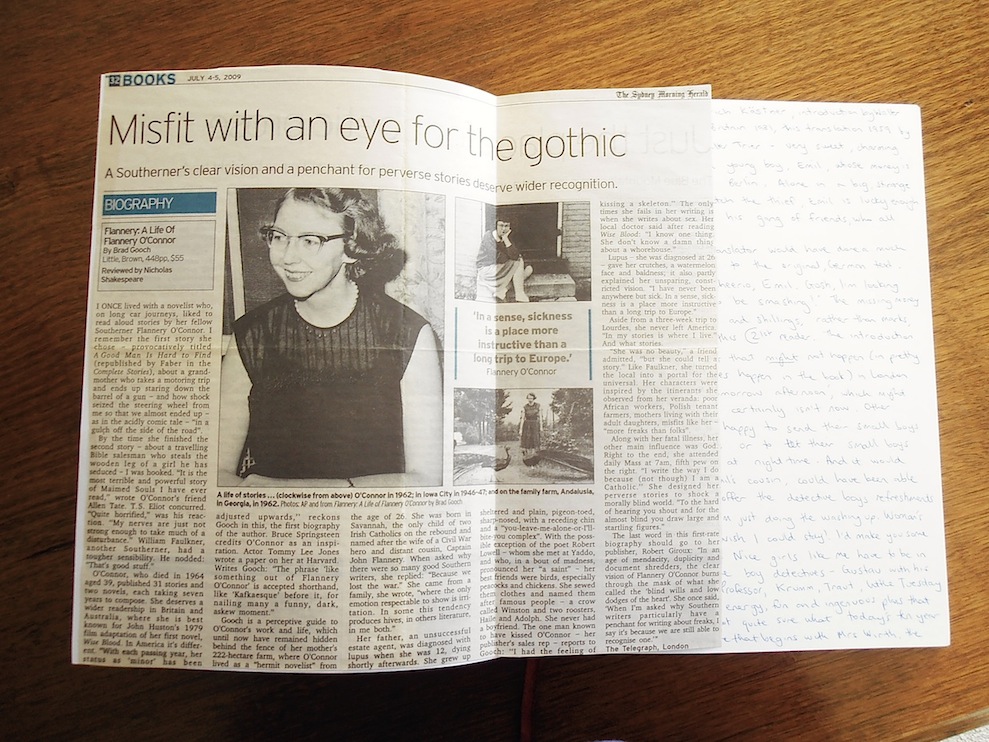
book review in journal

At the front of my journal, I keep clippings of book reviews and Post-It notes of titles that have caught my attention. When I start to run out of books to read, I consult these notes and reviews, and track the books down at the library or the bookstore (usually the library, because I am now an impoverished writer lacking a Proper Job). My current To Be Tracked Down book list includes:

The Uninvited Guests by Sadie Jones
A Few Right Thinking Men by Sulari Gentill
Cold Light, the final book in the Edith Campbell Berry trilogy, by Frank Moorehouse
Backwater War by Peggy Woodford
Lettie Fox by Christina Stead
A Pattern of Islands by Arthur Grimble

There are also quite a few books on my list that have not been treated to very much investigation at all. For example, I have a Post-It note that says ‘Hilary McKay – Casson family?’, which means I haven’t actually got around to looking up the book titles, let alone reserving them from the library. I also got stuck on Patrick Melrose’s novels, because the library catalogue informed me it only had the fourth book in a five-book series. (Does anyone know if I need to read Never Mind/Bad News/Some Hope before Mother’s Milk? Or are the books so depressing that I’ll regret reading any of them?) Still, it’s not as though I have a dearth of reading material at the moment.

Now that I’ve started a book journal, I wish I’d kept a record of all the books I’d ever read. It would be fascinating to see what I thought of The Famous Five and Trixie Belden and What Katy Did and all those other books I loved to pieces (literally) in my early reading years. Or maybe it would just be really embarrassing.

* That is, a job which involved me commuting by train to an office, often while wearing a suit, and having someone else pay me each fortnight and even pay me when I went on holiday or got sick . . . Oh, those were the good old days.
** It’s a detail from Part Seen, Imagined Part (1896), which apparently can be viewed at the Kelvingrove Art Gallery and Museum in Glasgow.
*** One day I will figure out how to do proper footnotes in WordPress.

For those of you who keep book journals, I’d also like to remind you that my book giveaway is still open, till the end of the month. You could win a copy of the Vintage Classics edition of A Brief History of Montmaray and then write about it in your journal! (Note: Those who don’t have book journals are also welcome to enter the giveaway.)

Vintage Classics Book Giveaway

'A Brief History of Montmaray' Vintage Classic edition

A Brief History of Montmaray is being re-published as a Vintage Classic Children’s book next month. This new edition has a lovely illustrated cover by Samantha Battersby and features the original illustrated introduction page by Zoë Sadokierski:

'A Brief History of Montmaray' illustrated introduction page

And there are some added extras – historical background information, reading group discussion questions and information about some of Sophie’s own favourite classics. It goes on sale in Australia and New Zealand on the first of August, but I’m also giving away three copies here. For all those North American readers who were curious about the original text of A Brief History of Montmaray before it was edited for American readers – here it is! And for Australian and New Zealand readers who already have the Australian edition – um . . . oh look, pretty cover! And cute sketches of puffins and teapots and cats inside the covers! (Note: if an Australian or New Zealander wins a book and would actually prefer a copy of the North American paperback, I’ll send them that instead.)

Usually, when I hold a book giveaway on my blog, I ask people for book recommendations, but I thought I’d do something a bit different this time. To enter this book giveaway, leave a comment below about your favourite film (or television series) adapted from a book you’ve loved. I’ll start you off with some of my favourites.

1. Brideshead Revisited, 1981 television series. One of those rare examples of a television series being better than the book, in my opinion. All those pompous sermons in the final section of the novel were turned into poignant monologues or the sort of dialogue that real people might actually speak. Special mention must go to Jeremy Irons for transforming snobby, wife-abandoning Charles into a sympathetic character. And the bear who played Aloysius did a pretty good job, too. (Let’s just ignore that 2008 film version, shall we?)

2. Cold Comfort Farm, 1995 film. This has a dream cast – Ian McKellen, Eileen Atkins, Miriam Margolyes, Rufus Sewell (in unbuttoned shirt), Stephen Fry, Joanna Lumley and Kate Beckinsale. The film’s almost as funny as the book, and that’s high praise.

3. Harry Potter and the Goblet of Fire, 2005 film. I think this was my favourite Harry Potter film. The Yule Ball! Draco as a ferret! Hedges that eat people! A Voldemort who was even scarier than in the book! (They shouldn’t have killed the dragon, though – that was just mean.)

4. The Hitch Hiker’s Guide to the Galaxy, 1981 television series. Admittedly, it’s been a long time since I watched it and I’m sure today’s teenagers would scoff at the low-tech special effects, but I really loved this series. It probably helped that quite a few of the cast members had been part of the original radio series, but I can’t imagine a better Arthur Dent than Simon Jones. (And no, I haven’t seen the 2005 film version.)

5. Careful, He Might Hear You, 1983 film. A lovely film with a stellar Australian cast (including Robyn Nevin, Wendy Hughes and Geraldine Turner), based on Sumner Locke Elliott’s beloved novel.

So, what is your favourite film or television series, adapted from a book you’ve loved? Comment below for a chance to win one of three signed copies of the new Vintage Classics edition of A Brief History of Montmaray.

Conditions of entry:

1. This is an international giveaway. Anyone can enter.
2. Make sure the e-mail address you enter on the comment form is a valid one, so I can contact you if you win (no one will be able to see your e-mail address except me, and I won’t show it to anyone else). Please don’t include your real residential or postal address anywhere in the comment. However, it would be nice if you mentioned which country you live in, because I’m curious about who reads this blog.
3. The three winners will be chosen at random, unless there are three or fewer comments – in which case, it won’t be random and all will win prizes.
4. This contest and/or promotion is not sponsored or authorised by Random House Australia. Random House Australia bears no legal liability in connection with this contest and/or promotion. (My Australian publishers say I have to put this bit in. This is the first time I’ve ever given away any of my Australian books on my blog.)
5. Entries close on the 1st of August, 2012, when the Vintage Classics edition of A Brief History of Montmaray goes on sale in Australia. The winners will be e-mailed then, and I will send off the winners’ books as soon as possible after that.

Note: This book giveaway is now closed. Click here to see the names of the lucky book winners.

Miscellaneous Memoranda

The National Year of Reading Read This! prize winners have been announced, after attracting lots of fabulously creative entries from young readers. I think my favourite entry was the knitted Wizard of Oz characters by twelve-year-old Lexi, although the papier-mâché model of James and the Giant Peach by Michelle, also twelve years old, was wonderful, too. (Also, I just discovered that ‘papier mâché’ is French for ‘chewed paper’. Thanks so much for telling me that, Oxford Dictionary.)

Entries in the 2012 John Marsden Prize for Young Australian Writers are now open, with “young writers under the age of 25 [. . .] urged to enter the competition to share in $5,500 in prize money and have the opportunity to be published online and in the December issue of Voiceworks, Express Media’s literary quarterly.” You have until September to enter your short story or poem, with more information here.

Speaking of young readers and writers, there’s a great new(ish) online magazine for teenage girls called Rookie. I wish magazines like that had existed when I was a teenager. (Sadly, the internet hadn’t even been invented when I was a teenager.)

There’s an interesting article here by Anthony Horowitz about how book covers end up plastered with glowing endorsements from other writers. I’m currently reading a YA novel by an established US author, and the Cassandra Clare endorsement (“A gorgeously written, chilling atmospheric thriller.” CASSANDRA CLARE, bestselling author of THE MORTAL INSTRUMENTS SERIES) takes up more space on the front cover than the name of the book’s author. But do book buyers actually pay any attention to these quotes? As the first commenter on the article says, “Probably the only people who would truly benefit from an author’s endorsement are new or little-read authors – exactly the kind of people who (for completely understandable and rational reasons) are least likely to get them.”

I recently read two fascinating articles about successful novelists who decided to stop writing (and, presumably, to stop endorsing other authors’ books). “There’s just too much stress on authors,” said Steph Swainston, author of the Castle series. She was unhappy with the pressure from fans and publishers to produce a book a year, and disliked the modern need for authors to be ‘celebrities’ and engage with social media (“The internet is poison to authors”). The other author, Elizabeth Harrower, was less forthcoming about why she stopped writing in 1966:

“It’s not as though she ran out of things to say – ‘there were probably too many things to say’. It’s not as though her work was poorly received – her second novel, The Long Prospect, was described as ranking ‘second only to Voss as a postwar work of Australian literature’. It’s not as though she was busy raising children – she never married and is childless.”

In the end, she simply says, “[I] realised I just can’t be bothered any more.”

To end on a more positive note, this year The Famous Five celebrate the seventieth anniversary of their first adventure, Five on a Treasure Island. Naturally, the celebratory feast will feature ham sandwiches on crusty bread, hard-boiled eggs, currant buns and lashings of ginger beer.

This Writing Life

Shannon asked me about the new book I’m working on, so I composed a long blog post on the subject, complete with jokes and a cool photograph of a turtle. But then I read over it and realised I didn’t feel comfortable revealing that much detail about a writing project that’s at such an early stage, it doesn’t even have a title, let alone a publisher.

So I deleted the post.

But it wasn’t a complete waste of time, because I also realised that writing that post had made me feel more confident about this new book. After I finished The FitzOsbornes at War, I flipped through my mental catalogue of Ideas For Books and decided I needed to write something that would not be the start of a series, would not be a complicated family saga, would not include scenes of heart-rending anguish, and would not require much research. This next book would be fun and easy to write!

Of course, it hasn’t turned out quite the way I’d expected. I’ve spent the past six months compiling a vast folder of notes and diagrams and photocopies, but feel I’ve barely started on the research. It isn’t a complicated family saga, but at the heart of the story is a mystery that requires far more complicated plotting than I’ve ever before attempted. It was supposed to be a stand-alone novel, but I already have ideas for a sequel and I’m not even sure the book would be best described as a ‘novel’. Plus, there’s at least one scene of heart-rending anguish.

But as I wrote the blog post, which was in the form of a dialogue between the two main characters, I realised that I actually knew quite a lot about how the whole thing would fit together. I knew most of the facts I needed to know, and even better, I could see what I still didn’t know and I knew how to find out what I needed. The best part, though, was that as the two characters argued and joked and talked over the top of one another, I could hear their voices in my head just as clearly as I used to hear the FitzOsbornes. I could see the two girls waving their hands about and rolling their eyes at each other – I even laughed out loud at one of their jokes (yes, their joke, not mine). And that’s when I thought that I might actually be able to write this book, and that made me very happy.

Unfortunately, that doesn’t really answer Shannon’s question, but I will say that the book is about science and history, and it’s set in Sydney, and I wrote a bit about it here.

On a slightly different topic, I’ve noticed that a tiny corner of Tumblr has been taken over by some FitzOsborne fans, who have set up a blog devoted to Montmaray. There are some fabulous graphics based on the books, as well as a film trailer that looks so professional that, for a moment, I wondered if I’d absent-mindedly sold the film rights to the BBC, then forgotten about it. However, I think my favourite fannish creation is this post, which sorts the FitzOsborne cousins into Hogwarts Houses and gets it exactly right. It doesn’t include Henry FitzOsborne, but she is obviously in Gryffindor. I’m not sure about Carlos – Hufflepuff or Gryffindor? Aunt Charlotte would simply refuse to let that grubby old hat touch her head, then would stalk out to set up a Thestral racing syndicate (Minister for Magic: But . . . but we can’t permit those creatures to race each other! Half the spectators wouldn’t even be able to see which Thestral won! Aunt C: I shall announce the winner of each race. Now get out of my way, you silly little man.) As for the other characters, Rupert is clearly pure Hufflepuff, but what about Daniel – Hufflepuff or Ravenclaw? Would Julia end up in Slytherin or Gryffindor? Anyway, I love how those characters have wandered out of the books and into the imaginations of some readers. That’s what makes writing so rewarding, when the books take on a life of their own. It makes up for all those times when I was writing the Montmaray books and felt daunted and discouraged and wondered why I kept plodding on. It’s because eventually the books get finished, and they find a reader or two to love them.

And that’s what I keep reminding myself, as I work on this new book.