
A note for the benefit of those new to this series: ‘dated’ means ‘of its time, not ours’. ‘Dated’ books can be horribly offensive to modern sensibilities, or they can be charmingly nostalgic, or they can simply be a bit . . . odd. Friday’s Tunnel by John Verney falls mostly into the charmingly nostalgic category, with the dated bits generally being amusing, rather than annoying. It was recommended to me by Debbie during my search for 1950s schoolgirl books, so thank you, Debbie – I thoroughly enjoyed this book (and took careful notes on the schoolgirl slang, hobbies, clothes and other useful information contained therein). But first I ought to show you the lovely old hardcover I purchased from Rainy Day Books:
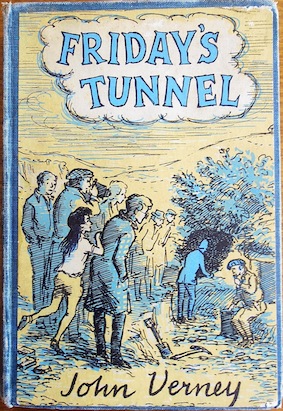
This was once a library book at the ‘City of Collingwood Junior Library’ and the following letter to ‘Junior Borrowers’ is pasted in the front:

I wish all the adults who borrow books from my local library would follow that advice.
I should also point out that my 1959 (first?) edition includes lots of great illustrations by the author, as well as a detailed map (which certainly came in handy, given the complicated plot).
Friday’s Tunnel is narrated by February Callendar, who we learn is “stuck in bed for ages with a broken nose, a broken pelvis and a broken several other things” and is therefore at leisure to write down the extraordinary story of how she managed to save the world during her summer holidays, when she’d actually planned to spend all her time practising show jumping for the district gymkhana and improving her overarm tennis serve (both of which turn out to be very useful skills when dealing with the villains). She also explains that she intends to write “the sort of book I like to read, which means one with a map and drawings, and talk on every page and not one with long descriptions about the sun’s early rays touching the feathery beech-tips with gold and gossamer quivering in the dew, because I think dew is soppy and anyway I’m usually still asleep when all that sort of thing is going on”.
February’s adventure reminded me quite a lot of the Tintin books, even though she herself never actually leaves England. It involves, among other things, a world crisis triggered by a (possibly fake) coup d’état in a small island kingdom called Capria, a mysterious mineral that might be capable of blowing up the world, a millionaire businessman and his vulgar wife, a mysterious plane crash, a missing journalist, a dead body in a canal, a celebrity racing car driver, secret tunnels, a sinister sweet shop owner and a newspaper cartoon strip that may (or may not) contain vital coded messages.
And as with Tintin, the attitudes are from the 1950s. The villains are all swarthy and “foreign-looking”, even if they’re British. The Caprian President, Umbarak, however, was educated at Harrow, so he is “a Christian and a highly civilised man with Western ideas who had enabled the Caprians to live free of fear for the only time in history”, whereas his half-brother Zayid, the coup leader, is “just a bandit like his Moslem forefathers . . . mixed up in every racket in the Mediterranean and the Middle East”. Umbarak has “a gentle, beautiful face like a prince in a fairy tale” and is described as a “saint”, while Zayid looks “splendidly fierce”. I don’t think Zayid is actually Muslim, though, because he drinks alcohol, gambles, sells dope and smuggles “Jewish emigrants into Palestine”. It must also be noted that February and her brother Friday are much more sympathetic towards Zayid (February thinks he sounds “more fun” and she “rather sympathised with him for shutting Umbarak up in the Jenin Palace”, while Friday thinks Umbarak sounds “wet” and that one of Zayid’s more ingenious dope-smuggling rackets is “a wizard idea”). A friend of February’s father, a Very Important Man in the War Office, later gives a pompous speech about how Britain ought to take charge of all the stock of the mineral caprium because “England is the only Great Power who could use caprium as it must be used if the world is to survive”, although his view is countered by the newspaper editor who says, “We happen to believe that if the world is to survive, Great Powers simply must stop grabbing everything they think they can get away with and try behaving openly for a change.” (Sadly, the current leaders of the Great Powers do not appear to agree with this last viewpoint. And I think the characters in this book are being overly optimistic to describe Britain in 1959 as a “Great Power”.)
But it was all the science-y bits that had me either groaning or laughing at their dated-ness. I’ve noticed during my recent 1950s reading that fiction writers of the time seemed obsessed with the notion that science was about to annihilate humanity (which I guess is understandable after nuclear bombs destroyed Hiroshima and Nagasaki in 1945) and that all scientists, but especially physicists, were believed to be secretive, incomprehensible and slightly deranged. So I was not surprised to see that science plays a large role in this book. A schoolboy friend of February’s is “mad on chemistry” and is constantly doing dangerous experiments (which, by the way, cause no concern to his parents, even when he burns off his sister’s hair with acid). He buys a lot of different cigarette brands (one of which is supposed to be “non-cancer”) to test, and wonders why one is wrapped in paper that won’t burn. His father, the village doctor, thinks the paper is probably made of asbestos:
“No reason why it shouldn’t be used instead of tin-foil,” he said. “Perhaps it preserves the cigarettes better in some way.”
Then he wanders off (probably smoking his pipe). Mind you, this is the same doctor who cheerfully discusses his patients’ details with February, explaining that the old woman he’s about to see only has a fever because she “gets herself so excited with all the things she thinks are wrong with her” so he’s going to give her “the nastiest tasting medicine I can think of, which is asafoetida and bromide”. Which is probably an accurate description of the behaviour of doctors, in the days before anyone paid much attention to ideas like “patient confidentiality” and “evidence-based medicine”.
But the funniest part was when the War Office bigwig gave a solemn lecture on physics, explaining that uranium is “the heaviest” element1 and that Britain’s “top nuclear physicist has had a nervous breakdown” because the mysterious mineral caprium has “upset his confidence in himself” and he’s been forced to accept that “all his knowledge is no less ludicrous than was the flat earth theory in its day”. I’m pretty sure “top nuclear physicists” don’t usually go “round the bend” when they come across a new, interesting element (isn’t that what they hope for?) and in any case, the reported properties of caprium don’t actually seem to prove that the atomic theory is wrong. (Also, despite no one understanding what caprium does, the War Office bigwig straps a bag of (possibly radioactive) caprium to his abdomen to cure his duodenal ulcer, which, of course, has been caused by the stress of dealing with the caprium crisis.)
Overall, though, I enjoyed February’s story very much. Her voice is lively and often very funny, her eccentric family and friends are entertaining, and the dated bits are quite amusing. Recommended for fans of Tintin or for those who wish the Famous Five books had had more plausible characters and more complex plots.
More ‘dated’ books:
1. Wigs on the Green by Nancy Mitford
2. The Charioteer by Mary Renault
3. The Friendly Young Ladies by Mary Renault
4. Police at the Funeral by Margery Allingham
5. Emil and the Detectives by Erich Kästner
6. The Wind in the Willows by Kenneth Grahame
7. Swallows and Amazons by Arthur Ransome
8. Kangaroo by D. H. Lawrence
_____
- I was pretty sure that heavier elements had been synthesised during or just after the war, so I looked up the history of the periodic table, and yes, by 1959, there were at least five discovered elements heavier than uranium, with even heavier elements that had been theorised and were later observed. But then again, the author couldn’t Google this information in thirty seconds, as I just did. ↩
 The ‘Leopard’ is Don Fabrizio, the head of an ancient noble family of Sicily in 1860, which is not a very good time to be a Sicilian prince. Should Don Fabrizio continue to prop up the disintegrating Kingdom of the Two Sicilies or should he support Garibaldi and his Red Shirts as the rebels attempt to unify Italy? Don Fabrizio’s handsome, charming nephew, Tancredi, has no doubts. “If we want things to stay as they are, things will have to change,” declares Tancredi. Then he rushes off to join the Red Shirts, gains a heroic (but not very serious) wound, and swaggers back to the family’s country estate, where he falls in love with the mayor’s beautiful daughter, to his cousin Concetta’s dismay. A further dilemma for Don Fabrizio! Should he permit, even encourage, this marriage? The mayor, Don Calogero, is vulgar, devious and violent, the very opposite of a nobleman, but he’s rich and powerful and the marriage would allow ambitious Tancredi to prosper in this new regime. But what about poor Concetta’s broken heart? Will she continue to spurn Tancredi’s friend, the shy but devoted Count? Will the hapless family priest, Father Pirrone, ever manage to convince Don Fabrizio to take religion seriously? Will Paolo, Don Fabrizio’s useless son, ever turn into a worthy heir? And will Bendicò, Don Fabrizio’s affectionate but destructive Great Dane, ever stop digging up the flower beds?
 The author, a British historian, was given limited access to MI5’s archives and then the final manuscript was vetted by MI5 to remove anything that “would damage national security” or be “inappropriate for wider public interest reasons” (that is, anything that might make MI5 look bad). The book does provide a good overview of the early years of MI5 (which was founded in 1909 to deal with the threat of German imperialism) and of MI5’s work during the two world wars. However, the closer it gets to the current day, the more guarded the author becomes. He’s reluctant to criticise any of MI5’s actions during the 1950s and 1960s, which included helping the CIA overthrow the democratically elected government of British Guiana (on the grounds the Prime Minister had Communist sympathies, although ironically, the man they put in his place actually strengthened the country’s links with the Soviets), plotting to assassinate inconvenient people (Colonel Nasser in Egypt, for instance) and spying on ‘friends’ (bugging the French Embassy during European Economic Community negotiations and eavesdropping on African leaders during independence talks). At most, Andrew is mildly disapproving when Guy Liddell, an MI5 Director, vehemently opposes independence for the colonies because the “niggers” (Liddell’s term, used in official correspondence) aren’t capable of governing their own countries – but then Andrew excuses this on the grounds that everyone thought that way in the mid-twentieth century. The author also apparently has no problem with MI5 targeting British citizens regarded by the (Conservative) government as ‘subversives’, including such dangerous people as trade unionists, members of the Labour Party and suburban grandmothers campaigning for nuclear disarmament. (Communists, the lot of them! They deserve to be spied on!) He also goes to great lengths to accuse Harold Wilson, the Labour Prime Minister who believed MI5 was bugging his office, of paranoia and outright insanity. But MI5 did keep a file on Wilson! MI5 had previously
  Next I turned to a more controversial book, Spycatcher by Peter Wright, a former MI5 officer. Australians may remember that the British government tried to ban its publication in Australia, with the book successfully defended in court by none other than Malcolm Turnbull
 Her book also provides an interesting account of how MI5 was forced to change in modern times – to become more professional and accountable to the public, and to recruit more diverse staff. She’s particularly good at describing the challenges faced by women working within MI5. When she joined in the 1960s, women were not thought capable of doing anything other than administrative tasks, and her managers were bemused and sometimes hostile as she battled to become an officer and progress up the ranks to become a director (although she insists she wasn’t one of those “aggressive feminists”). Her work was made even more difficult because she was a single parent. At one stage, when child care arrangements fell through, she ended up taking her young daughter with her to a ‘safe house’ where she’d arranged to meet a contact. On another occasion, she was about to leave to meet a possible Soviet defector when her nanny called to say Rimington’s daughter was being rushed to hospital, suffering convulsions. (Rimington ended up going to the hospital after the defector meeting, but having to borrow money from the potential defector for taxi fares to the hospital. Perhaps that’s why he decided against defecting.) Family life was further disrupted when Rimington became the first Director-General to be publicly named, which caused a media sensation and meant that she and her daughter (and dog) had to leave their home and hide in an MI5 ‘safe house’ while her daughter was trying to do her A-levels (their dog, however, quite enjoyed this because he got to go on patrols with the security guards and was made an honorary member of the security team, with an official pass attached to his collar).


 and
and