
I’ve been plodding on through the 1950s and 1960s, which has included reading books written about the period in more recent times. (This, by the way, did not involve much adventure. I just borrowed all these books from my local library.) First was Family Britain: 1951-1957 by David Kynaston, which was a thoroughly researched sociological history, examining issues such as housing, entertainment and food, as well as taking a close look at a few significant political events, including the Suez crisis. There’s lots of detail about the experiences of working class and lower middle class people, told in their own words (often thanks to the interviewers from Mass Observation) so the book was often very interesting – but it was slightly disorganised and repetitious, so this is possibly not a book for the general reader.
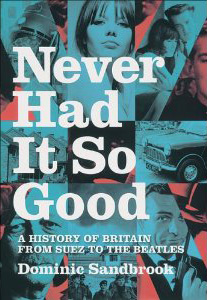 Those looking for a more entertaining read about the period may prefer Never Had It So Good: A History of Britain from Suez to the Beatles, 1956-63, by Dominic Sandbrook. This is also very detailed and carefully researched, and it was particularly good at summarising important political events (for example, the resignations of Prime Ministers Anthony Eden and Harold Macmillan and subsequent political manoeuvrings). There are also interesting discussions of popular culture (film, television, music and books), although the author’s personal biases become apparent here. For example, he devotes more than an entire chapter to Kingsley Amis, who Sandbrook believes is “brilliantly funny”, with Lucky Jim considered to be “a work of tremendous influence”, “emblematic of a post-war literary trend”, with an immense number of imitators (Really? Did Amis have more imitators than, say, J. R. R. Tolkien?). Meanwhile, William Golding, Iris Murdoch, Muriel Spark, John Fowles, Anthony Burgess, Mervyn Peake, C. S. Lewis and Tolkien are collectively dealt with in three sentences. Similarly, women are nearly absent from this book. There are a couple of pages about Christine Keeler (the young woman at the centre of the Profumo scandal), a few references to a young Tory politician named Margaret Thatcher, some anonymous housewives buying washing machines and a horde of anonymous teenage girls screaming at the Beatles, but that’s it (and don’t expect much about topics such as fashion, either). Otherwise, this is an entertaining, informative read about the late 1950s and early 1960s.
Eager to find out more about women’s experiences, I turned to Sheila Rowbotham‘s Promise of a Dream: Remembering the Sixties. Goodness, it was dull. There are a few interesting anecdotes about her personal experiences as a young academic and political activist, but mostly it was pages and pages of tedious squabbling between various Left factions – trade unionists versus Marxist academics, Leninists versus Trotskyists versus Maoists, and so on – with every single participant named and none of them actually seeming to achieve anything useful. Most of the men are appallingly sexist and the book becomes more interesting when the women start to object to this behaviour and begin ‘consciousness-raising’ groups to share their experiences. Unfortunately, this doesn’t happen until the final chapter, and the book ends with the author and others planning the first Women’s Liberation conference in Britain, which was held in 1970. The author does make an interesting point, linking the 1960s hippies to Margaret Thatcher’s economic policies:
“The ‘do your own thing’ sense of individual liberation was turned into a justification of living completely for yourself. Elements of this self-absorption were also to persist, transmuting into the ruthless selfishness which would come into ascendancy in the late eighties.”
Jenny Diski, author of The Sixties, agrees and takes this idea further:
“There are two accusations: that we caused the greed and self-interest of the Eighties by invoking the self, the individual, as the unit of society and setting up individualism for the Right to pick up and run with; or that we caused it by being so permissive, so soppy about matters that needed hard, firm handling, that a reaction was inevitable if the West wasn’t to sink into a morass of self-indulgent chaos.”
 Otherwise, this is a very different sort of book, a collection of entertaining personal essays on the topics of consumerism, drug-taking, sex, revolutionary politics, education and mental health in ‘the Sixties’ (which is defined as circa 1965-1974). It wasn’t particularly useful for my research purposes, as Jenny Diski’s experiences were so outside the ‘norm’ (for example, she was expelled from school at fifteen for sniffing ether, was incarcerated in various mental institutions, then lived in a commune with drug addicts and then, while still a young trainee teacher, set up her own school for disadvantaged children, run on ‘alternative education’ principles). However, I found it fascinating and often very funny. (Jenny Diski is a novelist, and Sheila Rowbotham an academic and historian, and it shows.) (Oh, I just found Jenny Diski’s review of Sheila Rowbotham’s Promise of a Dream in London Review of Books. Ha!)
To give myself a break from politics and drugs and mental asylums and so on, I then read 84, Charing Cross Road by Helene Hanff, a charming and very funny collection of correspondence between Miss Hanff, an irreverent New York writer, and Mr Doel, a stuffy London bookseller. The letters began in 1949 when she wrote to order a book from the antiquarian shop where he worked, but soon the correspondents included the bookseller’s colleagues, wife and neighbour, as well as the writer’s friends, with books, recipes and gifts being exchanged across the Atlantic for the next twenty years. If you love books, you will adore this.


 Less ridiculous, but still entertaining, is Here’s England by Ruth McKenney and Richard Bransten. This is another American-tourists-in-1950s-England guidebook, but this one ranges a bit further than London, travelling as far south as Cornwall and north to Yorkshire. The authors believe England is “the most beautiful, wonderful, exciting country in Europe”, but they caution their fellow Americans: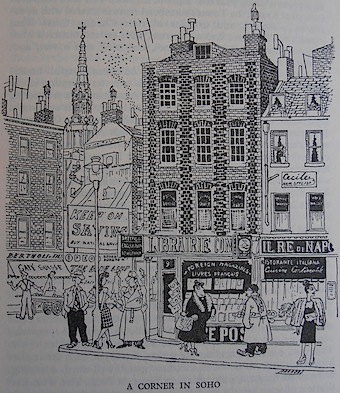

 Some of the descriptions, particularly of clothes and food, have dated badly (I doubt that respectable lower-middle-class women wear “a navy crimplene two-piece trimmed with lemon” to weddings nowadays or that they decorate their food with radish flowerets) but I suspect quite a lot of the observations still hold true, especially regarding attitudes to schools and universities. There are sweeping generalisations, especially about the working classes, and a lot of terrible, terrible puns, but I found this to be a very entertaining (and occasionally informative) read. I should also note that the edition I read had a very strange cover photograph (see above), depicting what appeared to be a palette knife with some green lumps (olives? uncut emeralds?) balanced on the end of it, but this was explained in an early chapter: