My Book Journal

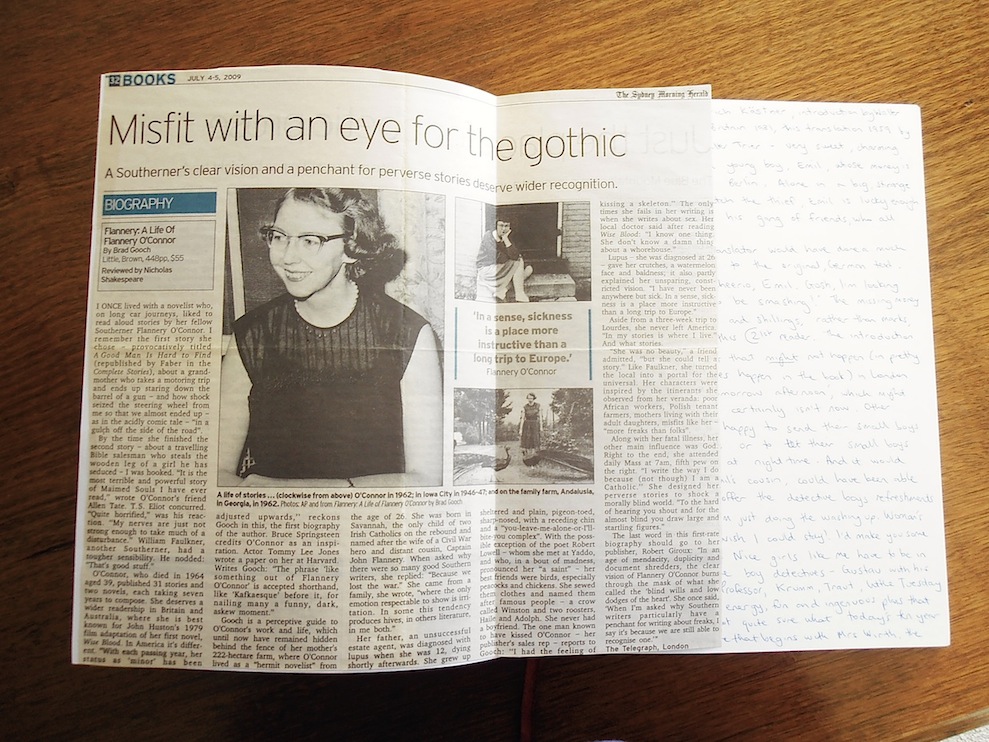
A few years ago, I stopped working at a Proper Job* and on my final day, my colleagues had a little party and presented me with a farewell gift – a lovely silver pen and a blank journal. I’d just had my first novel accepted for publication and my colleagues said I could use the pen and book to write my next novel. It was a lovely idea, and in fact, I did use the pen to take notes for A Brief History of Montmaray (and indeed, I still use that pen nearly every day, because it really is a very nice pen, of exactly the right size and weight and ink colour to suit my tastes). But as for the blank journal – well, I type my novels on a computer, and when I take research notes, they’re scribbled on cheap lecture pads and technicoloured Post-It notes. I couldn’t imagine writing a novel (with all the crossing-out and page-tearing-out that that involves) in a beautiful journal with gilt-edged pages, decorated with a detail from a Charles Rennie Mackintosh painting**.

book journal cover

gilt-edged pages of book journal

blank book pages in journal

The book was simply too pretty to sully with my scribblings, so it sat in a cupboard for a couple of years.

However, at the start of 2011, I decided it would be handy to keep a record of all the books I read and to make brief notes on the books I found interesting (either interestingly good or interestingly bad). I suppose I could have just joined Goodreads or LibraryThing, as everyone else does, but I wanted to keep my notes private. I considered setting up some sort of spreadsheet on my computer, but that sounded too much like hard work. And then I remembered my ‘Blank Note Book’.

Readers, it is blank no more.

entry in book journal

Note: Photo is artfully blurred so you can’t see what I wrote about Insignificant Others and Dead Until Dark – although I did enjoy both those books, for different reasons.

I write down the title and author of each book I read and what I thought of the book. Sometimes I only write a sentence; sometimes I write pages. I often write about the book’s structure and the effectiveness of the literary devices used, because analysing other books helps me to become a better writer. But just as often, my book journal reflects how I was feeling and what was going on in my world at the time I read the book, so I guess it is a bit like a personal diary. The books I really loved get a star, and I use the stars to compile my Favourite Books blog post at the end of each year. Sometimes I also stick in the review that prompted me to try the book in the first place.

book review in journal

At the front of my journal, I keep clippings of book reviews and Post-It notes of titles that have caught my attention. When I start to run out of books to read, I consult these notes and reviews, and track the books down at the library or the bookstore (usually the library, because I am now an impoverished writer lacking a Proper Job). My current To Be Tracked Down book list includes:

The Uninvited Guests by Sadie Jones
A Few Right Thinking Men by Sulari Gentill
Cold Light, the final book in the Edith Campbell Berry trilogy, by Frank Moorehouse
Backwater War by Peggy Woodford
Lettie Fox by Christina Stead
A Pattern of Islands by Arthur Grimble

There are also quite a few books on my list that have not been treated to very much investigation at all. For example, I have a Post-It note that says ‘Hilary McKay – Casson family?’, which means I haven’t actually got around to looking up the book titles, let alone reserving them from the library. I also got stuck on Patrick Melrose’s novels, because the library catalogue informed me it only had the fourth book in a five-book series. (Does anyone know if I need to read Never Mind/Bad News/Some Hope before Mother’s Milk? Or are the books so depressing that I’ll regret reading any of them?) Still, it’s not as though I have a dearth of reading material at the moment.

Now that I’ve started a book journal, I wish I’d kept a record of all the books I’d ever read. It would be fascinating to see what I thought of The Famous Five and Trixie Belden and What Katy Did and all those other books I loved to pieces (literally) in my early reading years. Or maybe it would just be really embarrassing.

* That is, a job which involved me commuting by train to an office, often while wearing a suit, and having someone else pay me each fortnight and even pay me when I went on holiday or got sick . . . Oh, those were the good old days.
** It’s a detail from Part Seen, Imagined Part (1896), which apparently can be viewed at the Kelvingrove Art Gallery and Museum in Glasgow.
*** One day I will figure out how to do proper footnotes in WordPress.

For those of you who keep book journals, I’d also like to remind you that my book giveaway is still open, till the end of the month. You could win a copy of the Vintage Classics edition of A Brief History of Montmaray and then write about it in your journal! (Note: Those who don’t have book journals are also welcome to enter the giveaway.)

Miscellaneous Memoranda

The National Year of Reading Read This! prize winners have been announced, after attracting lots of fabulously creative entries from young readers. I think my favourite entry was the knitted Wizard of Oz characters by twelve-year-old Lexi, although the papier-mâché model of James and the Giant Peach by Michelle, also twelve years old, was wonderful, too. (Also, I just discovered that ‘papier mâché’ is French for ‘chewed paper’. Thanks so much for telling me that, Oxford Dictionary.)

Entries in the 2012 John Marsden Prize for Young Australian Writers are now open, with “young writers under the age of 25 [. . .] urged to enter the competition to share in $5,500 in prize money and have the opportunity to be published online and in the December issue of Voiceworks, Express Media’s literary quarterly.” You have until September to enter your short story or poem, with more information here.

Speaking of young readers and writers, there’s a great new(ish) online magazine for teenage girls called Rookie. I wish magazines like that had existed when I was a teenager. (Sadly, the internet hadn’t even been invented when I was a teenager.)

There’s an interesting article here by Anthony Horowitz about how book covers end up plastered with glowing endorsements from other writers. I’m currently reading a YA novel by an established US author, and the Cassandra Clare endorsement (“A gorgeously written, chilling atmospheric thriller.” CASSANDRA CLARE, bestselling author of THE MORTAL INSTRUMENTS SERIES) takes up more space on the front cover than the name of the book’s author. But do book buyers actually pay any attention to these quotes? As the first commenter on the article says, “Probably the only people who would truly benefit from an author’s endorsement are new or little-read authors – exactly the kind of people who (for completely understandable and rational reasons) are least likely to get them.”

I recently read two fascinating articles about successful novelists who decided to stop writing (and, presumably, to stop endorsing other authors’ books). “There’s just too much stress on authors,” said Steph Swainston, author of the Castle series. She was unhappy with the pressure from fans and publishers to produce a book a year, and disliked the modern need for authors to be ‘celebrities’ and engage with social media (“The internet is poison to authors”). The other author, Elizabeth Harrower, was less forthcoming about why she stopped writing in 1966:

“It’s not as though she ran out of things to say – ‘there were probably too many things to say’. It’s not as though her work was poorly received – her second novel, The Long Prospect, was described as ranking ‘second only to Voss as a postwar work of Australian literature’. It’s not as though she was busy raising children – she never married and is childless.”

In the end, she simply says, “[I] realised I just can’t be bothered any more.”

To end on a more positive note, this year The Famous Five celebrate the seventieth anniversary of their first adventure, Five on a Treasure Island. Naturally, the celebratory feast will feature ham sandwiches on crusty bread, hard-boiled eggs, currant buns and lashings of ginger beer.

Alex and Me by Irene M. Pepperberg

'Alex and Me' by Irene M. PepperbergI love birds, and science, and books, so how could I not love a book about a talking bird, written by the scientist who raised him? Alex and Me is a touching, funny account of a scientist who trained an African Grey parrot to talk, in order to gather information about bird cognition and language. Alex learned how to label colours, materials and objects, knew ‘same’ versus ‘different’, was able to construct original phrases from words he’d been taught, could count to six and possibly add numbers, and even taught himself to segment words into phonemes, after being taught how to link English speech sounds to plastic letters. He played jokes on his trainers, loved to dance and be tickled, and said ‘I’m sorry’ and ‘Calm down’ during tense situations after watching people in the lab use these phrases. The book is full of entertaining Alex anecdotes – for example, he once ordered a toy parrot, ‘You tickle!’ and then, when the toy failed to respond, said, ‘You turkey!’ and stalked off in a huff. When recuperating at the vet’s after an operation, he wanted to talk to everyone he saw, including the accountant who was working late one night:

“‘You want a nut?’ Alex asked her.
‘No, Alex.’
He persisted. ‘You want corn?’
‘No, thank you, Alex, I don’t want corn.’
This went on for a little while, and the accountant did her best to ignore him. Finally Alex became exasperated and said in a petulant voice, ‘Well, what do you want?’ The accountant cracked up laughing and gave Alex the attention he was demanding.”

I must admit that Dr Pepperberg is not the world’s greatest writer, and this book would have benefitted from further editing. I really didn’t need to know the details of the author’s childhood or her early studies, for example, and I would have liked more information about how Alex produced human-like sounds when he didn’t have lips or teeth. I’d also have loved some photos of Alex (although I later found a film clip of him in action). Another issue, barely alluded to in the book, is how captivity affected Alex’s life. His beak, claws and wings were clipped when he was young, and he never had the chance to fly, to sit in a tree or to mate with another parrot. Dr Pepperberg had difficulties securing permanent research funding, and the constant moves around the country made Alex so stressed that at times, he pulled his own feathers out. I’d like to think that a similar research project nowadays would show greater concern for the bird’s welfare, although it’s clear from the book that Dr Pepperberg and Alex had a strong, affectionate bond and that she was devastated by his relatively early death at the age of thirty-one.

One thing that surprised me was how resistant many scientists were to Dr Pepperberg’s theories (and evidence) about animal cognition and language, with many refusing to accept that animals could actually use ‘language’. Some continue to believe that Alex was merely repeating the sounds he heard without any understanding of their meaning, and that his intelligent behaviour was simply a ‘Clever Hans’ effect, with Alex responding to cues from his handlers during testing. This seems highly unlikely to me – the research was carefully planned to control for the ‘Clever Hans’ effect by using multiple trainers and testers. Anyway, Alex repeatedly demonstrated complex, novel, situation-specific behaviours that could not have been prompted by his handlers. But perhaps some scientists feel threatened by the notion that animals other than themselves are capable of intelligent behaviour, of using language – of even, perhaps, experiencing human-like emotions.

I’ve never met an African Grey parrot, but I’ve spent the past decade watching the wild rainbow lorikeets that hang out on my apartment balcony and they use language. Rainbow lorikeets don’t imitate human sounds, but are capable of ‘almost continuous screeching and chattering’, as Jim Flegg’s Birds of Australia says. They make happy, murmuring sounds when they’re feeding or grooming each other; enquiring calls if their mate is out of sight, rising in intensity if the other bird doesn’t respond immediately; sharp, angry sounds when another bird muscles in on their territory; and inquisitive, chirruping sounds at me if I’m watering my balcony plants or appear to be eating something they might like. When baby rainbow lorikeets want their parents’ attention (which is pretty much all the time), they make a noise like bits of styrofoam rubbing against each other, and the harassed parents respond as quickly as they can. Isn’t that ‘using language’? But I think they go even further in human-like behaviours than simply using language.

One morning last year, I was awakened by the sound of some rainbow lorikeets screeching with distress outside my window. I went out to investigate, assuming they were being harassed by currawongs, and found a dead adult lorikeet lying on my balcony. It showed no obvious signs of injury or disease – the poor thing had simply died. Two lorikeets were sitting on the balcony railing, looking down at the dead bird and screeching, but they fell silent when they saw me and climbed down the railings to have a closer look. One of them started grooming the feathers around the dead bird’s face; the other took hold of the dead bird’s claw and gave it a couple of tugs, as if to urge it to wake up. The two birds climbed back up onto the railings to watch while I took the body away, and then flew to a nearby tree branch, where they sat for twenty minutes gazing at the spot where the dead bird had been. Did they feel sad? Or confused? It’s impossible to tell, but they were certainly unsettled by what they’d seen – and this was an adult bird that had died, not their baby.

As I don’t have any photos of Alex, here are some photos of rainbow lorikeets. First, a rainbow lorikeet eating a grape:

Rainbow lorikeet

And a group of rainbow lorikeets hanging out on my balcony:

Lorikeets on balcony

And finally, rainbow lorikeets take flight:

Rainbow lorikeets take flight

Reading Roundup

I’ve read some really good novels lately, which is fortunate for me, because the non-fiction I’ve been reading (as research for my next book) has been very heavy (in both the literal and figurative senses). Here are some of the novels I’ve enjoyed:

The Beginner’s Goodbye by Anne Tyler

'The Beginner's Goodbye' by Anne TylerI’d feared this might be merely a reprise of The Accidental Tourist, and it’s true the protagonists of these novels have many similarities – they are both introverted, socially-awkward men who write guidebooks, and they have both just lost a beloved family member in shocking circumstances. However, this book feels quite different in a lot of ways. It’s shorter, for one thing, and lighter in tone. In The Beginner’s Goodbye, Aaron’s wife has died in a freak accident, and there is nobody he can blame – not even God, because Aaron is an atheist. He copes with the loss of Dorothy by moving out of the house where she died and throwing himself into his work at the family publishing firm. He tells everyone he’s doing fine and he even believes it, until he suddenly begins to ‘see’ Dorothy. At first, she is a silent presence in his life, but eventually they begin to talk, and to argue, with more honesty than they ever did when she was alive. Aaron’s growing self-awareness feels true, his well-meaning friends and relatives are interesting and funny, and I loved the customary glimpse of a character from a previous Anne Tyler novel (in this case, it’s Luke from Dinner at the Homesick Restaurant, now grown up and yes, running a restaurant – perhaps he inherited it from his uncle Ezra). My only criticism would be that the final chapter wrapped things up a little too neatly (Luke even provides the moral of the story, as if we couldn’t work it out for ourselves), but by that stage, I was so fond of the characters that I was happy to see that they were happy. This is highly recommended for Anne Tyler fans, even if it’s not her best novel. There’s a good review of the book here and you can read my previous post about Anne Tyler here.

The Getting of Wisdom by Henry Handel Richardson

I had read this before, but that was so long ago I couldn’t remember anything about it, except that I’d liked it. This is a wonderfully honest story of a precocious, headstrong country girl sent to a snobby boarding school in 1890s Melbourne. Poor Laura gets into one scrape after another as she attempts to ingratiate herself with her classmates, but her gaudy, home-made frocks, outspoken manners, and lack of interest in boys means she’s doomed to failure. Fortunately, she manages to make it out of school with her self-esteem intact, and the final chapter implies she goes out into the world and achieves great things (unlike her classmates), because “even for the squarest peg, the right hole may ultimately be found”. The edition I read also included a hilarious review quote from a 1910 journal, which sternly declaimed:

“The book is calculated to impress very unfavourably those who do not know that the Australian girl is a much cleaner, wholesomer and straighter person than any of the characters portrayed. It is a book we should strongly recommend adults to keep out of the hands of girls.”

So, you’ve been warned.

Insignificant Others by Stephen McCauley

'Insignificant Others' by Stephen McCauleyThis felt a lot like a grown-up version of Peter Cameron’s Someday This Pain Will Be Useful To You, as both narrators were droll, articulate and perceptive when observing the failings of others, but were quite unable to acknowledge or fix their own problems. And the narrator of Insignificant Others, Richard, has plenty of problems. He has a distant relationship with his live-in boyfriend, who is probably cheating on him; he has an affectionate but futile attachment to a married man; he has become obsessed with exercising at the gym, to the detriment of his health; and he’s frustrated by his job at a software company. I’m not sure I’d usually care about any of these problems, but Richard’s narration makes the whole thing into a very entertaining satire of modern American life. For example, here’s Richard contemplating his homophobic, religious-fanatic secretary:

“The degree to which one is obliged, for the sake of tolerance, to be tolerant of the intolerant has never been clear to me.”

And, when arguing with his cheating partner:

“I hate when truthfulness is offered up as a sign of love and friendship, especially when it’s truthfulness about betrayal.”

And, after being berated, yet again, by his sister for not having children:

“The world of parents was divided between those like Benjamin who, worries about Tyler notwithstanding, had unqualified love for their kids and saw childlessness as a disability, and those like my sister Beth, who had ambivalent feelings about their offspring and therefore labelled childlessness as unmitigated selfishness.”

Recommended, unless you’re a fan of George W. Bush (Richard’s hilarious rants about Bush’s inadequacies feature throughout the novel). If you’d like to know more, there’s a review and excerpt here.

Regarding Internet Piracy

I’ve been contemplating this topic for a while, but put off blogging about it because . . . well, I suspected it would be a difficult and depressing experience. However, I’ve decided that writing this post as a discussion question, rather than a one-sided rant, might end up being very informative for me. At the very least, it might make me feel less frustrated about the issue.

First, that term ‘piracy’. Perhaps that’s part of the problem? Pirates – either the traditional cutlass-wielding, skull-and-crossbones-flag-waving ones, or the modern, machine-gun-wielding, hostage-taking ones – are violent, murderous thugs. Using the same word for people who illegally download music, movies and books is hyperbole, and it makes illegal downloaders far less likely to take their own crimes seriously. But the thing is, internet piracy IS a crime, and it’s a crime that has victims. It’s just that illegal downloaders (or the people who upload the files in the first place) don’t seem to regard it as a crime, not even a minor crime.

This is where I, a Generation X technophobe with an extremely slow dial-up internet connection, confess my ignorance. I’ve never downloaded a movie, a song or a copyrighted book from the internet – not just because I lack the technological ability, but also because I believe that if I take someone’s creative work, I should pay them for it (assuming they’re asking for payment). To me, ‘don’t steal from other people’ is a basic moral principle, along the same lines as ‘don’t hit other people’. But the recent SOPA* proposal generated lots of online discussion that made me realise that there are many internet users who regard downloading copyrighted material for free as either ‘not really stealing’ or ‘justifiable stealing’. Here are some of the justifications I read:

I’m not hurting anyone if I illegally download movies/music/books. Okay, maybe a few huge multi-national companies will earn a bit less money, but they’re ripping us consumers off, anyway, so they deserve it.

I’ll concentrate on book piracy here, rather than movie and music piracy, because I’m an author. Yes, you are hurting someone when you choose to download a pirated book, instead of buying it. You’re hurting the author. If you’d bought the book, the author would receive some royalties from the sale. This would allow the author to pay her electricity bill and buy some more printer cartridges, so that she could write another book. The publisher would also note that the author had sold some books, so would be more likely to publish the author’s next book. If the author sold lots of books, the publisher might actually sign up the author’s next book before it was even written, and pay the author an advance, which would allow the author to pay both her electricity and her gas bills. This would make her so happy that she might even be able to give up her part-time job(s) and become a full-time writer, so her next book would be written much faster.

Books are too expensive. If they were cheaper, I’d buy them. As it is, I’m forced to download them illegally.

As an avid reader, I have some sympathy for the ‘books are expensive’ viewpoint, but if you can afford a computer and a high-speed internet connection, you can probably afford to buy a paperback every now and again. Most online booksellers sell books at discounted prices, particularly when a new book in a series comes out – for example, the e-book edition of A Brief History of Montmaray was on sale for less than five dollars during April. You can often find bargains in second-hand book shops (yes, I know authors don’t receive royalties when the book is sold a second time, but they did when the book was sold the first time). You can also borrow the book from a library – the library bought the book, so the author gets royalties from that initial sale. (In Australia, there’s also a government scheme that pays authors a small amount of money each year, proportionate to the number of their books in libraries.) There are lots of cheap options for book lovers. And if you truly value books, don’t you expect to pay something for them?

There’s also a reason that books are expensive. A lot of work goes into creating them – not just the author’s work, but the labour of editors, proof-readers, designers and typesetters (even legal advisors, in the case of my books, because I don’t want to be sued for defamation by a real person I’ve put into my novels). Each of these people deserves some compensation for their work. If no-one pays for the book, how will these workers earn any money?

Sometimes I wonder if readers think all writers are as rich as J. K. Rowling. I’m certainly not, and neither are any of the writers I know. That’s okay for me – if the aim of my life was to earn loads of money, I’d do something other than writing. I don’t live a luxurious life. I don’t need a car, or a TV, or a mobile phone, or an iPod, and I don’t need to go on overseas holidays. But I still have to pay my bills and buy food, so I do need some money.

Books should be for everyone to share. The people who run file-sharing websites are doing society a favour, out of the goodness of their hearts.

No, the people who run file-sharing websites are making a fortune from advertising on those sites. They’re doing it to make money, and none of that money goes to the artists, musicians and writers who created that content. There’s plenty of free, legal creative content on the internet, uploaded by creators who want to share their work, and that’s great. For instance, anyone can read my blog posts for free, either here or at blogs where I’ve done guest posts. But when I spend two years writing a novel, I’d really like to get paid some money for it when it’s finally published.

Creators should be flattered that people are illegally downloading their work. It shows how popular the work is and creates a bigger market for the creator’s next work.

Illegal copies of The FitzOsbornes at War were all over the internet a few hours after the book went on sale in Australia. I didn’t feel flattered. I felt depressed that my hard work was being stolen.

I’m flattered if readers write nice comments about my books on their blogs. I’m flattered if readers care enough about my characters that they’re inspired to write Montmaray fanfiction**. I’m flattered if people say they’ll buy my next book because they liked the last one. But I’m never going to feel flattered by people who illegally download my books instead of buying them.

The book/movie/music I want isn’t available where I live. I shouldn’t have to wait six months for it to reach my country. I’m forced to download it illegally.

I’m sympathetic to this viewpoint, too. In a global fandom, it seems unfair that some people get instant access to creative work and are able to discuss it, while others have to wait. But in the case of books, publishers often have good reasons for releasing a book when they do. For example, they might think a book will sell best if it’s released at the start of the school year, or the start of the summer holidays, so the release dates will differ for the United States and Australia. (I know I don’t need to explain this to Australians and New Zealanders, but I’m amazed at the number of Americans who’ll ask how my summer vacation’s going in the middle of July.) Anyway, in the case of books, you don’t have to wait. You can order a (paper) book online and get it within days of the original release date, no matter where you are in the world. If you order from sites like The Book Depository, you won’t even have to pay postage. It’s true that if you want the e-book, you will have to wait till it reaches your territory, due to territorial copyright laws. But don’t penalise the author or the publisher for this – they’re just following the law. (Author Seanan McGuire wrote a post about this recently.)

I wouldn’t upload my favourite e-book to one of those big file-sharing sites, but what’s wrong with me sharing it with my friends? It’s no different to lending them a paperback that I’ve bought.

I don’t have an e-reader, so I’m not sure of the technical details, but some e-books can be legally shared (in a limited way) with friends, and that’s fine, just as some libraries have e-books available to borrow. The problem is when one person sends an illegal copy of an e-book to a friend, and that friend shares the copy with several others, and one of them posts a link to the file on Twitter, so that in the end, several hundred people have read the book for free. That’s quite different to lending a paperback to a friend – in that case, only one person at a time can read it, and probably only half a dozen people, at most, will read the same copy of the book. I think the people involved in this sort of file-sharing are genuinely keen to spread their love of the book, and don’t see it as a large-scale problem. But when illegal downloads of the Montmaray books outnumber sales of the Australian editions, then I have a big problem, and so do my Australian publishers. There is no motivation for them to publish my next book, because they know it won’t sell enough to make them any money.

This whole issue reminds me of an article I read a few weeks ago in the Business section of The Sydney Morning Herald. Marcus Padley wrote about how the stock market depends on ‘integrity’ and he reflected on some conversations about life that he’d had with his teenage children:

“My kids are making some glorious backward steps of their own. There is a new code they have got from someone other than me, and God forbid it should become part of the financial markets. I am referring to the culture of taking things because you can, of exploiting any loophole. This culture says if people are dumb enough to let you take it, it’s not criminal, it’s smart. I blame the internet […] Knowing how to get away with things and getting away with them has become their philosophy and the consequences (lost industries) are too long term to be of concern to them.”

Leaving aside the obvious retort that the “taking things because you can” culture already IS a “part of the financial markets” (hence the Global Financial Crisis), I wondered if there really has been a generational shift in ethics due to the internet. However, I’m reluctant to buy into that ‘young people these days, they’ve got no morals’ attitude, which is why I’d like this blog post to be a question, rather than a statement.

If you have any insights into the issue of illegal book downloading, I would love it if you left a comment below. You can do it anonymously. (I know the comment form asks for your e-mail address, but you can always use a fake one. The only time I ask for valid e-mail addresses is if I’m doing a book giveaway, so that I can contact you if you win.) I’m genuinely interested in understanding more about this issue, because it has significant implications for my life as a professional writer.

Oh, and if you’ve ever bought one of my books – I’m very, very grateful to you.

*I’m not going to discuss SOPA, other than to say that the proposed legislation seemed to take a heavy-handed and probably ineffective approach to the very real problem of internet piracy.

**I think fanfiction is a wonderful and creative thing, but it’s probably best not to tell me about it if you’ve written Montmaray fanfiction. And please don’t try to make money from selling your Montmaray fanfiction, otherwise my publishers could get very cross at you.