This Writing Life

Shannon asked me about the new book I’m working on, so I composed a long blog post on the subject, complete with jokes and a cool photograph of a turtle. But then I read over it and realised I didn’t feel comfortable revealing that much detail about a writing project that’s at such an early stage, it doesn’t even have a title, let alone a publisher.

So I deleted the post.

But it wasn’t a complete waste of time, because I also realised that writing that post had made me feel more confident about this new book. After I finished The FitzOsbornes at War, I flipped through my mental catalogue of Ideas For Books and decided I needed to write something that would not be the start of a series, would not be a complicated family saga, would not include scenes of heart-rending anguish, and would not require much research. This next book would be fun and easy to write!

Of course, it hasn’t turned out quite the way I’d expected. I’ve spent the past six months compiling a vast folder of notes and diagrams and photocopies, but feel I’ve barely started on the research. It isn’t a complicated family saga, but at the heart of the story is a mystery that requires far more complicated plotting than I’ve ever before attempted. It was supposed to be a stand-alone novel, but I already have ideas for a sequel and I’m not even sure the book would be best described as a ‘novel’. Plus, there’s at least one scene of heart-rending anguish.

But as I wrote the blog post, which was in the form of a dialogue between the two main characters, I realised that I actually knew quite a lot about how the whole thing would fit together. I knew most of the facts I needed to know, and even better, I could see what I still didn’t know and I knew how to find out what I needed. The best part, though, was that as the two characters argued and joked and talked over the top of one another, I could hear their voices in my head just as clearly as I used to hear the FitzOsbornes. I could see the two girls waving their hands about and rolling their eyes at each other – I even laughed out loud at one of their jokes (yes, their joke, not mine). And that’s when I thought that I might actually be able to write this book, and that made me very happy.

Unfortunately, that doesn’t really answer Shannon’s question, but I will say that the book is about science and history, and it’s set in Sydney, and I wrote a bit about it here.

On a slightly different topic, I’ve noticed that a tiny corner of Tumblr has been taken over by some FitzOsborne fans, who have set up a blog devoted to Montmaray. There are some fabulous graphics based on the books, as well as a film trailer that looks so professional that, for a moment, I wondered if I’d absent-mindedly sold the film rights to the BBC, then forgotten about it. However, I think my favourite fannish creation is this post, which sorts the FitzOsborne cousins into Hogwarts Houses and gets it exactly right. It doesn’t include Henry FitzOsborne, but she is obviously in Gryffindor. I’m not sure about Carlos – Hufflepuff or Gryffindor? Aunt Charlotte would simply refuse to let that grubby old hat touch her head, then would stalk out to set up a Thestral racing syndicate (Minister for Magic: But . . . but we can’t permit those creatures to race each other! Half the spectators wouldn’t even be able to see which Thestral won! Aunt C: I shall announce the winner of each race. Now get out of my way, you silly little man.) As for the other characters, Rupert is clearly pure Hufflepuff, but what about Daniel – Hufflepuff or Ravenclaw? Would Julia end up in Slytherin or Gryffindor? Anyway, I love how those characters have wandered out of the books and into the imaginations of some readers. That’s what makes writing so rewarding, when the books take on a life of their own. It makes up for all those times when I was writing the Montmaray books and felt daunted and discouraged and wondered why I kept plodding on. It’s because eventually the books get finished, and they find a reader or two to love them.

And that’s what I keep reminding myself, as I work on this new book.

Inside a Dog Index

I’ve just finished a month of blog posts at Inside a Dog, the website of the Centre for Youth Literature, so I thought I’d post the links to each post here, for my own reference and for the benefit of anyone else who might be interested.

Introduction

How To Write a Historical Novel in Seven Easy Steps

1. Think up a good idea for a story
2. Do lots of research
3. Get organised
4. Write lots of words
5. Edit, edit, edit
6. Gaze upon the efforts of the designer and typesetter
7. Admire your finished book

More About Writing a Historical Novel

'Sitting Rough Collie', frontispiece in 'His Dog' (1922) by Albert Payson TerhunePlanning vs Not Planning
Real People in Historical Fiction
Same Book, But Different (editing for an international readership)

Life in Wartime

Keep Calm and Carry On
Looking Good in Wartime, Part One
Looking Good in Wartime, Part Two
Eating Well in Wartime
Blackout
Animals at War

An End and a Beginning

I promise my next blog post will not mention the FitzOsbornes. Or the Second World War.

Vintage Classics Children’s Collection

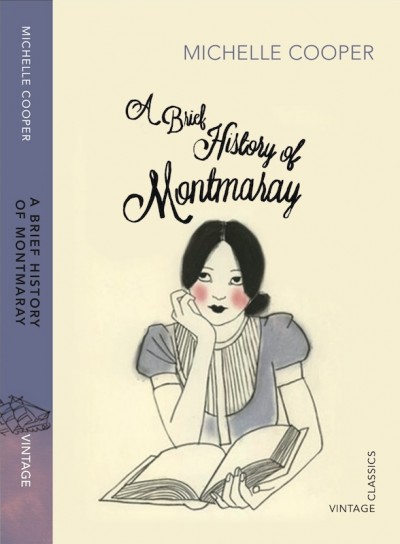
This week, Random House Australia announced the launch of a new series of classic children’s books, with the first twenty-one books to be published in August. It’s a wonderful list, including some of my favourite children’s books. Alice in Wonderland, Little Women, I Capture the Castle, What Katy Did, Treasure Island, Emil and the Detectives, The Railway Children . . . and guess what? One of the titles is A Brief History of Montmaray! It will have a lovely illustrated cover and will look like this:

'A Brief History of Montmaray' Vintage Classic edition

Pretty, isn’t it? The other Australian title on the list is Deborah Abela’s The Remarkable Secret of Aurelie Bonhoffen.

In other news, I’m still blogging away at Inside a Dog until the end of the month, so come over and say hello and read about life in wartime England.

Miscellaneous Memoranda

Look what I received yesterday!

'The FitzOsbornes at War' North American ARC

It’s the North American ARC (Advance Reader’s Copy) of The FitzOsbornes at War and it’s even bigger than the Australian edition, at a very hefty 554 pages. If you dropped one of these books on your foot, you could do yourself some serious damage. I should point out that the North American edition has more pages because the typeset is bigger, not because it contains more words. Although it does have one extra feature – a FitzOsborne family tree, dated 1955, so you can see the next generation of FitzOsborne cousins. Anyway, now I am busy proofreading all the pages.

Someone has also created a book trailer for A Brief History of Montmaray. It is excellently done, although the sea monster does look a bit like a whale. (But then, sea monsters are very sneaky and are Masters of Disguise. People sailing through the Bay of Biscay will be innocently strolling about on the deck of their ship and say, ‘Oh, look, is that a whaAARRGGHH!’ And that’s the last you ever see or hear of them.) I was also very impressed that the book trailer’s creator carefully cited every image used in the trailer. Well done.

Congratulations to all the Australian authors whose books were recognised in the Children’s Book Council Awards last week. Congratulations also to the New South Wales government, which, after a review, decided to continue the NSW Premier’s Literary Awards. The awards will be presented in November this year at the State Library, rather than during the Sydney Writers’ Festival in May, as they have been in previous years. No congratulations to the new Queensland government, who decided, without a review, to cancel the Queensland Premier’s Literary Awards. It’s the National Year of Reading everywhere in Australia except in Queensland, it seems.

Back in Sydney, the Museum of Sydney is running a Home Front: Wartime Sydney 1939-1945 exhibition from 31st March to 9th September. There will also be various ‘Life on the Homefront’ events, including ‘Dig for Victory’ kitchen garden tours, children’s activities and a ‘Victory in Europe’ GI dance on the VE Day anniversary.

The Sydney Writers’ Festival programme is also out, with lots of interest for all readers, including those who like historical and young adult books.

And I’m still blogging at Inside a Dog and will be giving away a Montmaray book at the end of the month, so come over and say hello.

Inside a Dog and Book Giveaway

My new book, The FitzOsbornes at War is out now in Australia and New Zealand! Very exciting. I haven’t actually seen it in any bookshops, but I’m told it’s out there.

In other exciting news, I’m also Writer in Residence at the Centre for Youth Literature’s blog, Inside a Dog, throughout this month. This week, I’ll be explaining how to write a historical novel in seven easy steps. Come over and say hello! I’m giving away a signed Montmaray book to a commenter chosen at random, so you might even score a free book.

FitzOsbornes at War image