
I have not been reading much fiction lately as I’ve been distracted by ALL THE POLITICS, but two novels I recently read did provide some insight into race and immigration, which seems highly relevant to current events.
 The first was Americanah by Chimamanda Ngozi Adichie, a hugely ambitious, sprawling novel about the experiences of African immigrants, “none of them starving, or raped, or from burned villages, but merely hungry for choice and certainty”. The author’s observations on race felt true-to-life and were often quite funny, and it was particularly interesting to read her thoughts on the vast differences between ‘African-Americans’ (that is, the descendants of the African slaves sent to America many years ago) and ‘American-Africans’ (people from Nigeria and other African countries who have recently migrated to the United States). I also loved the sections set in Nigeria, which were beautifully described.
However, I had two problems with this novel. Firstly, it was not really a novel. Structurally, it was a mess – although perhaps this was meant to reflect the chaos of modern-day Nigerian life? It is supposedly the story of two lovers, Ifemelu and Obinze, who are cruelly torn apart by circumstances, except the narrative quickly wanders off in a variety of competing directions and so I lost all interest in the love story (which is abruptly and implausibly resolved in the final chapters). There is a cast of hundreds of characters, most of whom are introduced and then quickly disappear, never to be seen again. There are long sections in which nothing much happens. There are a lot of blog posts, written by Ifemelu, which say the same things the characters have already said. The whole book is unashamedly didactic, which makes me think it might have worked better as a memoir or a collection of essays.
A greater problem for me, though, was Ifemelu, who narrates most of the book. Ifemelu is the biggest Mary Sue I’ve encountered since Bella in Twilight. Ifemelu – or, as I came to think of her, ★ IFEMELU ★ – is perfect. She is beautiful (but naturally beautiful, not like those vain girls who straighten their hair and fuss over their clothes to attract men). She is smarter and wiser and has better taste than anyone else. She wins scholarships and fellowships and everything she attempts is a great success. She starts a blog about race and not only does it quickly become famous, she makes so much money from it that she’s able to buy a condo. Everyone adores her, especially rich men and small children, even though she never seems to do anything to help anyone else. Her rich boyfriends fall over themselves to shower her with whatever she desires – jobs, money, expensive clothes, overseas holidays. Not that she asks for those things, not like those other girls do, which again shows how much integrity she has! (In fact, she gets bored when her boyfriends are too nice to her, so she cheats on them or dumps them without a word of explanation, no doubt to teach them a valuable life lesson.) ★ IFEMELU ★ is also the best at pointing out other people’s flaws. She despises well-meaning white liberal Americans for being ignorant, African-Americans for not understanding how privileged their lives are compared to Africans, and Nigerians for being lazy and corrupt. All of this would be bearable if Ifemelu ever showed any self-awareness or made any attempt to change, but that never happens. The author has said that Ifemelu is autobiographical and suggests her flaws are meant to be endearing. I was not endeared and would much rather have spent more time with some of the other characters – Obinze, for example, who becomes an ‘undocumented’ immigrant in Britain, or Aunty Uju, who has much less luck than Ifemelu when it comes to choosing male partners, or Dike, the depressed teenager caught between two cultures in America. Despite these reservations, I did find the book interesting and it would be a great choice for a book club because there’s just so much to discuss.
 After that I read something very different, but also about cultural clashes – Breakfast with the Nikolides by Rumer Godden. This is a small, perfectly formed novel about the conflict between British colonials and Indians working and studying at an agricultural college in Bengal. The author drew strongly on her own life experiences and her view of Indian society is both compassionate and clear-eyed. The descriptions of places and people are wonderful. She’s particularly good at portraying sensitive, awkward, plain girls on the verge of adolescence – in this novel, it’s twelve-year-old Emily, whose feuding parents have been forced to re-unite due to the war in Europe. When Emily’s little dog appears to contract rabies, it sets off a chain of disasters that ends up involving the whole town. The plotting is very skillfully done and the conclusion is deeply satisfying. And considering this was written by a white British woman in the 1940s, it’s commendable for its lack of racism. What did make me wince was the depiction of domestic violence and marital rape. At one stage, the most sympathetic character is indignant that anyone should judge him harshly for smashing up his house and assaulting his wife – after all, both were his property to do what he liked with and anyway, she provoked him by being annoying. Of course, this is what most people believed at the time (and unfortunately, how some people still think), so it’s entirely plausible – just unpleasant to read. However, on the whole, this is a beautiful piece of writing and highly recommended for Rumer Godden fans. A good companion read would be Anne Chisholm’s excellent biography of Rumer Godden, so that you can see the parts of the novel that were inspired by real events in the author’s life.
 So, thank heavens for Ben Aaronovitch. I am continuing to devour his Peter Grant novels, which began with
  I think Whispers Under Ground, the third book, is my favourite so far. Lesley gets to play a greater role in the action as Peter, Nightingale, the Murder Squad and an unwanted FBI agent investigate the death of an American art student in London. Of course, the good guys are still trying to catch what Nightingale refers to as the “black magicians” and Peter insists on calling “Ethically Challenged Magical Practitioners”. There are some great action scenes set in the tunnels beneath London (although I could have done without the scene in which Peter and friends nearly drown in raw sewage) and there’s an awesome bit of fantasy world-building. Also, some terrific new characters! Jaget Kumar, who, when not policing the London Underground system, enjoys exploring uncharted cave systems in India! And Abigail, juvenile delinquent daughter of Peter’s mum’s neighbour, to whom Peter accidentally reveals a bit too much about magic. (Nightingale’s horrified reaction to Peter and Abigail: “What are you proposing? A Girl Guide troop?”). Also, there’s more Stephanopoulos, always a good thing.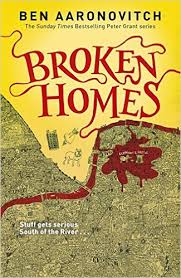
 Well, what happens next is Foxglove Summer. Peter, still a mess after the traumatic conclusion to Broken Homes even though he’s pretending he’s fine, is sent off to the countryside to help with an unsolved case in which two children have gone missing from an idyllic village. There’s probably not even any magic involved! What could possibly go wrong? There’s some enjoyment in seeing Peter, the quintessential Londoner, struggling with smelly sheep, recalcitrant farm gates and a lack of mobile phone coverage and there’s the customary action-packed conclusion in which, I’m pleased to say, the whole Heroic Man Saving Damsel in Distress thing is turned on its head (although Peter does do something very heroic in this book, bless him). We also get to find out more about the mysterious WWII battle that wiped out most of Britain’s wizards. However, I’ve just finished this book and still don’t completely understand why the children were taken or the significance of the foxgloves, so I think I’m going to reread it (which is no great hardship, because these books are just so much fun). I may have been distracted by my library copy, in which a previous reader had decided to cross out most of the swear words and ‘correct’ the narrator’s grammar, with ‘helpful’ comments added in the margins. Unfortunately, Library Editor seemed confused about modal verbs and failed to realise that a sentence containing the verb phrase “could have been” is a perfectly valid sentence. Also, I’m not sure why Library Editor decided to read all the way through to the fifth book in a series that’s narrated by a character who delights in not speaking the Queen’s English. In fairness to Library Editor, the UK editions of this series do have a bothersome number of typographical errors. Get your act together, Gollancz. These books deserve better. Also, I’d like the sixth book,
 Then there’s the most lucrative career of all for a girl – being an air stewardess. Women could earn up to nine pounds a week, plus a flying allowance and an overseas allowance and free world travel and free hotel stays, and they were provided with a stylish uniform. Of the four thousand applications, only about forty lucky girls were offered a job with B.O.A.C. each year. Such a girl had to be between 21 and 28 years old, have a “good private school background”, speak at least one foreign language, have nursing or catering experience, be charming and beautiful, and be willing to submit to a “thorough checkup” by airline doctors every couple of months. Also, she had to be able to stay smiling during non-stop twelve-hour shifts, in which she was expected to serve food and drinks, calm nervous flyers, cure travel sickness, amuse fretful children, change nappies and “delicately snub the wolf” (it is not clear whether the sexual harrassers were passengers or pilots, or both). But it’s okay, she’d probably manage to snare a husband pretty quickly:
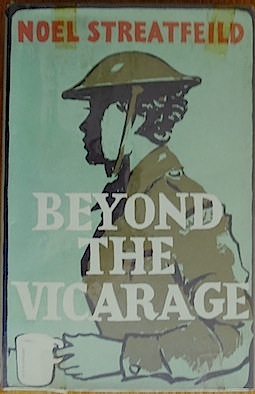 Fair enough, but it does lead to phrases like “Victoria seemed to think that …” and “Victoria must have forgotten that …”, which is a bit odd when she’s writing about herself. Anyway, this book is about how Victoria/Noel decides to stop being a successful actress touring the world and become a writer. She sails back from Australia via Siam (as it was then called), where her brother works, and eventually arrives in England to look after her recently-widowed mother. Although Victoria’s father had been a bishop from a well-off family, the family is now in ‘reduced circumstances’ and Victoria’s mother is the sort of helpless genteel lady who has never had to look after herself, so living in lodgings does not go well. After employing a series of disastrous companions, her mother is finally settled in her own new home with appropriate help and Victoria, breathing a huge sigh of relief, moves back to London to write her first novel. Despite the distractions of her busy social life (she eventually resorts to writing in bed in her pyjamas so she won’t be tempted to go out), she quickly writes the manuscript, immediately finds a publisher and is instantly making a comfortable living as a novelist. Her publisher even pays her a weekly wage when she complains the system of advances and royalties is too complex for her to deal with. The only complaint her publisher has is that “you make everyone too loveable. I doubt you could write about a bitch if you tried.” (Victoria then vows to write “the bitchiest bitch you ever read about” and writes It Pays To Be Good.) Then another publisher, aware of Victoria’s theatrical background, asks her to write a children’s book about child actors, so Victoria, “cross at herself for agreeing to something she was convinced she could not write”, produces Ballet Shoes, which is an instant bestseller, and the rest is history. Although she ended up writing a few more novels for adults, she gave up on them in the early 1960s, telling herself,
 Taking a break from post-war England, I then read Quiet: The Power of Introverts in a World That Can’t Stop Talking by US writer,