What I’ve Been Reading

'The Death of Lucy Kyte' by Nicola Upson I liked The Death of Lucy Kyte by Nicola Upson, a murder mystery set in the 1930s, featuring a fictional version of the real-life mystery writer, Josephine Tey, as well as several other famous people (for instance, Dodie Smith and Wallis Simpson both make brief appearances). In this book, the fifth in a series, Josephine has to unravel the mystery of her godmother’s death and strange bequest. Could this possibly be linked to the famous, real-life murder of Maria Marten, a local servant girl who’d died a hundred years before? Well, yes, of course it is, but it also ends up being far more complicated and terrifying than I’d expected (admittedly, I am easily spooked). The story reminded me quite a lot of The Little Stranger by Sarah Waters, although I think The Death of Lucy Kyte was more successful at handling the ‘supernatural’ elements of the plot (which may or may not be truly supernatural). I don’t read a lot of murder mysteries, because they so often use violent death as a mere plot device, without much acknowledgement of the terrible suffering it causes to the people who knew the victim. However, in this book, each of the characters was a plausibly complicated person, each violent incident had tragic repercussions, and there was nothing neat or painless about the conclusion. I hadn’t read the previous books in the series and this one worked well as a stand-alone novel, although I did become curious about the background of Josephine’s lover (who presumably is the subject of one of the earlier books). I believe the first book is called An Expert in Murder and it’s now on my To Read list.

Dogsbody by Dianna Wynne Jones was a clever and charming children’s book about Sirius the Dog Star, who is wrongfully accused of murder and sentenced to live in the body of a dog on Earth. I am not very interested in mythology or astronomy (or fantasy), but I loved the descriptions of Sirius’s doggy life and particularly his interactions with the other animals he encountered. Sirius is taken in by Kathleen, a young Irish girl with her own problems, and I liked the way the author didn’t hold back from showing that truly awful things can happen to children – but also that children can be brave and resilient and that hope can be found in unexpected places.

'Goodbye to Berlin' by Christopher IsherwoodGoodbye to Berlin by Christopher Isherwood was a fascinating look at Germany in the early 1930s. The author insists in his introduction that it’s not “purely autobiographical”, but given the narrator is a young Englishman called ‘Christopher Isherwood’ who is living and working in Berlin at the same time that the author did, I think it’s fair to say it’s a reasonably accurate portrayal of his real experiences. Christopher drifts about Berlin, giving English lessons, hanging out in coffee shops and seedy bars and meeting a lot of interesting people. These include Sally Bowles, only nineteen and hopelessly naïve and romantic, even if she does refer to herself as an “old whore”; Peter, an Englishman besotted with a working-class boy called Otto; Otto’s impoverished family, living in a decrepit attic; and the Landauers, a wealthy Jewish family who own a department store. At first Christopher seems quite detached (“I am a camera with its shutter open, recording, not thinking . . .”), but he becomes closer to the people he’s observing, even when he disapproves of them and despairs for their future (“these people could be made to believe in anybody or anything”). He shows clearly how poverty and despair created by high unemployment and the collapse of the banking system after the First World War made it easy for Hitler to rise to power. The film Cabaret is based on the Sally Bowles section of Goodbye to Berlin, but the film doesn’t have a lot in common with the book. Both are interesting, though, in their different ways.

Old Filth wasn’t as immediately warm and engaging as most of Jane Gardam’s novels, perhaps because it was about a snobby, emotionally-repressed old Englishman. However, the story of how Edward came to be that way was engrossing and involved a variety of interesting settings. Edward spends his early years in a remote Malayan village before being sent to an abusive foster home in Wales, then on to several English boarding schools, whereupon war breaks out and he finds himself on an evacuee ship . . . and he hasn’t even made it to adulthood yet. The plot is very clever, moving back and forth in time to reveal information at exactly the right pace, with characters reappearing at strategic points (although occasionally in a way that strains credibility). It was fascinating to watch the decline of the British Empire through the eyes of a ‘Raj orphan’ who ended up a judge in Hong Kong before retiring to an England that was no longer Home. I believe there are several books about the same set of characters, and I’d be especially interested to read more about Edward’s wife Betty, who seemed to have led a very busy life (even if Edward was unaware of most of it).
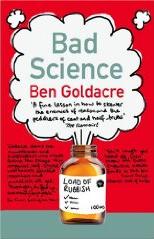
'Bad Science' by Ben GoldacreFinally, some non-fiction. Bad Science by Ben Goldacre takes aim at the pharmaceutical companies, vitamin pill manufacturers, homeopaths, nutritionists, politicians and journalists who ignore scientific evidence in their quest to make money or become famous. Some of his examples will probably make more sense to UK readers (for example, he devotes a chapter each to Gillian McKeith and Patrick Holford, apparently famous in the UK although I’d never heard of them), but there are also good general discussions about statistics, the placebo effect and how to analyse a scientific research paper. If you’re familiar with Dr Goldacre’s website or you read a lot of sceptic-based blogs, there won’t be a lot here that’s new to you, but I still found this to be an entertaining and interesting summary of some major issues in modern medical science (or at least, how medical science is reported in newspapers, magazines and on television).

My Holiday Reading

I wasn’t supposed to be doing any holiday reading – I was meant to be finishing writing a book – but there’s just something about the week between Christmas Day and New Year’s Day in Australia that forces you to lie about in a hammock, eating grapes and reading novels (and by ‘you’, I mean ‘me’). They were pretty good novels, though, and I guess I could argue that, as a writer, reading novels is an essential part of developing my professional skills. See, I wasn’t lazing about, I was working. Anyway, here’s what I read:

'All Change' by Elizabeth Jane HowardAll Change by Elizabeth Jane Howard was the fifth and final volume of the Cazalet Chronicles, a family saga set around the time of the Second World War. Although I’ve enjoyed this series very much, the fourth volume was the least compelling and I wasn’t sure a fifth novel was really necessary. It seemed to me as though the Cazalets had finally sorted out their lives for good – but no, in this book, everything falls apart, just as it did for a lot of wealthy English families in that post-war decade of upheaval. In All Change, bankruptcy looms for the Cazalets, although I must admit it was hard for me to feel much sympathy for them. The brothers have inherited a thriving timber business and numerous valuable properties from their father, but are too stubborn to accept business advice from their social inferiors (Hugh), too extravagant (Edward) or too indecisive (Rupert) to manage it effectively. Meanwhile, the women succumb to depression, dementia and terminal illnesses, have unhappy affairs and are exhausted by the demands of their badly-behaved children. There’s a whole new generation of characters that had me constantly referring to the family tree in the front of the book and there were quite a few continuity errors (for instance, Simon is described as having a dead twin, when that’s actually Will, who is mostly absent from this book). But I didn’t care! I devoured all six hundred pages in two days, thoroughly engrossed in the Cazalets’ story and sad that this was truly the end, as Elizabeth Jane Howard died last week at the age of ninety. She left behind a number of excellent novels and a lot of devoted fans of her work.

I also read Journey to the River Sea by Eva Ibbotson, an excellent children’s novel about an orphaned girl sent to live in Brazil in 1910. Among the characters Maia encounters are a stalwart governess with a mysterious past, a travelling troupe of actors, a kindly scientist, a missing heir to an English estate, a Russian count and a couple of evil (but fortunately, incompetent) private investigators. As always with Eva Ibbotson’s books, the heroine is a little too good to be true (beautiful, intelligent, a talented musician, a skilled dancer, friendly and kind to all people and animals, etc), but the story and setting were fascinating and I enjoyed following Maia’s adventures.

'A Long Way From Verona' by Jane GardamHowever, my favourite holiday read would have to be A Long Way From Verona by Jane Gardam, a brilliant coming-of-age novel set during the Second World War. Jessica is a bright, imaginative, melodramatic twelve-year-old who is utterly tactless and incapable of dissembling, yet convinced that she alone is able to understand others perfectly (meanwhile, wondering why she isn’t more popular at school). She gets into trouble constantly – for handing in a forty-seven-page essay that is not actually about ‘The Best Day of the Summer Holidays’, for eating potato chips on the train in an unladylike fashion, for hiding out in the library and reading ‘unsuitable’ books such as Jude the Obscure – and her idiosyncratic observations of her world are clever and hilarious. Here, for example, is her description of a stranger’s front parlour, in which she and her friends find themselves after a prank goes wrong:

“We tiptoed over it into a fearfully clean front room with the coals arranged on the sticks like a jigsaw, and the arm-chairs made out of brown skin and never sat on, and a terrified-looking plant standing eyes right in the window, wishing it were dead.”

Jessica is told by a visiting author that she is A WRITER BEYOND ALL POSSIBLE DOUBT, and although there are moments when her self-confidence falters, she triumphs in the end. I can’t recommend this novel too highly – it’s a work of genius. And it’s the first book I read in 2014, which I think is a GOOD OMEN.

Meet The Mitfords

Last week, I was at the library and noticed a new book about Nancy Mitford, this one about her relationship with French politician and diplomat, Gaston Palewski. I opened the book to a random page and not only recognised the anecdote being related, but knew at once where the quotes had come from. At that moment, I realised I’d read far too many books about the Mitfords and didn’t need to read another one. But then I considered that perhaps readers of this blog might be interested in some of the Mitford-related books I’ve read. Hence this post.

The Mitfords were what Wikipedia1 accurately calls “a minor aristocratic English family”. None of the famous Mitford sisters, with the possible exception of Jessica, ever had any effect whatsoever on political events or world history. They are mostly remembered because they were rich, good-looking, opinionated aristocrats who knew a lot of famous and influential people during a fascinating period of history. More importantly, they were writers, so we have detailed records of their thoughts, observations and jokes. But I ought to introduce the Mitford siblings properly, so here they are:

'The Pursuit of Love' and 'Love in a Cold Climate' by Nancy Mitford1. Nancy (1904 – 1973) was the author of the wonderful comic novels, The Pursuit of Love and Love in a Cold Climate, as well as several other novels and biographies, and numerous essays and newspaper articles. She was unhappily married to Peter Rodd, but the love of her life was Gaston Palewski and she moved to France to be with him after the Second World War. There are several published collections of her letters, including The Letters of Nancy Mitford and Evelyn Waugh, edited by Charlotte Mosley. Life in A Cold Climate by Laura Thompson is a fairly good biography of Nancy, provided you can cope with the biographer’s prose style (sample sentence: “Yet there is a quality to her voice, as she lingers on their paradisiacal images, that reveals what was always there, and what constitutes so great a part of her appeal: the yearning soul within the sophisticate’s carapace: the imagination that can take illusion and make it into something real.” Oh, how Laura Thompson loves colons! And also, hates feminists. But then, so did Nancy.)

2. Pamela (1907 – 1994) was married to physicist and RAF pilot Derek Jackson, but she divorced him to spend the rest of her life with female ‘companions’. Not that you’ll ever hear a Mitford sister using the word ‘lesbian’ to describe Pamela. Pamela seemed the most sensible and practical of the sisters, and enjoyed breeding poultry and cooking elaborate meals.

3. Thomas (1909 – 1945) was the only boy and the heir to the title, and seems to have been adored by everyone. At school (Eton, naturally), he was the lover of Hamish St Clair-Erskine (to whom Nancy was once, disastrously, engaged) and James Lees-Milne, although Tom seemed to have preferred women in later life. He joined the British army and was killed in Burma during the war, having refused to fight against the Nazis in Germany.

'Diana Mosley' by Anne de Courcy4. Diana (1910 – 2003) was the beauty of the family. She married Bryan Guinness at the age of eighteen, but dumped him when she fell in love with Oswald Mosley, leader of the British Union of Fascists. She married Mosley in Berlin in 1936, at a ceremony at which Adolf Hitler was the guest of honour, then she and Mosley were imprisoned without trial in Britain for several years during the war. After the war, she supported Mosley’s various unsuccessful attempts to re-enter politics and they hung out with other rich Fascists. Anne de Courcy’s biography, Diana Mosley, provides a good account of Diana’s life, although it’s a rather biased one (“I came to love Diana Mosley,” gushes the biographer in her introduction, while also describing Diana, despite all the evidence to the contrary, as “the cleverest of the six Mitford sisters”). Diana also wrote a self-serving autobiography, A Life of Contrasts, which is interesting due to the sheer, gobsmacking awfulness of her opinions. Hitler, according to Diana, was a lovely man and the Holocaust wasn’t his fault at all. No, it was due to “World Jewry” and their “virulent attacks upon all things German and their insistent calls for trade boycotts, military encirclement and even war”. Also, the number of Holocaust victims was exaggerated, and anyway, Stalin and Mao killed far more people. She also spends a lot of time boasting about her social life (“At Mona Bismarck’s Paris Christmas dinner parties, I was always put next to the Duke [of Windsor]”) and going on about Mosley’s “brilliance”, and, with an apparent lack of irony, writes of her enemies, “This is typical of many people who reject truth in even the most trivial matters if it conflicts with a prejudice”.

5. Unity (1914 – 1948) was the one who was obsessed with Hitler and shot herself in the head when war broke out. A lot of her attention-seeking behaviour seems to have been due to a childish desire to shock people, but she was in her twenties when she met Hitler, surely old enough to know better. Was she emotionally or intellectually immature, or simply caught up in the political excitement of the 1930s? Her biography, Unity Mitford: A Quest, by David Pryce-Jones, doesn’t really help to answer this question. The biographer has clearly done a lot of research, interviewing more than two hundred of her acquaintances, but the result is a very dull and disorganised account of her life, with little attempt at analysis. I really can’t recommend this book (unless, of course, you happen to be writing a novel that includes Unity as a character).

6. Jessica (1917 – 1996) ran away as a teenager to the Spanish Civil War with Esmond Romilly, Winston Churchill’s Communist nephew. A lot of very sad things happened in her personal life – her baby daughter died of measles, Esmond was killed in action during the war, her elder son died at the age of ten – but these are all glossed over in her memoir, Hons and Rebels, because Mitfords were brought up to put on a brave face in public. Jessica married Robert Treuhaft in 1943, and the two of them were active members of the American Communist Party and passionate civil rights campaigners. Jessica also wrote a number of books based on her investigative journalism, including exposés of the American funeral industry and prison system. Bonus fact: J. K. Rowling so admired Jessica Mitford that she named her daughter after Jessica.

7. Deborah (1920 – ) married Andrew Cavendish, who became the Duke of Devonshire, and then she turned Chatsworth, the Devonshire family home, into a thriving business and tourist attraction. She also had terrible things happen in her life – three of her children died at birth, and her husband turned out to be a philandering alcoholic – but as Charlotte Mosley observed, Deborah was a Mitford, and therefore used to hiding her “vulnerability behind a lightly worn armour of flippancy and self-deprecation”. Deborah is usually portrayed as the apolitical Mitford, but is a proud Tory, was close to Diana, and “adored” Mosley. She has written several books about Chatsworth and her life, the most recent of which is Wait For Me! Memoirs of the Youngest Mitford Sister.

'The Mitford Girls' by Mary S. LovellThere have also been a number of books about the whole Mitford family. I think the best, most balanced, family history is The Mitford Girls by Mary S. Lovell, although it’s been a while since I read it. There’s also The House of Mitford, by Jonathan Guinness with Catherine Guinness, or, as Hermione Granger would call it, A Highly Biased and Selective History of the Mitfords. The authors are Diana’s son and grand-daughter, so Diana is portrayed as a saint and Jessica as the devil incarnate. It also starts with a very long and boring section about the Mitford sisters’ ancestors. Still, it includes a lot of fascinating family photos that you won’t find in other books. However, my favourite Mitford-related book would have to be The Mitfords: Letters Between Six Sisters, edited by Charlotte Mosley. Yes, she’s Diana’s daughter-in-law and she seems to have done some very selective editing when it comes to Diana’s letters from the 1930s, but she has also done an excellent job of writing introductions and explanatory footnotes (which is vital, when the letter writers use as many nicknames as the Mitfords do) and of arranging all the correspondence in a way that makes sense. To quote J.K. Rowling again, “The story of the extraordinary Mitford sisters has never been told as well as they tell it themselves”.

_____

  1. Wikipedia once noted in its ‘Mitfords in Popular Culture’ section that “Unity Mitford appears as a minor character in the last two books of Michelle Cooper’s Montmaray Journals trilogy”, but this sentence has now disappeared. Wikipedia also fails to mention the most famous popular culture reference to the Mitford sisters – that is, Narcissa, Bellatrix and Andromeda Black in the Harry Potter books, who bear a strong resemblance to Diana, Unity and Jessica Mitford.

Same-Sex-Attracted Gentlemen in English Society in the 1930s and 1940s

I’ve been meaning to write a blog post on this topic ever since The FitzOsbornes in Exile was first published in North America (that is, two years ago, which says something about my blogging habits). I don’t want to give away any plot spoilers to those who haven’t read the book, but let’s just say that it’s set in the late 1930s, in England, and that at least one male character is gay1. A surprising number of readers seemed to assume that any well-brought-up young lady of this time and place would have been shocked, horrified and outraged at the very idea of homosexuality, and that all gay men were shunned by Society and were in constant danger of being carted off to prison, à la Oscar Wilde. So, there were a number of comments from readers about how ‘implausible’ it was that Sophie and Veronica, the two young ladies at the centre of the story, would be so accepting of their gay male relative.

Now, it’s true that any kind of sexual activity between men was illegal in England between 1885 and 19672, but it’s also true that these laws were applied very selectively. In general, rich, aristocratic men were free to do whatever they liked. Yes, Oscar Wilde was convicted of “gross indecency”, but that was an unusual case because he started the whole thing off (by bringing a libel action against his boyfriend’s belligerent father, when what the father was saying about Wilde was mostly true). Anyway, that case was in 1895, forty-two years before the events of The FitzOsbornes in Exile. Consider current attitudes to gay issues, and compare this to how most people thought in the early 1970s, and you’ll see that things can change significantly in forty-two years. The fact is that in the 1930s and 1940s, there were quite a lot of popular, important and influential same-sex-attracted men who were part of English Society. Here are some of them.

First, the obvious ones. In the world of theatre and music, the most famous were probably Ivor Novello, Noël Coward and Benjamin Britten. There was also stage designer Oliver Messel, who was closely associated with the British royals and designed Princess Margaret’s Caribbean house. Norman Hartnell and Hardy Amies held Royal Warrants to design frocks for various British royals (Hardy Amies also happened to be a Special Operations Executive agent who worked with the Belgian resistance during the war), while the crème de la crème of Society queued up to be photographed by Cecil Beaton.

Ivor Novello
Ivor Novello

Meanwhile, the Bloomsbury set was not, strictly speaking, part of respectable Society, but it was influential and included writer Lytton Strachey, economist John Maynard Keynes and artist Duncan Grant.

Those with connections to Oxford included Maurice Bowra (Warden of Wadham College, later Vice-Chancellor of the university and awarded a knighthood), Brian Howard (poet, journalist, supposedly an inspiration for the character of Anthony Blanche in Brideshead Revisited) and Harold Acton (writer, also supposedly a model for Anthony Blanche). Other famous same-sex-attracted male writers were Siegfried Sassoon, Raymond Mortimer and E.M. Forster.

Then there were a whole lot of aristocrats who didn’t do much, but were certainly accepted in Society, starting with Prince George (brother of King Edward VIII and King George VI), whose male lovers were rumoured to have included his cousin Louis Ferdinand, Prince of Prussia, Noël Coward and Anthony Blunt (art historian, cousin to the Queen, Communist spy). There was also Stephen Tennant, who “spent most of his life in bed” and supposedly inspired the character of Cedric in Love In A Cold Climate. However, I think my favourite aristocrat would have to be Gavin Henderson, 2nd Baron Faringdon: “Described by David Cargill as a ‘roaring pansy’, Henderson was known for his effeminate demeanour, once opening a speech in the House of Lords with the words ‘My dears’ instead of ‘My Lords.'”

What is more interesting to me is the number of gay men in positions of real political power, either in the House of Commons or the diplomatic services. For example, Oliver Baldwin, son of Prime Minister Stanley Baldwin, had a long career in politics, first as a Labour MP, then as Parliamentary Secretary to the Secretary for War. When he was appointed Governor of the Leeward Islands, a British colony in the Caribbean, he took his partner, John Boyle, with him. Other politicians included Henry ‘Chips’ Channon, Harold Nicolson, Tom Driberg and Robert Boothby. It’s true that these men did not always receive unconditional positive regard from their family and colleagues. For example, Oliver Baldwin never became a government minister, despite his experience and political connections. He was also recalled from the position of Governor after three years (although this was more because he supported socialism and anti-colonial attitudes in the islands than because the white colonials were scandalised by his relationship with John Boyle – and Oliver’s parents did eventually come to accept his partner as almost a son-in-law).

Some of these men had long, happy, unconventional marriages with women (for example, Harold Nicolson’s marriage to Vita Sackville-West); some entered into brief or unhappy marriages in an attempt to placate their families and produce an heir; others were ‘confirmed bachelors’. Some of them were definitely gay, others were probably bisexual, and very few of them were ‘out’ in the public sense that we mean now. But all of these men participated in Society, and other people in Society knew about them and accepted them to varying degrees – which isn’t so different from the way things are now.

So I think Sophie and Veronica’s attitudes in The FitzOsbornes in Exile are entirely plausible – especially as neither of them is particularly religious, and Veronica makes a habit of rebelling against conservative values. And I also think Veronica would have loved a chance to debate Marxism with Oliver Baldwin.

_____

  1. Yes, I know they probably wouldn’t have used the word ‘gay’ in 1937, but the vast array of words used for male homosexuality in the twentieth century would take up an entire blog post of their own. For those who are interested, A Dictionary of Euphemisms, by Judith S. Neaman and Carole G. Silver, has a good discussion of North American, British and Australian terms.
  2. Lesbians did not exist, according to the law.

Five Books, Five Songs: We’ll Meet Again

“We’ll meet again,
Don’t know where,
Don’t know when …”

The FitzOsbornes at War is about saying goodbye, so the song I’ve chosen today is Vera Lynn singing one of the most famous (and saddest) songs of the Second World War, We’ll Meet Again.

A girl standing in the ruins of Battersea in January, 1945, after a V2 raid. Photograph taken by Toni Frissell, US Women's Army Corps.
A girl standing in the ruins of Battersea in January, 1945, after a V2 raid. Photograph taken by Toni Frissell, US Women’s Army Corps.

More in Five Books, Five Songs:

1. The Rage of SheepHester’s Request
2. A Brief History of MontmarayThe Sea Is Writhing Now
3. The FitzOsbornes in ExileDoing The Lambeth Walk
4. The FitzOsbornes at War – We’ll Meet Again
5. The Work-in-Progress – Through The Large Four-Chambered Heart