‘Bird by Bird: Some Instructions on Writing and Life’ by Anne Lamott

Although I’d seen many recommendations for Anne Lamott’s Bird by Bird1, I put off reading it because it sounded a bit too mystical for my tastes. In fact, this book is fairly big on spirituality, with the author frequently referring to God or her church or her pastor’s advice, but it’s balanced with a healthy sense of humour. For example, she explains that she begins each day of writing with a prayer and recommends that all writers use some form of ritual:

“Try it. Any number of things may work for you – an altar, for instance, or votive candles, sage smudges, small animal sacrifices, especially now that the Supreme Court has legalized them. (I cut out the headline the day this news came out and taped it above the kitty’s water dish.)”

'Bird by Bird' by Anne LamottHowever, most of the book consists of sensible advice about various aspects of fiction-writing, including plotting, creating a setting, developing characters and writing plausible dialogue. She advises writers who feel overwhelmed by the thought of writing an entire novel to begin with “short assignments” and to visualise scenes through a “one-inch picture frame”, because as E. L. Doctorow noted, “writing a novel is like driving a car at night. You can see only as far as your headlights, but you can make the whole trip that way.”

She also explains that “perfectionism will ruin your writing” and emphasises that all first drafts are terrible:

“I know some very great writers, writers you love who write beautifully and have made a great deal of money, and not one of them sits down routinely feeling wildly enthusiastic and confident. Not one of them writes elegant first drafts. All right, one of them does, but we do not like her very much. We do not think she has a rich inner life or that God likes her or can even stand her.”

I especially liked Lamott’s description of how to know when you’re finally “done” with writing your final draft, the process of which is like “putting an octopus to bed”:

“You get a bunch of the octopus’s arms neatly tucked under the covers – that is, you’ve come up with a plot, resolved the conflict between the two main characters, gotten the tone down pat – but two arms are still flailing around . Maybe the dialogue in the first half and the second half don’t match, or there is that one character who still seems one-dimensional. But you finally get those arms under the sheets, too, and are about to turn out the lights when another long sucking arm breaks free.

This will probably happen when you are sitting at your desk, kneading your face, feeling burned out and rubberized. Then, even though all the sucking disks on that one tentacle are puckering open and closed, and the slit-shaped pupils of the octopus are looking derisively at you, as if it might suck you to death just because it’s bored, and even though you know your manuscript is not perfect and you’d hoped for so much more, but you also know that there is simply no more steam in the pressure cooker and that it’s the very best you can do for now – well? I think this means that you are done.”

I didn’t agree with everything Lamott had to say about writing (for example, she is opposed to planning and dislikes “the rational mind”), but she discusses it all with such warmth and charm that I enjoyed reading and considering her thoughts. This book is highly recommended for both beginning writers looking for practical advice and encouragement, and more experienced writers seeking inspiration.

You might also be interested in reading:

‘On Writing’ by Stephen King

—–

  1. By the way, the book’s title comes from advice her writer father gave to her ten-year-old brother, who was overwhelmed by the task of writing a huge school report on birds that was due the next day: “Bird by bird, buddy. Just take it bird by bird.”

Copy (Not) Right

Last year, the Australian government asked the Productivity Commission to review intellectual property rights in Australia. The Commission’s draft report was recently released, and although I haven’t read all 587 pages of it, I have read the sections that concern the book publishing industry. The title, Copy (Not) Right, pretty much sums up the Commission’s attitude towards copyright. As the Australian Society of Authors reports:

“They believe copyright law is an impediment to the consumer and should be curtailed. They have gone about their task with dedication, cynicism and resentment towards the arts across the board, but none more so than towards books and authors.”

The Commission makes three main recommendations about books. Firstly, the length of time that copyright exists should be drastically reduced. Secondly, Australian territorial copyright should be abolished and parallel importation of books introduced. Thirdly, the current system of ‘fair dealing’ should be replaced with the US system of ‘fair use’.

I’ve previously written about how destructive the introduction of parallel importation would be for the Australian book industry. The implementation of a ‘fair use’ system would also cause significant problems for copyright holders. The current system of ‘fair dealing’ means that Australian copyright owners are paid if their work is used, with a number of sensible exceptions (for example, people are free to use copyrighted material for reviews, research, study, satire or parody, news reporting and legal advice). A ‘fair use’ system would mean that anyone could use any copyrighted material for free, without permission, provided the use was ‘fair’ – with the definition of ‘fair’ in each case decided by the courts. This would be great news for lawyers, but not so great for impoverished authors trying to stop unauthorised and unpaid use of their work.

However, it’s the Commission’s recommendation about term of copyright that’s really mind-boggling. Currently, copyright exists for seventy years after the death of the creator. (Personally, I think that’s too long, but I didn’t make that decision – it was made by US legislators, supposedly because Disney wanted to keep control of Mickey Mouse, and it was then agreed to by Australian legislators as part of a US-Australian trade agreement.) The Commission wants copyright to be fifteen to twenty-five years from creation. That’s right, fifteen years. That means that in a few years, I’ll have to give up all my rights to the novels I’ve written so far. I won’t be able to earn any money from them or control who publishes them. Not surprisingly, Australian authors are a bit upset about this. Jackie French has written:

“For 25 years I have worked as an author, supporting my family.
Innocently, I had assumed that the royalties from these books would continue to support my husband and myself in our old age.
Now, in my sixties, I have been told by the ill-named ‘Productivity Commission’ that ‘Writers rarely write for financial reasons,’ and I may only own my work for 15 years.
If I had spent my time renovating houses, or investing in shares, I’d own them. So would my heirs. If you built a bicycle or a house, would you give it to anyone who cares to grab it, in 15 years’ time?
Does Thomas Keneally have no moral right to ‘Bring Larks and Heroes’? Does Mem Fox no longer have a right to ‘Possum Magic’ nor I to ‘Diary of a Wombat’?
Will Malcolm Turnbull give away his investments when he has owned them for 15 years?”

As Richard Flanagan said in his keynote speech at the Australian Book Industry Awards last week:

“So Mem Fox has no rights in ‘Possum Magic’. Stephanie Alexander has no rights in ‘A Cook’s Companion’. Elizabeth Harrower has no rights in ‘The Watch Tower’. John Coetzee has no rights in his Booker winning ‘Life and Times of Michael K’. Nor Peter Carey to ‘The Kelly Gang’, nor Tim Winton to ‘Cloudstreet’. Anyone can make money from these books except the one who wrote it.”

How can the Commission possibly think that this will improve “productivity” in the book industry? Why would an author or publisher want to continue to produce books under these conditions? What about an author writing a long-running series? By the time she’d written the fifth book, the first could be out of copyright. And too bad for an author whose book is made into a film fifteen years after initial publication – the author won’t see a cent of the profits from the film sales, nor would she earn any royalties when the film tie-in book hits the bestseller lists.

I re-read this section of the report in an attempt to understand the Commission’s reasoning, but my most generous interpretation is that they simply don’t understand how the book industry works. For instance, they claim on page 114 that for books, “by 2 years [after initial publication], 90 per cent of originals are out of print”. Really? My first Australian novel was far from a bestseller, but it’s still in print nine years later, available in both paperback and as an e-book, and that’s hardly unusual.

The Commission also blithely suggests that any negative impact on the Australian publishing industry as a result of these changes “would be addressed by ensuring that direct subsidies aimed at encouraging Australian writing — literary prizes, support from the Australia Council, and funding from the Education and Public Lending Rights schemes — continue to target the cultural value of Australian books”. All those Australian literary organisations and writers reeling from Black Friday’s funding cuts may manage a hollow laugh at that.

There is still some hope for Australians who love books. Just remember, there’s a federal election in July.

Some Montmaravian Art

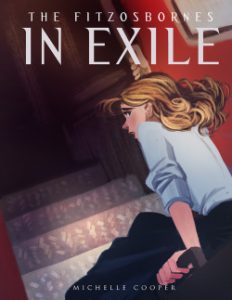
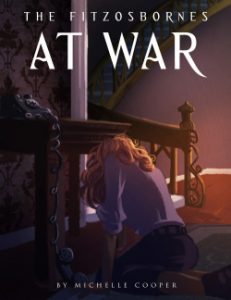
How amazing is this artwork? It was created by Noah Hayes, who’s studying art and design at college. Noah created some art based on The Montmaray Journals for his visual development class and I first became aware of it when I saw these great book cover designs:

'Montmaray book cover' by Noah Hayes

'FitzOsbornes in Exile book cover' by Noah Hayes

'FitzOsbornes at War book cover' by Noah Hayes

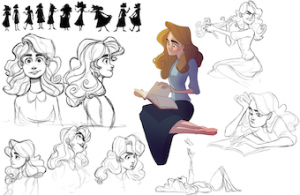
And then Noah did a whole lot of work developing character studies. Here’s Sophie:

'Sophie character study' by Noah Hayes

Plus, there’s a huge storyboard for the scenes following the funeral in A Brief History of Montmaray. Here’s Veronica and Sophie discussing events:

'Veronica and Sophie' by Noah Hayes

And Simon and Toby looking shifty-eyed after Sophie tracks them down:

'Simon and Toby' by Noah Hayes

You can see the whole thing here at Noah’s tumblr (click on the Tumblr image to enlarge it).

There’s also a wonderfully evocative depiction of Montmaray Castle:

Montmaray Castle by Noah Hayes

But I think this might be my favourite – some sketches of Henry and Toby. Look how happy Henry is!

'Toby and Henry' by Noah Hayes

Thanks to Noah for allowing me to share these images. You can find them all at Noah’s Tumblr.

What I’ve Been Reading

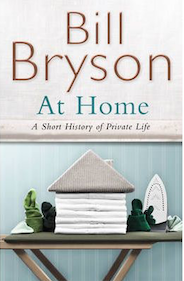
'At Home' by Bill BrysonAt Home: A Short History of Private Life is another of Bill Bryson’s entertaining books about history. This one came about when he was looking around his Victorian house in Norfolk and considering how the majority of real history isn’t about wars and treaties, but about “masses of people doing ordinary things”. Accordingly, this is a history of domestic life, with a chapter devoted to each room in his house, so that the kitchen chapter is a history of food and cooking, the bathroom a history of hygiene, the nursery about the changing notion of childhood, and so on. Although there are references to ancient history and even prehistory, most of it looks at the past two centuries of life in England and the United States in fascinating and often amusing detail. Bryson is a wide-ranging researcher and I often found myself saying, ‘I never knew that!’ and wanting to learn more. For example, did you know that income tax didn’t exist in the United States until 1914 and that an earlier attempt to introduce a 2% income tax was ruled unconstitutional by the Supreme Court? Or that the ancient proto-city of Çatalhöyük had no streets, laneways or footpaths, and houses had no doors or windows, with people accessing their houses through a hole in the roof? Or that rats work in teams and have been observed forming a multi-rat pyramid under a hanging slab of meat, allowing one rat to climb up and gnaw its way through the meat above the hook until the meat falls to the floor, whereupon the meat is devoured by all the rats?
Although Bryson takes his research seriously, this book is more about breadth of coverage than depth. Once or twice, I came across a topic that I happened to know a lot about and I could tell he hadn’t read the relevant primary sources. For example, in his discussion of scurvy, he gets James Lind’s theory only half-right, then has this to say about James Cook:

“On his circumnavigation of the globe in 1768-71, Captain Cook packed a range of antiscorbutics to experiment on, including thirty gallons of carrot marmalade and a hundred pounds of sauerkraut for every crew member. Not one person died of scurvy on his voyage – a miracle that made him as much a national hero as his discovery of Australia …”

As most Australians would know, Cook wasn’t a Captain on that voyage and more importantly, he didn’t discover Australia. People had been living there for at least fifty thousand years by the time he arrived. He wasn’t even the first European to land there. Also, Bryson omits an amusing anecdote about the sauerkraut, which I’m certain he would have included if he’d read about it in Cook’s journals. But this was only a minor issue and for the most part, I was thoroughly engrossed in this book. Fortunately, it includes an extensive bibliography for those readers who want to know more about, say, the construction of Monticello or the history of London’s sewers or how the repeal of the Corn Laws affected England’s vicars. Recommended for Bill Bryson fans and those who enjoy popular history.

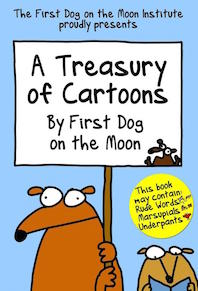
'A Treasury of Cartoons' by First Dog on the MoonI also enjoyed A Treasury of Cartoons by First Dog on the Moon. This selection of his work from 2009 to 2015 reminded me of just how awful Australian politics was during that period (five prime ministerships in six years, including two whole years of Tony Abbott). It was almost beyond satire, but First Dog still manages to make me laugh. My favourites were Ian the Climate Change Denialist Potato (who writes erotic fanfiction about Greg Hunt) and the racist carrot (“Tell me this! If Islam is a religion of peace, how is it that all these white Australian men are being provoked to attack Muslim women in the street – those headscarves are making people crazy!”). I also liked his non-political cartoons, such as his illustrated pavlova recipe “that was stolen from its inventor Margaret Fulton by the All Blacks that time they dropped around for a cup of tea and 270 scones”. (Apparently, beating the egg whites involves whacking the electric mixer with a wooden spoon and shouting things like “Stand up!” and “Go faster!” This must be where I’m going wrong in my meringue-making.)

I have read other books lately, but I didn’t like any of them enough to recommend them here. As a public service announcement, I should also add that if you’ve enjoyed some of Muriel Spark’s most popular novels and are delving further into her work, you should probably avoid The Driver’s Seat.

Miscellaneous Memoranda

Rivers of London fans, here’s a good interview with Ben Aaronovitch at Radio National (although, beware, it contains big plot spoilers for the whole series). Also at Radio National, there’s an interview with Leanne Hall about Iris and the Tiger.

I liked this article about Mary Gernat’s lovely cover art for the 1960s editions of the Famous Five books – the artist used her four sons and the family dog, Patch, as models for her sketches and watercolours.

Here’s an interesting attempt to sort into Hogwarts Houses by asking two questions: Are you governed by morality or ethics, and do you derive satisfaction from internal or external validation? (As always, I get thrown straight into Ravenclaw.)

A recent BBC poll of non-British critics about the greatest British novels of all time came up with a list in which women writers dominated the top ten and made up half of the top fifty. As I’d only read fifty-five of the books, I’ve added a few titles to my To Read list, although I think I can live quite happily without Lucky Jim and the two listed D H Lawrence novels.

I feel I’ve read a few too many of these type of novels lately (“I’m going to write a story about a character who feels the way I feel! Middle class, educated, with seemingly every advantage, but who still feels aimless and dissatisfied … Someone with my lived experience will be able to shine a penetrating dramatic light on the problems that arise when you don’t really have other problems.”)

In happier news, the new(ish) Australian children’s laureate is Leigh Hobbs, and hooray, he has a new Mr Chicken book out – Mr Chicken Lands on London!

If you happen to be in London (with Mr Chicken) and are worried about air quality – fear not, the Pigeon Air Patrol is on the case. The pigeons, equipped with tiny backpacks, measure nitrogen dioxide, ozone and other volatile compounds and send the results to Plume Labs for analysis. Londoners can request a reading for their particular location (by sending a tweet, of course). The patrol team includes “Coco, the ‘maverick’, Julius, the ‘hipster’, and Norbert — the ‘intellectual’”.

Finally, in important cephalopod news, a previously unknown species of milky-white octopus has been spotted four kilometres below the surface of the Pacific Ocean. The octopus is currently nicknamed ‘Caspar the Friendly Ghost’. It joins another a new species, a tiny orange octopus discovered last year that scientists would like to name Opisthoteuthis adorabilis because it is just so adorable.