Puffins and Giant Squid and Portuguese Water Dogs

It seems to have turned into Animal Month here at Memoranda.

Firstly, I read a wonderful story about a birding enthusiast who re-established a breeding colony of Atlantic puffins on the tiny island of Montmaray Eastern Egg Rock, off the coast of Maine. Stephen Kress and his colleagues used wooden decoys, recorded bird calls and mirrors to entice puffins and terns to nest on the island, and these techniques have now been used to help “restore 49 seabird species in 14 countries, including some extremely endangered bird species”.

Bo ObamaThen there was this story about Steve O’Shea, a marine biologist from New Zealand who is on a quest to capture (and breed) live giant squid, despite the many difficulties involved (for example, “Accustomed to living in a borderless realm, a squid reacts poorly when placed in a tank, and will often plunge, kamikaze-style, into the walls, or cannibalize other squid”). I also enjoyed Sy Montgomery’s description of the intelligence and creativity of giant Pacific octopuses1, who often do not appreciate being captured and studied by humans. According to Montgomery, “Octopuses in captivity actually escape their watery enclosures with alarming frequency. While on the move, they have been discovered on carpets, along bookshelves, in a teapot, and inside the aquarium tanks of other fish—upon whom they have usually been dining.”

Finally, it was announced this week that the world’s most famous Portuguese water dog, Bo Obama, will remain in the White House for another four years. Well done, Bo.

_____

  1. Yes, apparently it’s octopuses. My Oxford dictionary says that “the word octopus comes from Greek, and the Greek plural form is octopodes. Modern usage of octopodes is so infrequent that many people mistakenly create the erroneous plural form octopi, formed according to rules for Latin plurals”.

Jubilate Agno by Christopher Smart

I am more of a dog person than a cat person, but I was completely charmed by Christopher Smart’s ode to his cat Jeoffry, when I first read it a few years ago. The Jeoffry verses are part of a much longer work, Jubilate Agno1, which was written sometime between 1759 and 1763. Christopher and Jeoffry were incarcerated at St Luke’s Hospital for Lunatics at the time, which may account for what Robert Pinsky calls the “oddball, manic seriousness” of the poem.

Poor Christopher Smart died in a debtor’s prison a few years later, and Jubilate Agno was not published until 1939. Naturally, Rupert Stanley-Ross loved it and learned the Jeoffry section by heart, which is why he’s able to quote from it in The FitzOsbornes at War. There wasn’t room to quote the entire Jeoffry section in that book, so here it is, for those who are interested.

For I will consider my Cat Jeoffry.
For he is the servant of the Living God duly and daily serving him.
For at the first glance of the glory of God in the East he worships in his way.
For is this done by wreathing his body seven times round with elegant quickness.
For then he leaps up to catch the musk, which is the blessing of God upon his prayer.
For he rolls upon prank to work it in.
For having done duty and received blessing he begins to consider himself.
For this he performs in ten degrees.
For first he looks upon his fore-paws to see if they are clean.
For secondly he kicks up behind to clear away there.
For thirdly he works it upon stretch with the fore paws extended.
For fourthly he sharpens his paws by wood.
For fifthly he washes himself.
For Sixthly he rolls upon wash.
For Seventhly he fleas himself, that he may not be interrupted upon the beat.
For Eighthly he rubs himself against a post.
For Ninthly he looks up for his instructions.
For Tenthly he goes in quest of food.
For having consider’d God and himself he will consider his neighbour.
For if he meets another cat he will kiss her in kindness.
For when he takes his prey he plays with it to give it chance.
For one mouse in seven escapes by his dallying.
For when his day’s work is done his business more properly begins.
For he keeps the Lord’s watch in the night against the adversary.
For he counteracts the powers of darkness by his electrical skin and glaring eyes.
For he counteracts the Devil, who is death, by brisking about the life
For in his morning orisons he loves the sun and the sun loves him.
For he is of the tribe of Tiger.
For the Cherub Cat is a term of the Angel Tiger.
For he has the subtlety and hissing of a serpent, which in goodness he suppresses.
For he will not do destruction, if he is well-fed, neither will he spit without provocation.
For he purrs in thankfulness, when God tells him he’s a good Cat.
For he is an instrument for the children to learn benevolence upon.
For every house is incompleat without him and a blessing is lacking in the spirit.
For the Lord commanded Moses concerning the cats at the departure of the Children of Israel from Egypt.
For every family had one cat at least in the bag.
For the English Cats are the best in Europe.
For he is the cleanest in the use of his fore-paws of any quadrupede.
For the dexterity of his defence is an instance of the love of God to him exceedingly.
For he is the quickest to his mark of any creature.
For he is tenacious of his point.
For he is a mixture of gravity and waggery.
For he knows that God is his Saviour.
For there is nothing sweeter than his peace when at rest.
For there is nothing brisker than his life when in motion.
For he is of the Lord’s poor and so indeed is he called by benevolence perpetually — Poor Jeoffry! poor Jeoffry! the rat has bit thy throat.
For I bless the name of the Lord Jesus that Jeoffry is better.
For the divine spirit comes about his body to sustain it in compleat cat.
For his tongue is exceeding pure so that it has in purity what it wants in musick.
For he is docile and can learn certain things.
For he can set up with gravity which is patience upon approbation.
For he can fetch and carry, which is patience in employment.
For he can jump over a stick which is patience upon proof positive.
For he can spraggle upon waggle at the word of command.
For he can jump from an eminence into his master’s bosom.
For he can catch the cork and toss it again.
For he is hated by the hypocrite and miser.
For the former is affraid of detection.
For the latter refuses the charge.
For he camels his back to bear the first notion of business.
For he is good to think on, if a man would express himself neatly.
For he made a great figure in Egypt for his signal services.
For he killed the Icneumon-rat very pernicious by land.
For his ears are so acute that they sting again.
For from this proceeds the passing quickness of his attention.
For by stroaking of him I have found out electricity.
For I perceived God’s light about him both wax and fire.
For the Electrical fire is the spiritual substance, which God sends from heaven to sustain the bodies both of man and beast.
For God has blessed him in the variety of his movements.
For, tho he cannot fly, he is an excellent clamberer.
For his motions upon the face of the earth are more than any other quadrupede.
For he can tread to all the measures upon the musick.
For he can swim for life.
For he can creep.

'Six studies of a cat' by Thomas Gainsborough
‘Six studies of a cat’ by Thomas Gainsborough, 1763–70

_____

  1. The Jeoffry segment can be found in Fragment B, part 4.

Pigeon Power

Commando
Commando, one of the British pigeons who served in the National Pigeon Service during WWII
Carrier pigeon’s skeleton sparks WWII code mystery!1 Pigeons AND coded messages! My favourite kind of news article! Poor brave little pigeon.

On a cheerier note, here’s a news reel of some valiant pigeons who did make it home. It shows pigeons Gustav and Paddy being presented with the Dickin Medal, the animal version of the Victoria Cross.

_____

  1. Thanks for the link, Zoe.

Miscellaneous Montmaravian Memoranda

'The FitzOsbornes at War' North American edition The FitzOsbornes at War has been getting some nice reviews in North America, including a starred review in Kirkus and reviews at The Book Smugglers and Tea Cozy.

I also loved this post about the British Ministry of Food at The Children’s War, which was inspired by Sophie FitzOsborne’s wartime job. There’s an inspirational advertising poster (“HELP WIN THE WAR ON THE KITCHEN FRONT”), a photo of a Victory garden, a video discussing the Ministry of Food, and best of all, some examples of the Food Facts that were published in The Times (“Good News About Carrots”). The Children’s War is also a terrific resource if you’re looking for children’s and YA books about the Second World War.

Meanwhile, over at My Book, The Movie, I’ve been talking about the (hypothetical) casting of the (hypothetical) movie of The FitzOsbornes at War.

And I’ve now set up a Montmaray Q & A page for anyone who wants to ask me questions about the series (beware, it contains plot spoilers for all three books, especially the last book).

Bookshelf Neighbours

I loved this article1 by Geraldine Brooks about her method for shelving her books, which even she admitted was “eccentric”:

“I start out conventionally enough, alpha by author. But while I take account of the first letter of the writer’s surname, I have other ambitions for my shelves that transcend the conveniences of mere alphabetical accuracy. It’s impossible for me to place one book alongside another without thinking about the authors, and how they would feel about their spine-side companion.

I arrange my shelves as I would seat guests at a dinner party. Anne Tyler and Anthony Trollope both seem devoted to a diligent scrutiny of manners. So I imagine them, shelved side by side, comparing notes on the mores of their respective eras . . .”

This sent me off to examine my own bookshelves. As organised as I am in many other aspects of my life, I have never attempted to shelve my books alphabetically, or by any other method recognised by librarians. I do tend to arrange books about similar topics in the same general area. For example, here is part of my ‘Indian fiction’ section, containing Rohinton Mistry, Anita Desai, Ruth Prawer Jhabvala, Rumer Godden (well, her biography) and Meera Syal, with Hanif Kureishi and Salman Rushdie lurking just out of sight:

Bookshelf One

(Mind you, Vikram Seth and the remainder of my Ruth Prawer Jhabvala collection sit on various shelves below this. I have no idea why.) I also have a ‘YA fiction’ section, a ‘dictionaries and other reference books’ section and two shelves of 1930s and World War Two books. I also try to shelve books by the same author together:

Bookshelf Two

Oh, I seem to own a lot of Anne Tyler’s books. I’m not sure how she’d fare if seated next to Nancy Mitford at a dinner party (Nancy was not very fond of Americans), but perhaps Elizabeth Jane Howard, on the other side, could draw Nancy into a discussion about Paris fashions. I’d be more interested in eavesdropping on a dinner conversation between these three women:

Bookshelf Three

Especially if they were talking about writing historical fiction. I also have Germaine Greer sitting next to Gloria Steinem, and Stella Gibbons beside Mary Renault.

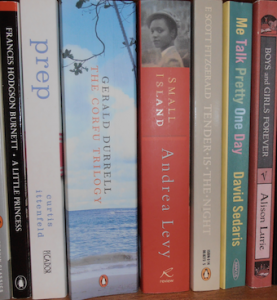
But the rationale for the shelving of other books may be less obvious. For example, what do Frances Hodgson Burnett, Curtis Sittenfeld, Gerald Durrell, Andrea Levy, F. Scott Fitzgerald, David Sedaris and Alison Lurie have in common?

Bookshelf Four

They’ve written books that are the same height, of course!

_____

  1. Thanks to Bookshelves of Doom for the link.