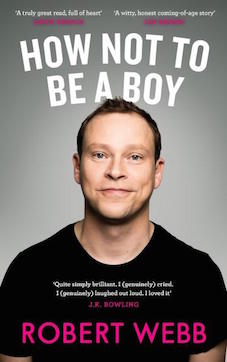
‘How Not To Be A Boy’ by Robert Webb

'How Not To Be A Boy' by Robert WebbI really liked How Not To Be A Boy by Robert Webb, a funny, thoughtful and moving memoir about a boy who absorbed a lot of toxic messages about masculinity – and what happened when he grew up to be a man. I wasn’t familiar with the author, but he’s an English comedian and actor who was in Peep Show and lots of other shows (I also discovered he does a very amusing impression of Mr Darcy). What sets this book apart from most celebrity memoirs is that Robert Webb can actually write and he has much more interesting things to write about than the usual How I Became A Famous Person On The Telly stuff.

He grew up in a dysfunctional working-class Lincolnshire family, with several older brothers and a violent, philandering, alcoholic father. Robert writes with a great deal of insight and humour about the ‘rules’ of boyhood – boys are loud and boisterous, boys don’t read, boys love sport, boys are brave and reckless, boys hate school, boys don’t cry, boys don’t fall in love with other boys – and how terrible he was at following any of these rules. Eventually, his mother threw his father out and married another man who was still fairly useless, although not actually violent or drunk. But then Robert’s beloved mother died of cancer when he was in his final year of school. Despite being suicidally depressed, Robert managed to become the first person in his family to attend university, became president of the Cambridge Footlights Dramatic Club and began his successful career as a comedian and actor.

But inside, he was a mess, and he took out his feelings of unacknowledged grief, shame, guilt and insecurity on his friends, colleagues and family. Despite being determined not to be like his father, he drank too much, he lost himself in work, and he was emotionally and physically unavailable to his wife and children. Fortunately for him, his wife didn’t give up on him and he was intelligent and introspective enough to go to therapy, cut down on the drinking and eventually, write this book.

He doesn’t actually call himself a feminist, but says he agrees with what feminists say and he quotes from and recommends Cordelia Fine’s excellent book, Delusions of Gender, so top marks from me for that. He also has a lot of sensible things to say to Men’s Rights Activists, who “tend to make a series of valid observations from which they proceed to a single, 180-degree-wrong conclusion.” Men’s documented problems with high suicide rates, alcoholism, imprisonment and premature death are not due to women or to feminism, he points out. These problems are due to the toxic rules of masculinity. Men turn to drugs and alcohol and self-harm because the rules say they can’t admit weakness or ask for help. They die younger than women of preventable diseases because they refuse to take their health seriously and go to the doctor. They’re violent because society tells boys and men to be aggressive and bottle up their emotions. “Feminists are not out to get us,” he says. “They’re out to get the patriarchy. They don’t hate men, they hate The Man. They’re our mates.”

As you’d gather from those pronouns, this isn’t a book aimed at women. It’s aimed at the men who grew up with the same sort of male role models as the author. It’s about and for the men who were similarly unable to follow the impossible rules of masculinity and are suffering the consequences of this. Of course, feminists have been banging on, for a very long time, about how society’s rigid gender rules harm men as well as women, but the men who need to hear this don’t listen to women. In fact, they viciously attack women who say this sort of thing. Still, Robert Webb is pretty good at acknowledging how privileged he is and how some of his unpleasant experiences (for example, being awkwardly chatted up by a gay man on a beach) are fairly mild compared to the constant and sometimes life-threatening harassment of women. How Not To Be A Boy would be an excellent book for teenage boys and men, but women may also gain from reading this insider’s view of masculinity. Apart from anything else, it’s often very funny.

‘Dr Huxley’s Bequest’ Miscellanea

'Dr Huxley's Bequest' by Michelle Cooper

For those who don’t follow me on Twitter (that is, the entire population of the universe, minus about 48 people), here are some bits and pieces about my latest book, Dr Huxley’s Bequest:

The Great Raven recently published a guest post from me, in which I explain why I turned to self-publishing for my fifth book.

– The Children’s Book Council of Australia published a nice review at Reading Time, saying, “This thoroughly researched chronology of medicinal inventions, discoveries and disasters is presented in an interesting and engaging manner. Dr Huxley’s Bequest is a fascinating look at the role science, pseudo-science, and convenient accidents have had on the well-being of humanity … perfect for readers aged 12 and up.”

Magpies Magazine also reviewed it, saying, “Cooper approaches the history of medicine with the same eclectic verve, pace and off-beat imagination as she demonstrates in her historically-based novels … the reader is positively bombarded with fascinating information.”

– Telani Croft at The Book Nut enjoyed the book and her thoughtful review concluded “… strong characters and a believable purpose combine with a deft writerly touch to produce an interesting and engaging narrative that educates and, as I mentioned, provides a positive perspective on research and the quest for knowledge, and this cannot be undervalued. I can see this being picked up by young readers for pleasure, but I would also commend it to teachers to consider as a class text, due to its quality and relevance to learning.”

Read Plus said, “The mystery technique is a fantastic way to tell the story of medicine from ancient Egyptian times to current genetic testing.”

– And Kate Constable wrote on her blog that she “learned something new on every page, but … it never feels too educational! It’s just like a very clever, funny person telling you loads of really interesting stories about medicine.” Thank you, Kate!

What I’ve Been Reading: Non-Fiction

At the end of last year, I resolved to blog more about books I’d enjoyed. Mmm, that’s been going well, hasn’t it? Anyway, I have been reading more this year, but for some reason, I’ve been underwhelmed by a lot of the fiction I’ve read. Fortunately, I’ve had more success with non-fiction books.

'The Disaster Artist' by Greg Sestero and Tom BissellThe most intriguing and entertaining book has definitely been The Disaster Artist: My Life Inside ‘The Room’, The Greatest Bad Movie Ever Made. I have never seen The Room, a cult favourite “revered for its inadequacy and its peerless ability to induce uncontrollable laughter”, although this collection of scenes gives some indication of its er, unique qualities. The Disaster Artist is narrated by Greg Sestero, a handsome young all-American guy who dreams of becoming a Hollywood star. At one of his acting classes, he meets Tommy Wiseau, who speaks largely incomprehensible sentences in a thick Eastern European accent and has a burning desire to be the next James Dean, despite being a very weird-looking middle-aged man with dyed black hair and no discernible acting talent. Tommy latches onto Greg like Tom Ripley attaching himself to Dickie Greenleaf, and the two become unlikely friends, roommates and (eventually) co-stars in a movie that Tommy decides to write, direct, produce and finance himself. The Disaster Artist describes the process of making a movie with no coherent plot, full of dialogue that no real person would ever speak, designed and shot according to Tommy’s bizarre and inept direction.

Interspersed with the film-making melodrama is an account of Greg and Tommy’s strange relationship, as Greg tries to figure out why Tommy is the way he is. Tommy gradually reveals something of his background, although the more we learn, the more confusing his story becomes. Is he suffering from PTSD caused by his experiences when escaping from behind the Iron Curtain? Did the near-fatal car accidents he claimed to have been involved in cause brain damage that has left him unable to remember and recite the simplest lines of dialogue (which he wrote himself)? Is he a deeply repressed and unhappy homosexual? Is he simply a refugee struggling to belong in a foreign land? At times, it seems Greg is being a bit mean, making fun of a man with such obvious problems – but Tommy is more often a bully than a victim, manipulating others to get his way, throwing massive tantrums, humiliating the young actress who plays his on-screen love interest, screaming homophobic abuse at the one crew member who calls out Tommy for his blatant lying. And Tommy, far from objecting to Greg’s account, has welcomed the attention the book and its recent movie adaptation have brought to him. He’s still friends with Greg – in fact, they’ve just made another movie together (in which Tommy plays an eccentric mortician, which seems more appropriate than the all-American hero he tried to portray in The Room). The Disaster Artist is a fascinating psychological study of a very strange man, but it’s also an interesting look at creativity, ambition and the American Dream.

'The Durrells of Corfu' by Michael HaagI also enjoyed The Durrells of Corfu by Michael Haag, about the family who produced two celebrated authors – Lawrence Durrell and his even more famous younger brother, Gerald Durrell. I was especially interested to read about the Durrells’ life before and after Corfu, which turned out to be far less amusing than Gerry implied in his books. Both parents and all the siblings were born in India, where the eldest daughter died of diphtheria, choking to death in her mother’s arms while four-year-old Larry watched. Then, when Gerry was still a toddler, their father died and their mother decided to ship the family ‘home’ to England, which proved to be cold and unwelcoming. Their subsequent escape to Corfu wasn’t a whim, as Gerry depicted in his books, but a desperate attempt by Larry to save his mother, who had fallen into alcoholism and a deep depression.

Fortunately, life improved somewhat in the sun. This book has lots of excerpts from the siblings’ books, letters and journals, as well as fascinating family photos, but the author also sorts out fiction from facts. For example, while Gerry portrayed all his tutors as bachelors, most of these men were actually husbands and fathers – in fact, Theodore’s daughter, Alexia, was Gerry’s best friend and both families hoped they’d get married (they didn’t). Larry himself was married to Nancy Myers, a beautiful English artist, and there are descriptions of visits from their famous bohemian friends, including Henry Miller, which caused local outrage due to naked sea-bathing and other scandalous goings-on. Sadly, war broke out in 1939 and the family’s carefree life was over. Gerry and his mother left for England immediately, but Larry, Nancy and their baby daughter ended up fleeing from the Nazis in an overcrowded boat to Egypt; Margo married a pilot and ended up in an Italian prisoner-of-war camp in Ethiopia, where she “gave birth by Caesarean section, without anaesthetic, to their first son”; and Leslie, having impregnated and abandoned their Greek maid, went on to a life of depravity. This book is a good introduction to the real story of this fascinating, unconventional family of mythmakers.

‘The Endsister’ by Penni Russon

'The Endsister' by Penni RussonI really enjoyed The Endsister, a thoughtful and beautifully composed ghost story for young readers. The Outhwaite family decide to uproot themselves from their comfortable semi-rural Australian life when they inherit a large, dusty house in London. Of course, this house turns out to be haunted, although the two girl ghosts, Almost Annie and Hardly Alice, drift about harmlessly, noticed only by the youngest Outhwaite, four-year-old Sibbi. But there’s something far more malevolent lurking behind the locked attic door: “a cobwebbed thing, tattered and dusty, so long forgotten, so long forgetting.” This dreaded Endsister seems to be sucking the life out of poor lonely Sibbi and feeding on the unhappiness of the older Outhwaites, especially teenage Else, trying to discover who she is now that she’s abandoned her once-beloved violin, and Olly, their mother, who’s left behind her friends and teaching job and is toiling fruitlessly at her PhD thesis.

All of the characters are vividly drawn, with the story told mostly from the perspective of Else, Sibbi and their stoic, nature-loving brother, Clancy. The descriptive prose is lovely and the family’s squabbles are both funny and sadly true to life. I was interested to read that this story was initially conceived as a weekly serial, because the narrative is complex and cleverly constructed, neatly looping back on itself – as Clancy concludes, it is “a story that ends where it begins: a story about coming home.” The revelation of the Endsister’s mystery is poignant and deeply satisfying, and there’s a lot to contemplate in this book about memory, creativity and belonging.

In fact, this novel is so intricate and ruminative that it won’t be for all young readers. It’s also quite spine-chilling in parts (the scene with Sibbi in the study gave me the creeps, although admittedly, I am easily spooked). The publisher says it’s for 10-14 year olds – I’d recommend it for readers in that age group, and older, who enjoy thoughtful, character-based stories.

As I was reading The Endsister, I was reminded of Come Back, Lucy by Pamela Sykes, a very spooky children’s book written in the 1970s that I’d thought no one (except for me and presumably Pamela Sykes) had ever read, although I have just discovered that it was made into a terrifying-looking television series and that there was a sequel novel called Lucy Beware! (because apparently Lucy didn’t learn anything from her first experience of being haunted). Here’s my beloved Puffin paperback copy:

'Come Back, Lucy' by Pamela Sykes

Lucy is an unhappy orphan sent to live with her youthful aunt, uncle and cousins, who are renovating a large Victorian-era house in London. Up in the dusty attic, Lucy encounters ghostly Alice, who at first seems to be the only one who truly understands and cares for Lucy. Alice, though, is gradually revealed to be capricious and self-centred, with sinister plans for Lucy … But does Alice really exist? Are Lucy’s experiences actually due to repressed grief and loneliness? Come Back, Lucy would be an excellent companion read for The Endsister, if you can get hold of a copy. As added incentive, the Puffin edition has lots of fab 1970s illustrations by Tessa Jordan:

'Come Back, Lucy', illustration by Tessa Jordan

'Come Back, Lucy', illustration by Tessa Jordan

New Paperback Edition of ‘Dr Huxley’s Bequest’

There’s a new paperback edition of Dr Huxley’s Bequest out tomorrow, Monday 15 January. This new edition has exactly the same content as the first edition, but the print size has been increased slightly (so it has 342 pages, rather than 270). I think the larger print will make it more enjoyable to read, especially for younger readers. This is how the new paperback looks:

'Dr Huxley's Bequest', 2nd edition

And there are illustrations inside:

'Dr Huxley's Bequest', 2nd edition, open page

Dr Huxley’s Bequest is also available in various ebook formats.

Wait, I have only just heard of this book. What’s it about?

Dr Huxley’s Bequest is a history of medicine for thoughtful readers aged about 12+, in the form of a mystery story, full of jokes and fascinating facts. It’s also a thoughtful look at the beauty, creativity and power of scientific reasoning and it’s especially for girls (particularly girls who’ve been told science is difficult, dull and only for boys).

You can read an excerpt of the book here and read more about the book’s real-life setting here. If you’d like to know more about why I wrote the book, see this blog post.

Which edition of Dr Huxley’s Bequest should I buy?

This second edition paperback has illustrations, author notes, a bibliography, a comprehensive index and a pretty cover. The first edition paperback is now out of print. (If you’d like to know why there’s a second edition coming out just two months after the first edition was published, see this very long blog post.)

The ebook versions are available in two formats. There’s a Kindle (mobi) version for Kindle readers and other devices that have the Kindle app installed. There’s also an ePub version, for iPads, iPhones, Nook readers, Kobo readers, and pretty much every other sort of ebook reading device. The ebooks don’t have the illustrations or the index, but do include the author notes and bibliography and they have a search function if you want to find keywords.

Where can I buy the book?

Here are some of the places where you can buy Dr Huxley’s Bequest online. I’ve listed stockists according to geographical region, because delivery costs are cheaper and you won’t have to pay currency conversion fees if you buy locally.

Australia and NZ
Amazon.com.au (paperback, Kindle ebook)
Angus & Robertson Bookworld (paperback, ePub ebook)
Apple iBooks (iBook ebook)
Booktopia (paperback)
Fishpond (paperback)
Kobo (Kobo ebook)

North America
Amazon.com (paperback, Kindle ebook)
Apple iBooks (iBook ebook)
Barnes & Noble (paperback, Nook ebook)
Chapters/Indigo Canada (Kobo ebook)
Kobo (Kobo ebook)

UK and Europe
Adlibris (paperback)
Amazon.co.uk (paperback, Kindle ebook)
Apple iBooks (iBook ebook)
Book Depository (paperback)
Foyles (paperback)
Kobo (Kobo ebook)
Libris (ePub ebook)
Waterstones (paperback)

Will it be in my local bookshop?

Maybe, if you ask them to order it for you! Bookshops are often reluctant to stock books that are self-published or published by small publishers. However, all book retailers will receive the same trade discount for this book as when they buy books from large publishers and any unsold books are returnable. Booksellers can order the book from Ingram Spark. (For more information, including ISBNs, see FitzOsborne Press.)

Can I borrow it from my library?

Maybe, if you live in Australia. If it’s not in your library’s catalogue, you can ask your librarian to order it. The book is in the catalogue of ALS Library Services and it has a National Library of Australia cataloging number.

Anything else I should know?

Dr Huxley’s Bequest is also on Goodreads, if you’d like to leave a review. (Thank you, Tina!)